LØL

@tlayoyo

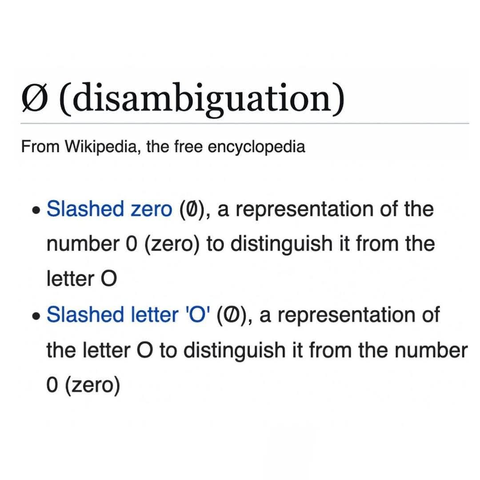
Back in the stone age (1978-ish), I had to submit my code to a punch-card operator. I had to explicitly state at the top of every sheet that 'slashed' meant 'zero' and 'unslashed' meant 'alpha' πŸ™‚

@bytebro @tlayoyo

Writing code in the beginning of the 70s slashed O was zero, then Z and 7 had a horizontal line through them. The punch card team knew exactly what these meant.

@tiggy @bytebro @tlayoyo writing by hand in the 70s in Germany was taught exactly so. 7 still has it to distinguish it from 1 (German 1kept always the hook to distinguish it from I), in Z it's less common now, but I can't unlearn it.
@mbletmathe @tiggy @bytebro @tlayoyo Having moved to Canada from Germany, I have difficulty unlearning adding the hook to the 1 because it's mistaken for a 7 here.

@robho

Oh that's always been a thing, which is why the 'seven' was 'crossed', and the 'one' was not. Kind of the same as the 'zed' or 'zee' which would be 'crossed', and 'two', which was not.

@mbletmathe @tiggy @tlayoyo

@bytebro @mbletmathe @tiggy @tlayoyo I had no problems stopping to cross the seven though. That just looks strange and old fashion.
@robho @mbletmathe @tiggy @bytebro @tlayoyo Japanese one and seven have that issue too I find. I cross my sevens.

@tiggy @bytebro @tlayoyo I was finally broken of my slashed zeros habit in calculus ('cause it looks like theta, ΞΈ).

But I will always slash my 7's and z's.

@tiggy @bytebro @tlayoyo I started writing that way in the 80s when I redesigned my handwriting one summer, and I still do today.
@tiggy @bytebro @tlayoyo local practice varied in Australia at the start of the 1980s. Some data entry teams were ALGØL 6O (Canberra CAE), other teams in the same suburb were ALGOL 6Ø (Australian Bureau of Statistics).