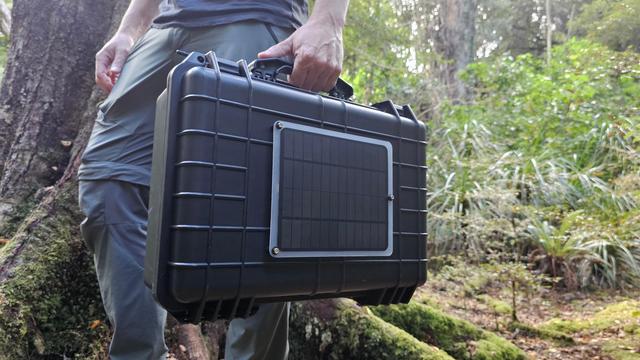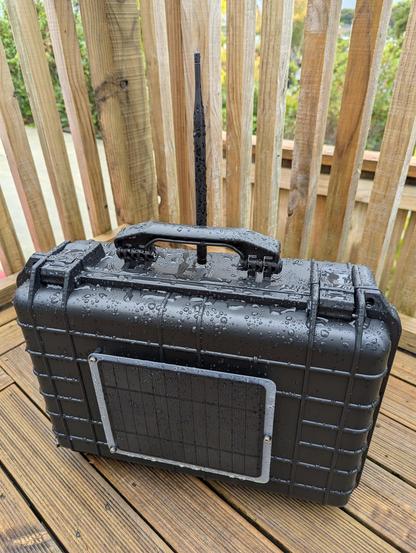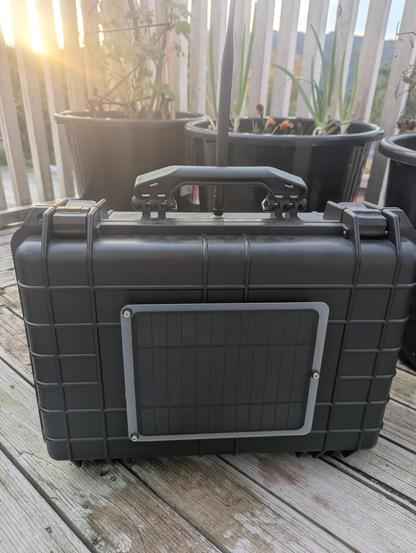
Glad to share a fun weekend project, a powerful #Meshtastic node in a waterproof & rugged case, for use in comms blackout situations/emergencies. It allows for texting across the mesh with a smartphone.

It also has an offline WiFi network serving both the Collapsible wiki, and simple usage instructions.

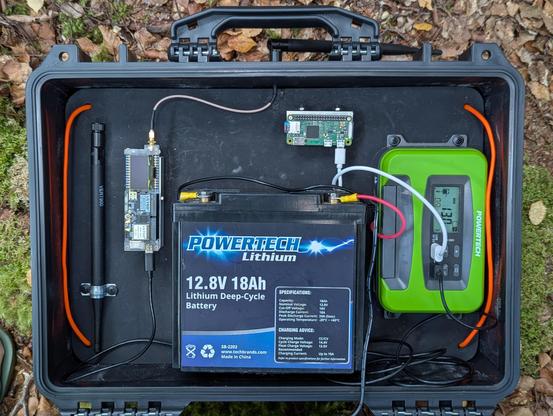
The solar panel trickle-charges a roomy LiPo that should give more than a week of cover, with phone charge port behind it. Has spare antenna (orange rope is for lifting the baseplate out)

1/3
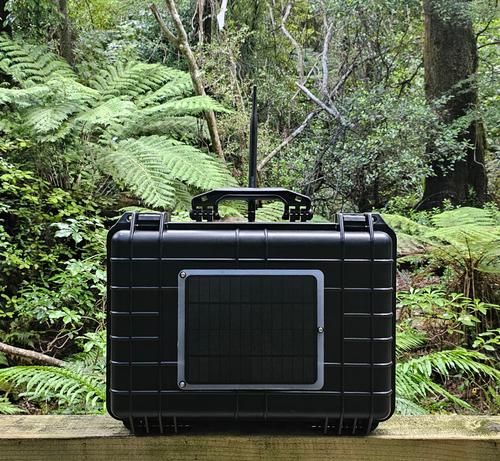
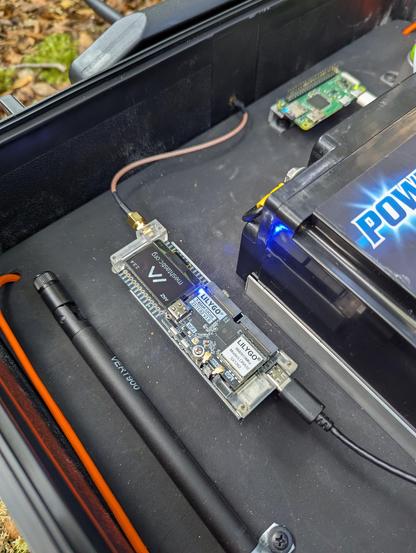
I went with a trusty VERT900 antenna, which I interfaced via SMA by repurposing the case’s pressure valve hole. It performs great in the 915~MHz space and is rugged. I haven’t range-tested yet, but for line-of-sight 50km should be easy.

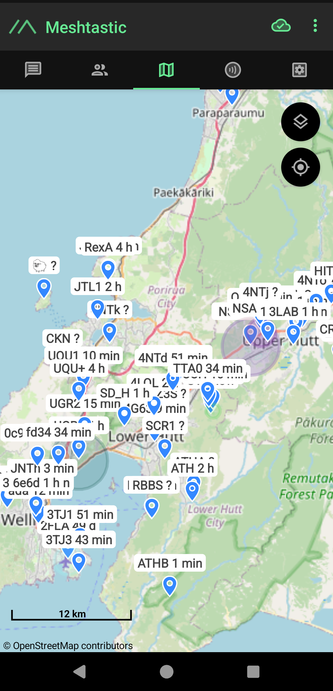
The map shows the nodes it can see in my region.

This model of the T-Beam has a cool UBLOX module, that can provide centimeter level location precision in presence of a GNSS RTK base station.

2/3

I wanted a nice yellow case as it’s cooler in the sun, & cooler in general, but they were out of stock.

FWIW I am thinking to add a few things to the lid:

- First Aid pack
- Laminated instructions
- Torch
- Pre-configured & charged Android smartphone, & poss also serving a build of the Meshtastic Android APK for other phones to use.

BTW I would serve the MT web-client, but it works poorly on phones.

Anyway, not perfect, just a quick fully functional prototype, whipped up in the shed!

3/3

Storm-testing, from a couple of days back. It seems to survive heavy rainfall, and winds strong enough for local civil defense to issue a warning. The battery gives it low center of gravity, which was a stability-design solely theory until the test. Dry and cosy inside the case when opened. #meshtastic

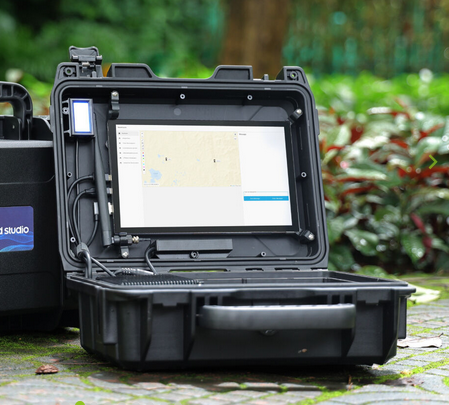
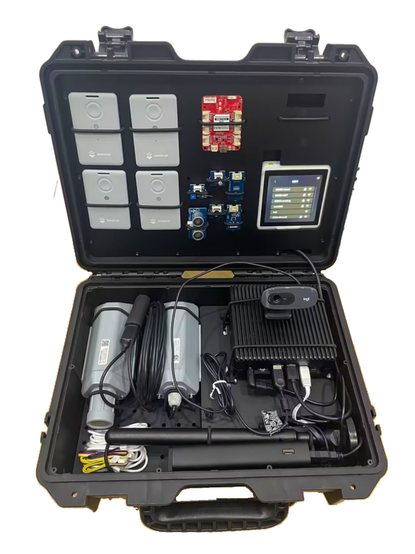
Not saying they were inspired by my own design strategy, but it is interesting that Seeed Studio have come out with a Hazard Response Mission Pack that has quite a bit in common.

https://www.seeedstudio.com/Mission-Pack.html

Starting at 1k US, it's not cheap, and that's without the AP and a wiki server.

My own weekend build was a fraction of that outlay. I can probably get it down to ~EUR300, ~NZD600 in materials, esp if going with NRF instead of ESP32

Hazard Response Mission Pack - All-in-one Compact Kit, Open-source AIoT Solution, Meshtastic-powered, No/Low-code

The Hazard Response Mission Pack is an open-source AIoT solution designed to efficiently manage and mitigate hazard scenarios. This compact system combines a range of hardware to enable effective remote sensing, data transmission, processing, inference, and analysis. The pack comes with a fundamental set of hardware that serves as the essential unit. Users also have the option to add various sensors according to their operational demands.

IMO their design of having the antenna next to the screen inside the case is not the best. Anyone that does RF stuff knows that displays create broad spectrum radio shadows. If it could be taken out and connected to an external mount point, that would be cool

I dug a bit and see that their first prototype was in 2023, and that aside from the format there is in fact little in common with my Meshtastic case build.

Theirs is intended as a sort of sensor kit for doing 'AI' driven disaster analysis, recon and comms local to the case itself, rather than a multi-day rugged node for long distance comms with existing mesh.

Their first iteration:

Tropical Cyclone due to hit in the next hours. Case node got a top-up in the sun ready to see us through any comms blackouts. #meshtastic
@decryption @camwilson saw this thread + thought of you re: tech preparedness for the worst...