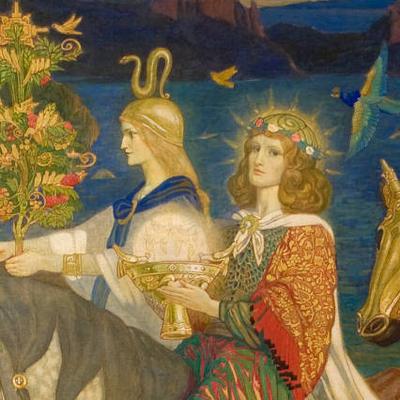
 The Gods and Their Croziers
Hi all - this is a new account just for my comparative mythology project on the Celtic-Christian Saints, which I've previously been sharing over on @seachaint 'til now.
"The Gods and Their Croziers" is my current passion - applying a comparative mythology model inherited from others such as "Taliesin's Map", I've been able to identify some key clusters of Gaelic and British saints who are, in fact, entirely Gods rewritten as Saints.
Indeed, almost every saint prior to 650CE (possibly later) appears to be a fictional re-writing of a Celtic mythological character. Even more interestingly, their names and locations of worship seem to frequently, perhaps usually, correspond to native epithets and associated sites.
I'm currently publishing dossiers on the God-Saints the day before their feast-days according to the Christian calendars. I try to include in each issue enough information to understand the connection, to get an idea of the function of the deity in context, and some information on names, places, animals/plants, and other dates or events that might be relevant to the god.
Anyone into #Celtic or #Irish #Paganism or #Mythology ought to enjoy this work - some of Ireland's "missing" gods are _only_ recorded clearly as Saints, having never been written as native mythology (or only in highly fragmentary, coded form). But, with the "Key" from the Saints, we can unpack mythology that's remained obscure until now.
I hope ye'll join me in exploring this whole new frontier of Irish mythological exploration.
https://buttondown.com/godsandcroziers/archive/
#Introduction

The Gods and their Croziers
The Gods of the Celtic pantheons have long resisted accurate identification alongside their famous counterparts in the Norse, Mediterranean, and Indo-Iranian religions. What remains might be only the garbled re-imaginings of bored Christian monks, stripped of authenticity. But what if it’s not as dismal as we thought? What if we can validate that the Irish God and Hero stories are preserved in remarkably faithful detail? And, what if there are many, many more of them hidden in plain sight, awaiting recovery? Using a framework inspired by Dumézil’s methods of comparative mythology, a slew of newly re-identified Irish and Welsh gods are already awaiting wider appreciation. It's a rich time to enjoy Celtic mythology. Inspired by this work, I’m applying the same methods to the Hagiographies of the Celtic Saints, and what I’ve found is amazing - nearly every significant Early Irish Saint is unambiguously a God of the Native Irish Pantheon, and the same seems to be true of other Celtic branches. By finding their parallel stories in native and other mythologies, we can restore them to their original identities, and better-understand the faithfully kept material we already enjoy. I’m compiling this work for a book, or perhaps a series of books. But, I want to share the work as early as I can! Join me as I explore the Comparative Mythology of the Celtic Saints, uncovering the Gods and their Croziers.
 Sir Rochard 'Dock' Bunson
 Jürgen Hubert
 Bowie
Bowie