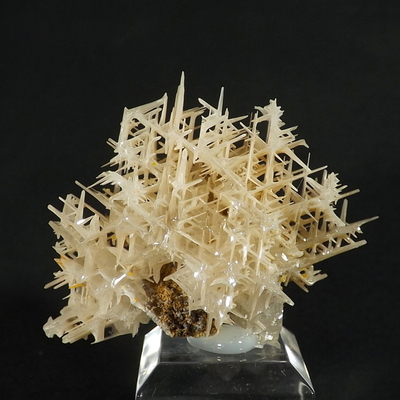
In the town of Quartzsite I picked up a beautiful chunk of labradorite. This mineral creates an eerie blue shimmer in the sunlight - a phenomenon called 'labradorescence'. Reading up on it, I discovered it's a form of feldspar. 60% of the Earth's crust is feldspar, and I know so little about this stuff!

Turns out there are 3 fundamental kinds of feldspar:

• orthoclase is potassium aluminosilicate
• albite is sodium aluminosilicate
• anorthite is calcium aluminosilicate

Then there are lots of feldspars that contain different amounts of potassium, sodium and calcium. We get a triangle of feldspars with orthoclase, albite and anorthite at the corners.

But not all points in this triangle are possible! There's a big region called the 'miscibility gap', where as you cool the molten mix it separates out!

And there are also subtler problems. When you cool down the feldspar called labradorite, it separates out a little, forming tiny layers of two different kinds of stuff. When the thickness of these layers is the wavelength of visible light, you get a weird optical effect: labradorescence!

(1/n)

Below is a photo of labradorite - not mine. You really need a movie to see the strange shimmer as you turn a piece of labradorite in the sunlight.

In fact there are 3 kinds of feldspar that separate out slightly as they cool and harden, forming thin alternating layers of two substances:

• The 'peristerite gap' produces layers in feldspars with 2-16% anorthite and the rest albite - these layers create the beauty of moonstone!

• The 'Bøggild gap' produces layers in feldspars with 47-58% anorthite and the rest albite - these are labradorites!

• The 'Huttenlocher gap' produces layers in feldspars with 67-90% anorthite and the rest albite - these are called bytownites.

The physics and math of all this stuff is fascinating.

(2/n)

What I'd like to understand better:

Feldspar crystals are complicated structures built from tetrahedra, and aluminum and silicon have to be distributed among these tetrahedra. This distribution is determined by the relative amounts of potassium, sodium and calcium, and it in turn controls the symmetry of the crystal, which can be either 'monoclinic' or the less symmetrical 'triclinic'.

There's a whole body of work - by Salje, Carpenter, and others - applying Landau's theory of symmetry-breaking phase transitions to map out the space of different possible feldspar crystals!

(3/n)

In case you're wondering about 'monoclinic' versus 'triclinic' crystals, the picture here shows the difference. But the picture doesn't fully capture the symmetry group of an actual crystal - because there's more to a crystal than just a shape of a parallelipiped!

Okay, let's get into the math.

The symmetry group G of a crystal, called a 'space group', fits into an exact sequence

0 → ℤ³ → G → P → 1

where ℤ³ is the group of translational symmetries and P is the group of symmetries that fix a point: the 'point group'. This sequence may or may not split! It splits iff G is a semidirect product of P and ℤ³.

For a triclinic crystal, there are only two possible space groups G, and both are semidirect products. P is either trivial or Z/2, acting by negation.

For monoclinic, there are 3 choices of the point group P as a subgroup of O(3):

• P = ℤ/2 (a single 2-fold rotation)
• P = ℤ/2 (a single reflection)
• P = ℤ/2 × ℤ/2 (generated by a 2-fold rotation and inversion — their product is a reflection).

For each choice of P there are 2 fundamentally different choices of lattice ≅ ℤ³ it can act on. One is made up of copies of the parallelipiped I showed you. The other is twice as dense. So we get 3 × 2 = 6 space groups G that are semidirect products.

But there are 7 other non-split extensions! These other 7 give nontrivial elements of the cohomology group H²(P, ℤ³). Thus, the hardest part of the classification of all 13 monoclinic space groups is essentially the computation of H²(P, ℤ³) for all 6 choices of P and its action on ℤ³.

I knew cohomology rocks. But it turns out cohomology helps classify rocks!

Now, which of these various groups are symmetry groups of feldspars?

(4/n)

Apparently feldspars have just two different symmetry groups:

For the monoclinic feldspars (including sanidine, orthoclase, high-temperature albite), the crystal has a 2-fold rotational symmetry, a mirror plane, and inversion symmetry (𝑥,𝑦,𝑧)↦(−𝑥,−𝑦,−𝑧). The point group is the Klein four-group ℤ/2 × ℤ/2. The lattice has an extra translational symmetry shifting by half a cell diagonal across one face.

For the triclinic feldspars (including microcline, low-temperature albite, anorthite), the only symmetry beyond translation is inversion: the map (𝑥,𝑦,𝑧)↦(−𝑥,−𝑦,−𝑧). So the point group is just ℤ/2. And the lattice is primitive: there are no extra generators of translation symmetry beyond the three edges of the parallelipiped I showed you.

Alas, each of these space groups G is the semidirect products of their point group P and their translation symmetry group ℤ³. So, no interesting cohomology classes show up! (Those show up in crystals with 'screw axes' or 'glide planes'.)

Thus, for you mathematical physicists out there, the main fun thing about feldspars seems to be the phase transitions, especially from the more symmetrical monoclinic feldspars to the less symmetrical triclinic ones! Like in this paper here:

• Ekhard Salje, Application of Landau theory for the analysis of phase transitions in minerals, https://www.researchgate.net/publication/222119979_Application_of_Landau_theory_for_the_analysis_of_phase_transitions_in_minerals

(5/n)

But wait! It turns out there's a rare form of feldspar called celsian that's contains *barium* as a substitute for calcium. It's made of barium aluminosilicate. And it has screw axes and glide planes, so its space group is not a semidirect product! It’s an extension of ℤ³ by the point group P = ℤ/2 × ℤ/2 that gives a nonzero element of the cohomology group H²(P, ℤ³)!

So, barium comes to the rescue for mathematicians who want feldspars with nontrivial cohomology! 🎉

For more details, read the end of this article:

https://johncarlosbaez.wordpress.com/2026/04/11/feldspars/

The picture show my chunk of labradorite!

(6/n, n = 6)

Feldspars

  I picked up this beautiful chunk of labradorite in the town of Quartzsite. This mineral creates an eerie blue shimmer in the sunlight: a phenomenon called ‘labradorescence’. Read…

Azimuth
@johncarlosbaez beautiful and very interesting. Much thanks
@johncarlosbaez I hope there is a physical system that gets discovered one day, most likely in material science or solid state physics, that is necessarily modelled by nonabelian 2-bundles. I believe there are known examples that use bundle gerbes, to the extent of articles in glossy experimental science magazines with images generated from measuring things in a lab. it's only taken 25-30 years to get to that point, from Michael Murray's original paper in the JLMS. So at some point in the next decade or so, who knows?

@highergeometer - so far I haven't seen anything promising about actual materials that might display 2-group gauge symmetries. So far it looks like people just make up field theories with such symmetries. But someday....

https://arxiv.org/abs/1802.10104

From gauge to higher gauge models of topological phases

We consider exactly solvable models in (3+1)d whose ground states are described by topological lattice gauge theories. Using simplicial arguments, we emphasize how the consistency condition of the unitary map performing a local change of triangulation is equivalent to the coherence relation of the pentagonator 2-morphism of a monoidal 2-category. By weakening some axioms of such 2-category, we obtain a cohomological model whose underlying 1-category is a 2-group. Topological models from 2-groups together with their lattice realization are then studied from a higher gauge theory point of view. Symmetry protected topological phases protected by higher symmetry structures are explicitly constructed, and the gauging procedure which yields the corresponding topological gauge theories is discussed in detail. We finally study the correspondence between symmetry protected topological phases and 't Hooft anomalies in the context of these higher group symmetries.

arXiv.org

@johncarlosbaez Nice thread!

At first sight the feldspars look like they're boringly simple, but are actually wildly complex. To mis-quote Paul Ribbe, "there will always be the need for another paper about feldspars" 😁

Just found this 2009 paper by computer scientists on rendering labradorescence in computer graphics. Their perspective is interesting/amusing: they concentrate on a lot of stuff most mineralogists gloss over AND create a labradorite biplane! 👏 🤓

https://www.cg.tuwien.ac.at/research/publications/2009/weidlich_2009_REL/weidlich_2009_REL-.pdf

@FaithfullJohn - wow, computer rendering of labradorescence - now that's a specialized topic!

I just learned that albite shrinks in one direction when you warm it.

@johncarlosbaez You should check out zeolites, feldspathoids, and melanophlogite https://www.mindat.org/min-2630.html.
Melanophlogite

First recognized natural clathrasil (or silica clathrate); compare bosoite and chibaite - the other natural clathrasils.

@Thorium - I once did a shallow dive into the incredible diversity of zeolites. There are some nice online galleries of their crystal structures. I know nothing about the other two.
@johncarlosbaez I can’t find it now, but my favorite feldspar meme from when I was a geology student was the principal skinner looking down meme (pathetic) with the eyepieces of a petrographic microscope edited in and the text was “When the plagioclase displays exsolution laminae” with the bottoms line reading “Perthitic”.

@johncarlosbaez a neat crystal feature called "twinning," while not unique to feldspars, makes them easily identifiable in thin section. What appears to be a single crystal under normal light is revealed to be discrete growths at different crystallographic orientations to each other under polarized light.

The type of twinning is even different depending on the feldspar, from simple twinning in most orthoclase feldspars, zebra stripe looking polysynthetic twinning in plagioclase feldspars, or even the visually striking crosshatch or plaid look of tartan twinning in microcline
https://youtube.com/shorts/XNM-C8E0Bt0?si=Cle37bmHQrcE13XT

Tartan Twinning in Alkali Feldspar in XPL

YouTube

@Krazinsky - thanks! I saw something about "tartan twinning" and didn't understand it. I still don't. I don't even understand plain old twinning! The YouTube short is cool, but I want to see a diagram of the microscopic structure of some crystals with twinning: how the two different orientations manage to coexist!

Anyway, it's always good to have more to learn.