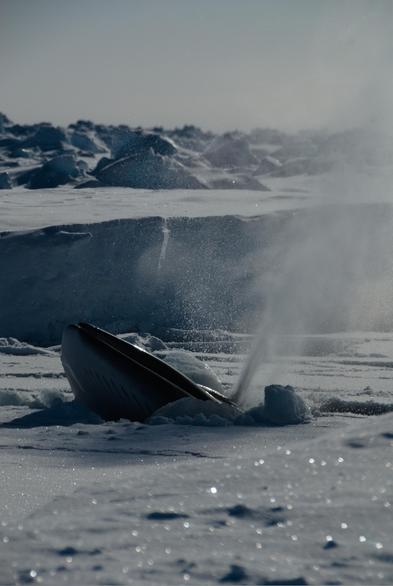
Another wander back to 2012 and the SIPEXII expedition. At the last sampling site (unplanned, we were stuck) - we had a visit from a Minke whale!

It decided to expand a hole that a seal made the day before - in ice about 10cm thick and not quite solidly frozen - for some room to breathe. The whale hung around for quite a while, returning to this spot to grab air.

It was .. very spectacular.
#fieldworkFriday #seaice #Antarctica

Crazily enough, a small team of us had been working in that exact thin ice channel the day before, installing some instruments to try and observe ice growth. Then de installing on whale visit day!

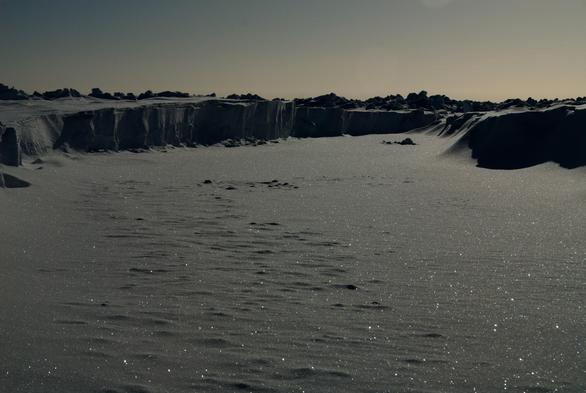
Somewhat nerve wracking, especially seeing a seal chew its way through while we were there. Here's a view looking away from where the whale came to say hi - a thin ice region with snow cover (a refrozen lead), surrounded by thicker, heavier ice and deeper snow.

#fieldworkFriday #seaice #Antarctica

...there's a *bunch* of novel safety doctrine and procedure around all of this. Especially since nobody is really doing this stuff (IIRC none working in the Australian programme any more).

This spot does highlight a key issue in some other safety doctrines I've met - in polar winter ice, relying on self rescue is tricky - because those walls of snow might be 0.5+ m tall. You're not getting out with ice spikes if you get in.

#fieldworkFriday #seaice #Antarctica

We operated on a buddy system based on the doctrine of don't fall in / practice team rescue. Always carry team rescue gear, always work together to maintain safety and effect rescue.

Side note - when I first arrived and said I want ice axes (classic straight mountaineering axes) people looked at me funny.

By the time I left, the axes I procured from the field store were always filtered out into various peoples' gear kits :D

/end

#fieldworkFriday #seaice #antarctica

ps.

I think it is really important to make a mental boundary between:

a. scientist who goes in the field, handles tools, does stuff once a year or two on fieldwork.

and

b. scientist who is on the tools, ropes, gear all the time, fieldwork is routine life in a different place with notebooks.

Both are seen as equal in management systems. They are not.

I've felt and seen this as a deep frustration in field doctrine.

Of course, if any of this made any sense I'd still be hired right? πŸ˜‚πŸ™ƒπŸ«©

@adamsteer This was an interesting thread, thanks!

Why would people look at you funny for suggesting ice axes in Antarctica?

@mjd

tradition.

...also most people working there didn't know how to use them.

@adamsteer It seems strange to me that if ice axes were going to be useful, someobe in the last hundred years of Antarctic exploration didn't say β€œhey, we could really use some ice axes”.

@mjd they have. I'm one of them.

field ops doctrine comes and goes, mythologies persist, the winners of the academia game get to write the rules, regardless of experience levels πŸ€·πŸ»β€β™‚οΈ

Important postscript: for land glaciogy, ice axes and general mountaineering gear is of course used and part of the regular kit. Glaciology on the ocean is the specific instance discussed here.