 gmays
gmaysI still prefer MCP over skills

This isn't a zero-sum game or a choice of one over the other. They solve different layers of the developer experience: MCP provides a standardized, portable interface for external data/tools (the infrastructure), while Skills offer project-specific, high-level behavioral context (the orchestration). A robust workflow uses MCP to ensure tool reliability and Skills to define when and how to deploy those tools.
MCP is just CLI wrapped in boxes.
CLI is the same API in more concise format. At minimum, the same amount of context overhead exist for MCP, but most of the time more because the boxes have size.
CLI can be secure, AWS CLI is doing just fine. You can also play simple tricks to hide secret in a daemon or run them remotely, and all of them are still smaller than a MCP.
I could not agree any less with the author. I don’t want APIs, I want agents to use the same CLI tooling I already use that is locally available. If my agents are using CLI tooling anyways there is no need to add an extra layer via MCP.
I don’t want remote MCP calls, I don’t even want remote models but that’s cost prohibitive.
If I need to call an API, a skill with existing CLI tooling is more than capable.
Ok, but there are still many environments where an LLM will not have access to a CLI. In those situations, skills calling CLI tools to hook into APIs are DOA.
idk, just have a standard internet request tool that skills can describe endpoints to. like you could mock `curl` even for the same CLI feel
What are the advantages of using an environment that doesn't have access to a CLI, only having to run/maintain your own server, or pay someone else to maintain that server, so AI has access to tools? Can't you just use AI in the said server?
Obvious example is a corporate chatbot (if it's using tools, probably for internal use). Non-technical users might be accessing it from a phone or locked-down corporate device, and you probably don't want to run a CLI in a sandbox somewhere for every session, so you'd like the LLM to interface with some kind of API instead.
Although, I think MCP is not really appropriate for this either. (And frankly I don't think chatbots make for good UX, but management sure likes them.)
Why are they not calling APIs directly with strictly defined inputs and outputs like every other internal application?
The story for MCP just makes no sense, especially in an enterprise.
This is obviously not what it is. If I give you APIGW would you be able to implement an MCP server with full functionality without a large amount of middleware?
Sorry, could you rephrase that?
It supports OAuth, IIRC. But I suppose the internal chatbot itself would require auth, and pass that down to the tools it calls.
I keep getting hung up on securely storing and using secrets with CLI vs MCP. With MCP, you can run the server before you run the agent, so the agent never even has the keys in its environment. That way. If the agent decides to install the wrong npm package that auto dumps every secret it can find, you are less likely to have it sitting around. I haven’t figured out a good way to guarantee that with CLIs.
And in a skill, I can store the secret in the skill itself, or a secure storage the skill accesses, and the agent never gets to see the secret.
Sure, if I want my agents to use naked curl on the CLI, they need to know secrets. But that's not how I build my tools.
I often just put direct curl commands in a skill, the agent uses that, and it works perfectly for custom API integrations. Agents are perfectly capable of doing these types of things, and it means the LLM just uses a flexible set of tools to achieve almost anything.
I think this is the best of both worlds. Design a sane API (that is easy to consume for both humans and agents), then teach the agents to use it with a skill.
But I agree with the author on custom CLI tooling. I don’t want to install another opaque binary on my machine just to call some API endpoints.
The "only skills" people are usually non-technical and the "only CLI" people are often solo builders.
MCP makes a lot of sense for enterprise IMO. Defines auth and interfaces in a way that's a natural extension of APIs.
I built an internal company MCP that uses Google Workspace auth and injects a mix of guidance (disguised as tools) on how we would like certain tasks to be accomplished via Claude as well as API-like capabilities for querying internal data and safely deploying small apps internally.
I’d really love to get away from the SSE MCP endpoints we use, as the Claude desktop app can get really finicky about disconnects. I thought about distributing some CLIs with Skills instead. But, MCP can be easily updated with new tools and instructions, and it’s easy to explain how to add to Claude for non-technical people. I can’t imagine trying to make sure everyone in my company had the latest skill and CLI on their machine.
I think many of us have been burned by the absolutely awful and unstable JIRA MCP and found that skills using `acli` actually work and view the rest of the MCP space thru that lens. Lots of early - and current! - MCP implementations were bad. So it’s an uphill battle to rebuild reputation.
I've started thinking of these systems as legacy systems. We have them. They are important and there's a lot of data in them. But they aren't optimal any more.
How we access them and where data lives is essentially an optimization problem. And AI changes what is optimal. Having data live in some walled garden with APIs designed to keep people out (most SAAS systems) is arguably sub optimal at this point. Sorting out these plumbing issues is actually a big obstacle for people to do productive things via agentic tools with these systems.
But a good way to deal with this is to apply some system thinking and figure out if you still need these systems at all. I've started replacing a lot of these things with simple coder friendly solutions. Not because I'm going to code against these things but because AI tools are very good at doing that on my behalf. If you are going to access data, it's nicer if that data is stored locally in a way that makes it easy to access that data. MCP for some SAAS thing is nice. A locally running SQL database with the data is nicer. And a lot faster to access. Processing data close to where it is stored is optimal.
As for MCP. I think it's not that important. Most agentic coding tools switch effortlessly between protocols and languages. In the end MCP is just another RPC protocol. Not a particularly good or optimal one even. If you had an API or cli already, it's a bit redundant to add MCP. Auth is indeed a key challenge. And largely not solved yet. I don't think MCP adds a whole lot of new elements for that.
100%
MCPs truly give the agent tools and allow the agent to make better informed decisions given you can have configured the right MCP tools. Skills are good for knowledge and general guidelines. They give context to the agent, and I have seen some skills being excessively long that could into eat into the context window of the agent.
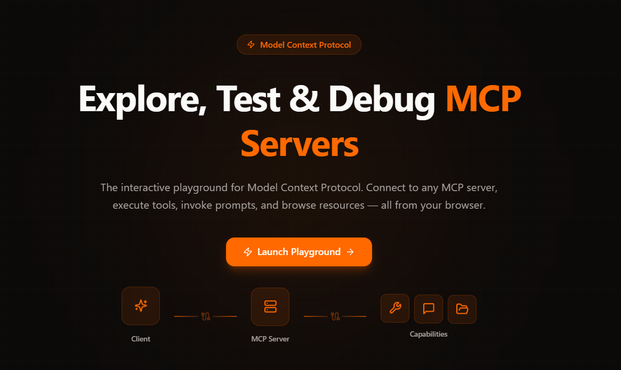
This tool https://protomcp.io/ helps a lot with testing MCP servers before integrating into the agent workflow. You can even see the agent call different tools in real time and view the trace.
MCPs truly give the agent tools and allow the agent to make better informed decisions given you can have configured the right MCP tools. Skills are good for knowledge and general guidelines. They give context to the agent, and I have seen some skills being excessively long that could into eat into the context window of the agent.
This tool https://protomcp.io/ helps a lot with testing MCP servers before integrating into the agent workflow. You can even see the agent call different tools in real time and view the trace.
> The core philosophy of MCP is simple: it’s an API abstraction. The LLM doesn’t need to understand the how; it just needs to know the what.
Wrong. It needs to "understand" both these things. The only difference is where and how the strings explaining them are generated.