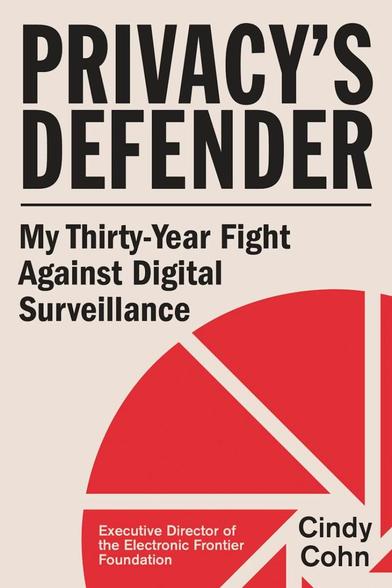
I've known EFF executive director Cindy Cohn for 27 years. I met her when I needed cyberlaw advice for a startup I'd helped found. We got along so well that I ended up quitting the startup and going to work at EFF. Now, Cindy's memoir, *Privacy's Defender*, is on the shelves:

https://mitpress.mit.edu/9780262051248/privacys-defender/

--

If you'd like an essay-formatted version of this thread to read or share, here's a link to it on pluralistic.net, my surveillance-free, ad-free, tracker-free blog:

https://pluralistic.net/2026/04/09/bernstein/#win-some-lose-some

1/
I'm hardly a disinterested party here, obviously. I was at Cindy's wedding, I've danced with her at Burning Man, and I've worked with her for most of my adult life. What's more, I was present for many of the pivotal moments she recounts in this book. But still: this is a *great* book that I found utterly captivating.

2/

Cohn's been with EFF since its earliest days, when she litigated one of the most important cases in computing history, the *Bernstein* case, which legalized civilian access to encryption technology and changed the world:

https://www.eff.org/deeplinks/2015/04/remembering-case-established-code-speech

3/

EFF at 25: Remembering the Case that Established Code as Speech

One of EFF's first major legal victories was Bernstein v. Department of Justice, a landmark case that resulted in establishing code as speech and changed United States export regulations on encryption software, paving the way for international e-commerce. We represented Daniel J. Bernstein, a...

Electronic Frontier Foundation

Cryptographers had been arguing with the US government over the ban on working encryption technology for years before Cohn joined the fight, and they'd tried all manner of arguments to overturn the ban: technical arguments, political arguments, financial arguments. All of these efforts failed - they didn't even make a dent.

4/

Cohn's genius was the way she formulated a free speech argument about the ban on encryption: arguing that computer code was a form of expressive speech, entitled to protection under the First Amendment. While she didn't come up with this idea, it was her gift for assembling a narrative and a cadre of unimpeachable experts that carried the day.

5/

In this age of bad faith right-wing trolling about "free speech" and "cancel culture," it's easy to forget how central free speech cases and causes have been for the advancement of human rights and human thriving. Free speech cases gave us the nation's first privacy protections, protection for unions, and protection for civil rights organizers.

6/

Cohn never forgets this. Her decades with EFF are a history of the fight for speech rights (and thus privacy rights) on the internet. After the US government seized on the 9/11 attacks as a pretext to dismantle privacy and turn the internet into a system of ubiquitous surveillance, Cohn (along with EFF, of course!) was at the center of the fight for digital rights.

7/

The same prescience and strategic brilliance that led her to take up the Bernstein case and win it were with her through those millennial years, and her description of our cases, campaigns and fights in those years vividly foreshadows the moment we are in today.

The same goes for her "three letter agency" chapter, which takes up our fights against the NSA and other US agencies in the wake of whistleblower disclosures by Mark Klein and Edward Snowden.

8/

These accounts are one part master class in legal tactics; one part battle cry for a global pushback against the transformation of the internet into the perfect surveillance and control machine, and one part personal memoir of a tactician, finding ways to leverage a righteous cause to raise a guerrilla army of experts, co-counsel, amici, and champions who carried our message to the world.

9/

All of this is connected back to her *other* legal career, as a human rights defender litigating on behalf of the survivors of a massacre perpetrated by a death squad working on behalf of Chevron in Nigeria. Cohn skilfully connects these very concrete, visible human rights struggles to the invisible - and no less important - human rights work she carried out for EFF.

10/

I didn't just have a front-row seat for this stuff - I had backstage passes for a lot of it (though not the juiciest national security cases, which required EFF lawyers to maintain total secrecy from colleagues, spouses, even our board, on pain of a long prison sentence for disclosing classified information).

11/

Even so, Cohn's pacey, smart retelling of these events brought them to life for me, and of course, there's a coherence that you get after the fact that is missing when you're living through it in a moment.

12/

But what really enlivened this delightful book were the personal details that Cohn weaves into the story. I've always known that she was an adoptee (and I even have a small, strange, coincidental connection to her birth family), but Cohn's intimate, personal, frank memoir of her early family life, and her bittersweet connection to her birth family were so intimate and well-told that I felt like I was getting to know my dear friend all over again.

13/

Cindy is retiring from EFF (but not the law) in a couple of months. This book is a beautiful capstone to a brilliant career that defined the fight for cyber rights, and a deep, accessible dive into the defining tech and human rights battles of this century.

eof/