@danialbehzadi @netblocks I don’t plan on turning my brain off, so your recommendation is noted and ignored.
There are 195 countries on the world, and *two* have intentionally cut their country off from the Internet. Iran may be in the news currently, but North Korea never connected in the first place. Their Internet blackout is more than thirty years old.
It doesn’t take a degree in social work to understand that both regimes are cruel to their own people. Nobody doubts they are using the information blackout to suppress information and dissent, yet that also happens daily around the world in places that *are* connected to the Internet.
Despite that, the Iranian government has a history of industrial control systems being targeted by cyberattacks. Their centrifuges were what brought that concept to the general public, even if it has been mostly forgotten.
https://www.cert-ist.com/public/en/SO_detail?code=stuxnet
The world is more connected than ever, and that includes critical infrastructure such as electrical power systems, water systems, hospitals, and more.
https://dailysecurityreview.com/security-spotlight/volt-typhoon-energy-grid-cyberattack-exposes-us-infrastructure-vulnerabilities/
https://statescoop.com/minot-north-dakota-water-treatment-ransomware/
https://www.sciencedirect.com/science/article/pii/S2950386825000103
https://academic.oup.com/jcsl/article-abstract/17/2/212/852771
It should surprise nobody that the American government, whose leader admits to war crimes on live TV then later threatens the genocide of all Iranians, would be launching relentless attacks on Iranian infrastructure should it still be connected to the Internet.
Is the Iranian government taking the moral high ground? Of course not. They’re launching their own attacks in retaliation, except they have their choice of targets.
https://www.pbs.org/newshour/world/iran-linked-hackers-take-aim-at-u-s-and-other-targets-raising-risk-of-cyberattacks-during-war
The only people who can confirm if this outage is intended to suppress the Iranian people or protect Iranian infrastructure are unlikely to answer that question truthfully. Their desired outcome could even have been both.
Alas, both governments are actively violating the basic human rights of the Iranian people. My comment was about whether the outage was wholly for that purpose or if it was also a new defensive strategy we should expect in future wars.
 NetBlocks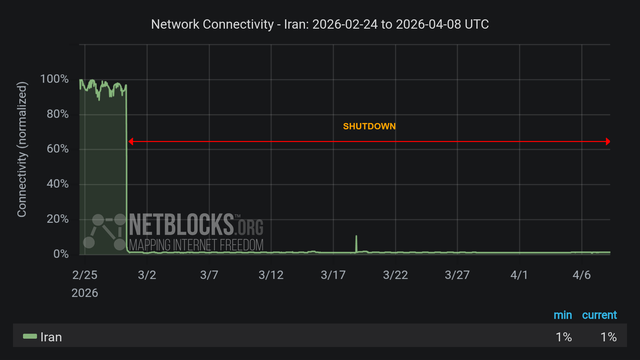
 ClickyMcTicker
 دانیال بهزادی 🦁