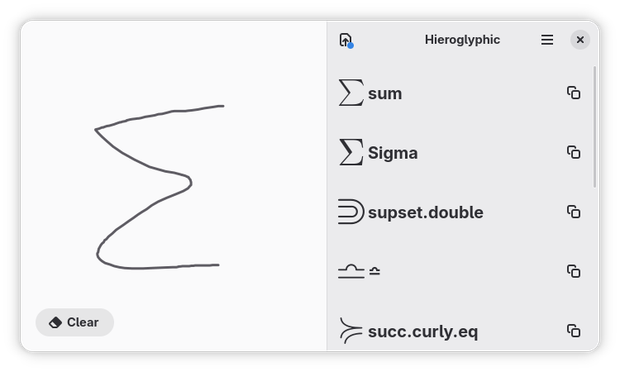
A new #Hieroglyphic release is out now. Thanks to the exciting work done by @bnyro,
Hieroglyphic can now also recognize @typst symbols (a modern alternative to
LaTeX). Hardware-acceleration will now be preferred over using the CPU, when
available, reducing power-consumption.

Head over to @flathub to download the latest version: https://flathub.org/en/apps/io.github.finefindus.Hieroglyphic

#GNOME #GNOMECircle #GNOMEApps #Tex #Typst

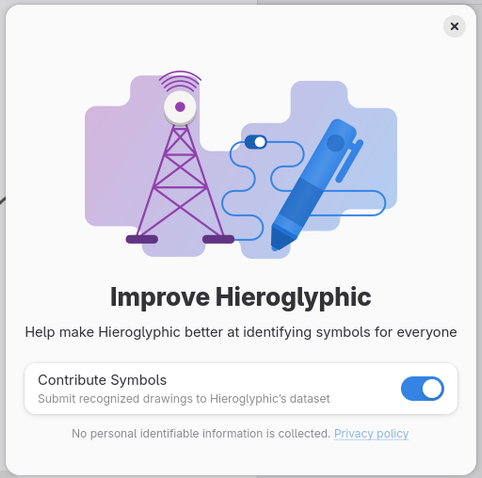
@FineFindus "Submit recognized drawings to Hieroglyphic's dataset".

I was wondering how this works. How does it know when it recognized something correctly? Does it do this if I actually copy a character?

And what's the risk of getting junk-data? Like will my awful writing make things worse?

Not criticizing, I'm just curious. It's a cool idea to collect this information for training on opt-in. :)

@sstendahl It's generally submitted when copying (there are some additional constraints, e.g. not on metered networks).

I generally trust people not to intentionally submit faulty data. Bad handwriting isn't an issue, since:
1) the data is cleaned up and downscaled before being saved/used for training
2) it's just training data with slightly more variance (which is infect helpful).

Happy to hear feedback about this, it's definitely something that could be improved.