I don’t think a prolonged general strike is going to happen in the US, and I’ll tell you why: the social safety net doesn’t exist, and people are broke.

43% of USians cannot afford an unexpected $1000 bill¹. The median household spends 33% of their income on rent². The median household has $8k in savings³. Most people will lose their health insurance if they don’t show up to work.

How many of these people can sustain a general strike during which they will not get paid?

¹ https://www.usnews.com/banking/articles/2026-financial-wellness-survey

² https://usafacts.org/answers/how-much-do-households-spend-on-rent/country/united-states/

³ https://www.bankrate.com/banking/savings/savings-account-average-balance/#how-much-does-the-average-household-have-in-savings

Most people who work for corporations are not unionized. The job market stinks. Mass layoffs have been rampant. VC-subsidized AI is making bosses drunk with power in the short term. Asking employees to put their jobs on the line in today’s uncertain market seems almost cruel.

The sad fact is most USians are utterly dependent on the capitalist class for our day-to-day living. Because we have allowed the cost of living to far outpace our income, and because we have steadfastly refused to create a public healthcare, housing, and food security program, our survival comes drip-drip-dripping from our corporate lords two weeks at a time. USians can’t afford to bite the hand that literally keeps us alive.

@drahardja "The median emergency fund balance has dropped by half from last year's survey."

Holy shit it's getting worse fast

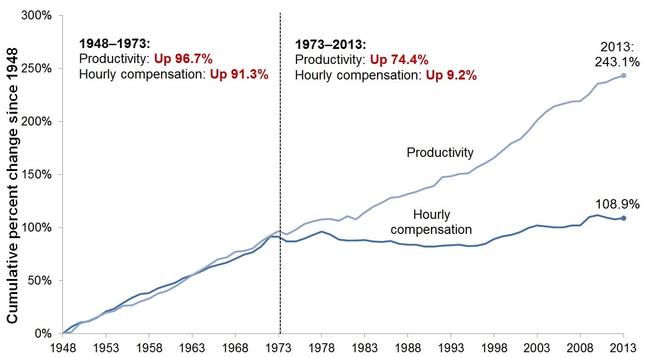
@jkb It’s been getting worse since Nixon. Wages have not risen while everything else has become more expensive. Workers are yielding more and more of their productive value to the capitalist class. People are being gradually pushed into poverty, and Republicans keep voting for more of the same.

US voters chose this policy for ourselves.

https://www.epi.org/chart/wage-summit-2014-figure-2-disconnect-between-productivity-and-typical-workers-compensation-1948-2013/

Workers produced much more, but typical workers’ pay lagged far behind: Disconnect between productivity and typical worker’s compensation, 1948–2013

Year Hourly compensation Productivity 1948  0.00% 0.00% 1949 6.25% 1.54% 1950 10.48% 9.33% 1951 11.76% 12.35% 1952 15.04% 15.63% 1953 20.85% 19.54% 1954 23.52% 21.56% 1955 28.74% 26.46% 1956 33.95% 26.66% 1957 37.15% 30.10% 1958 38.17% 32.79% 1959 42.55% 37.63% 1960 45.50% 40.05% 1961 48.00% 44.35% 1962 52.48% 49.79% 1963 55.03% 55.00% 1964 58.51% 59.99%…

Economic Policy Institute

@drahardja Yes I have some awareness of the whole process and timeline, but I still can't help being surprised by the extent of the damage.

I am not immune to propaganda, years of "America is the greatest country/the richest country" and "LOL shut up you Europoors" have skewed my perception and expectations. And then the figures come in, and lo and behold my middle-class single-income household is filthy rich compared to the US median despite a significantly lower salary and famously high tax rates (cheers from Belgium).

So yeah the purpose of a system is what is does, and all evidence point to the USA being a giant machine made to funnel money into billionaire's pockets, and it's very effective. I hope some form of liberation comes for our comrades in the USA, but I have no idea what it would take.

@jkb Me neither. It seems that there is a large portion of the US population who cannot be convinced to empathize with other people, and will vote to make life worse for everyone—including themselves—if only to prevent “the wrong people” from enjoying a better life.

They are being played like a violin by the billionaire class, and their hate prevents them from realizing it.