 kali
kalialso this has been rumored as a problem by the usual suspect. idk. i mean i trust the GCC to know how to restart an oil field? but it could take time.

tldr; : basically the flow to an oil well is to a little extend engineered, a dynamic flow regime underground. when you stop that it all comes to a halt. now. as far as i understand it, after settling, water and oil behave very different on restart than they have in that somewhat engineered flow regime and in some formations water flows faster to the well than the oil, "short circuiting" it, and they might have to flow back all that water before getting any oil out of the ground.
 Altbot
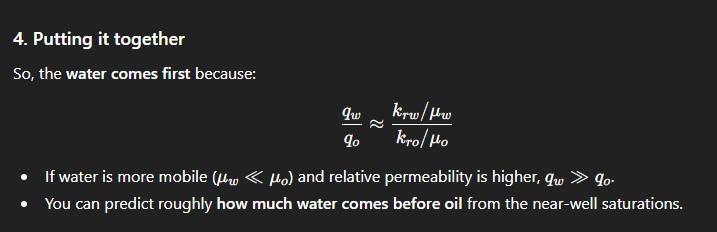
@kali This image is a digital screenshot of a presentation slide with a dark background and white text, labeled as section "4. Putting it together." The text begins with the sentence, "So, the water comes first because:" followed by a centered mathematical equation representing a ratio of flows. Below the equation, two bullet points provide an explanation: "If water is more mobile (μw << μ_o) and relative permeability is higher, q_w >> q_o." and "You can predict roughly how much water comes before oil from the near-well saturations."
―
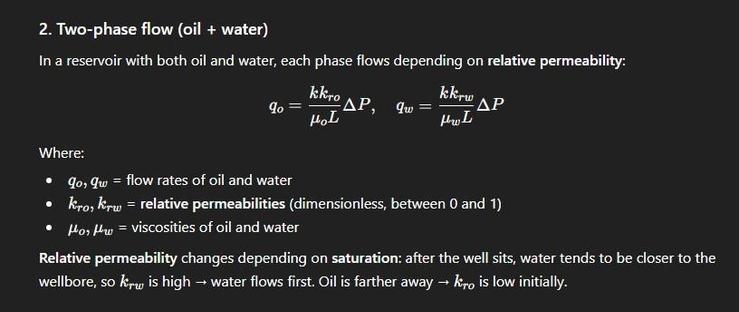
This image presents a section titled "2. Two-phase flow (oil + water)" featuring mathematical equations for oil and water flow rates in a reservoir. The central formulas show that flow rate ($q_o$ or $q_w$) equals the product of permeability ($k$) and relative permeability ($k{ro}$ or $k_{rw}$), divided by viscosity ($\mu_o$ or $\mu_w$) and length ($L$), multiplied by pressure difference ($\Delta P$). Below the equations, a "Where:" list defines these variables, specifying that relative permeabilities are dimensionless numbers between 0 and 1, while viscosities refer to oil and water. The bottom paragraph explains that "Relative permeability changes depending on saturation," noting that "after the well sits, water tends to be closer to the wellbore, so $k_{rw}$ is high -> water flows first." Finally, it states that "Oil is farther away -> $k_{ro}$ is low initially."
―
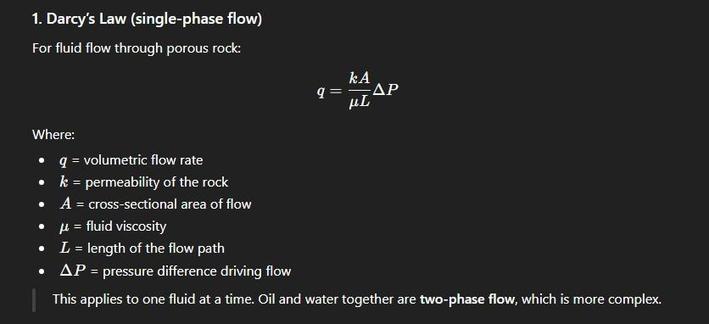
This image is a screenshot of a digital slide with a black background that explains Darcy's Law for fluid flow through porous rock. The title at the top reads "1. Darcy's Law (single-phase flow)" followed by the line "For fluid flow through porous rock:". Centered on the slide is the equation $q = \frac{kA}{\mu L} \Delta P$. Below this equation is a section labeled "Where:" which lists bullet points defining the variables: $q$ equals volumetric flow rate, $k$ equals permeability of the rock, $A$ equals cross-sectional area of flow, $\mu$ equals fluid viscosity, $L$ equals length of the flow path, and $\Delta P$ equals pressure difference driving flow. The slide concludes with a bottom note explaining that this applies to one fluid at a time, whereas oil and water together represent a more complex two-phase flow.
Provided by @altbot, generated privately and locally using Qwen3.5:9b
🌱 Energy used: 11.189 Wh