hey wanna see somethng cursed

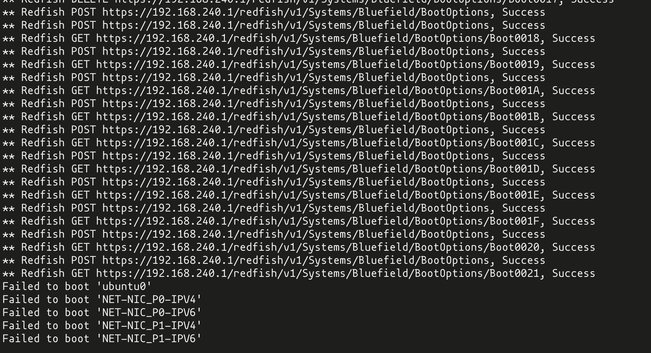
one part of this NIC is downloading UEFI boot options from another part of this NIC over HTTP. (well, failing to do it for some reason)

you're welcome
@whitequark oh no. oh no that implies multiple fucking processors
@freya yes it has two linuxes on it
@whitequark why. what. what. what
@freya second is AST2600
@whitequark what the fuuuuck, that's a wholeass BMC
@freya yup
@whitequark that is a cursed object and I hate it
@freya with 1 GB of RAM (256 MB of it is full of some crap)
@whitequark yeah that's basically a full BMC like on a supermicro
@whitequark @freya would not be surprised if that was (reserved for) the (host's) video framebuffer
@vmp_ @whitequark yep, you would be exactly correct, the AST2600 is configured to prevent to be a Matrox MGA-G200 VGA chipset

@freya @vmp_ what

no that's not the case at all. what the hell are you talking about

@whitequark @vmp_ the Aspeed AST2600 uses a hunk of ram to be a VGA chipset because it's used as a BMC in servers, right?
@freya @vmp_ first, you need barely any RAM for a Matrox framebuffer (the Matrox card you're talking about came with eight megabytes of it. today you could put that in on-die SRAM if you wanted). second, i'm talking about Linux-accessible RAM, on the Linux kernel, that I have root on
@whitequark @vmp_ nvm ok I misunderstood
@freya @vmp_ also this thing doesn't connect the AST2600 over PCIe, it has a USB link to th main SoC
@whitequark @vmp_ oh what the fuck? what is the AST2600 even doing then?
@freya @vmp_ it lets you connect to the serial console of the main SoC. you can use minicom to configure the firmware. it does something funny with escape sequences so all of that barely works
@whitequark @vmp_ oh that is so fucking..... who designed this? who designed this and why.......
@freya @vmp_ the entire thing is like this top to bottom
@whitequark @vmp_ this is like..... this is like a hardware device designed by.... I was going to say designed bny AI but no AI wouldn't be like thjis, this is a hardware devcie designed like a node.js project
@freya @vmp_ ... this is actually kinda true yeah
@whitequark @vmp_ no care for efficiency, maximal features at the cost of maximum complexity
@freya @whitequark @vmp_ I happen to know a company working exactly like this. And they still sell shit (small scale)

@freya @vmp_ there's not enough storage to store one "bf-bundle" (installation media) on the BMC and bfb-install can only install from a file so i don't think you could reinstall the main SoC from it

maybe if you mounted it via nfs...?

@whitequark @freya (also from x86 experience) the BMC can emulate USB storage forwarded from somewhere else, e.g. from a human's web browser over websockets
@vmp_ @freya this specific BMC is not configured the way you'd see it on a SuperMicro board even though it is the same chip; you just get ssh. it's running OpenBMC firmware
@vmp_ @freya admittedly i don't fully understand how it works (i doubt anybody fully understands how it works) but this is my findings so far. the docs assume you'd install a bf-bundle from the PCIe host, and then you can use the main OS itself to upgrade via apt or yum
@whitequark @freya that would be good BMC firmware. Bad firmware would make you host ISO images on a samba server
@vmp_ @whitequark my R710 did this

@freya @vmp_ @whitequark Yeah I was going to say, last time I had to deal with BMCs it was either cursed proprietary Java clients or getting it to stream an ISO from SMB using barely documented commands.

I think an HP something once was able to do HTTP? But not very well...

@lina @vmp_ @whitequark oh no you had to use the SuperMicro java thing didn't you?
@freya @vmp_ @whitequark Worse, the Dell one. I still have a shell script somewhere with the jars and overrides to get it to work on a modern system...
@lina @freya @vmp_ @whitequark I believe my HP server's BMC streams ISOs over web sockets or something. It can somehow use a local file as a virtual CD without uploading it. I believe the connection gets severed when the licensing detects that the server you're bootstrapping has booted and kicks you out of the KVM.
@juliancalaby @freya @vmp_ @whitequark Yeah the ones with HTML5 clients can usually do that. It's wacky but it usually works.
@whitequark @freya pfft, insufficient overkill
@whitequark @freya ah well, just speculating. When it's bolted to an x86 as a PCIe endpoint, the AST2500 and AST2400 share a chunk of their DRAM with the PCIe host, as part of a VGA class device (the ones I've seen did declare themselves aspeed though
.. I've seen others declared as Matrox (Nuvoton?)). The aspeed side can then read it and implement "KVM over IP". This would be configured in aspeed's devicetree and, well, 256MB in not implausible.

@whitequark @freya @vmp_

Also, the G200 is a 3D GPU. If you just want to just draw a simple GUI once a fortnight, it's total overkill.

Although that does make me wonder what's the simplest and/or cheapest video chip manufactured today. Some kind of dumb RAMDAC where the CPU does all the work, I guess?

@argv_minus_one @freya @vmp_ this will 100% depend on your definition of "video chip"

@whitequark @freya @vmp_

A device that generates a DP/HDMI/whatever video signal by reading pixel data from a block of memory, I guess.

@argv_minus_one @freya @vmp_ how "whatever" are we talking?

@whitequark

I'm…not sure? VGA and SCART and such are fine too, I guess, but I assume those are more complex because there's DAC involved.

Must be pixel graphics, though, so vector displays and RS232 don't count.

@freya @vmp_

@argv_minus_one @freya @vmp_ you can get LCDs where you can write the framebuffer via SPI, so probably "a shift register" could be a video card :p
@argv_minus_one @freya @vmp_ there are also ones without a framebuffer (there's one on my desk that's basically SPI but you have to drive it in an exactly specific way so it refreshes at 60 Hz or something)

@whitequark

Yep, that's pretty simple.

What about actual DP/HDMI/DVI-D? What's the simplest solution there?

@freya @vmp_

@argv_minus_one @whitequark @freya @vmp_ Maybe whatever Dell uses on PowerEdge T160 – that thing couldn't smoothly fade in Server 2025 login screen on a 1280x1024 monitor.