Hilbert, by Constance Reid.

A great book, showing David Hilbert's passage from a bold young and ambitious mathematician to an old man surrounded by the ruin of the mathematics department in Göttingen in the 1930s. This helped me place a lot of names of contemporaries, and I can appreciate Minkowski's truncated career much better, I had no idea how big a deal he was in this whole circle, nor that he died early. The author treats the mathematics very well even though she's not trained in it, and from a modern standpoint it helps me connects back from post-1930s work to the previous generation's revolutionary developments.

Electronic version: https://doi.org/10.1007/978-1-4612-0739-9

#Read2026

@highergeometer - I may have read this once; I should read it again!

Minkowski was more than Einstein's teacher - the guy who realized time is imaginary - but I don't know his whole institutional role.

@johncarlosbaez He worked on both the geometry of numbers https://en.wikipedia.org/wiki/Geometry_of_numbers as well as mathematical physics later in his life. When he was just 18 he won (jointly, due to his youth) a big prize from the French Academy of Sciences. Was a close friend of Hilbert and was in the Göttingen mathematics department after Zurich, which was a position taken out of necessity to have a job. Also, Carathéodory was his student, also a later Göttingen member.
Geometry of numbers - Wikipedia

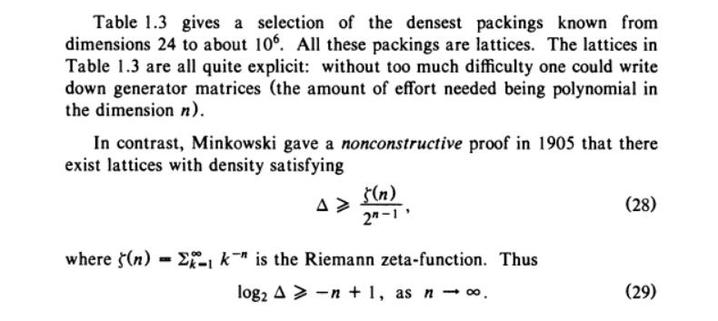
@highergeometer - I'm somewhat familiar with Minkowski's work on the geometry of numbers, though I can never remember the key results. One of them lets us show that a "randomly chosen" lattice packing of spheres in high dimensions is denser than any lattice packing we currently know explicitly. I think that's cool... and frustrating.

(Yes, I can see the key results on Wikipedia!)

@johncarlosbaez @highergeometer I didn't know that went back to Minkowski. I've thought about this kind of thing a lot but I'm not expert enough to make a useful contribution. I think that there are many problems where if you explore the space of possible solutions it turns out the space is full of good solutions. But, bizarrely, short strings of mathematical language are surprisingly good at finding the bad solutions. The unreasonable ineffectiveness of mathematics!

@dpiponi @highergeometer - Maybe it's just the unsurprising "sometimes effective, sometime ineffective"ness of mathematics.

From page 14 of the third edition of Conway and Sloane's Sphere Packings, Lattices and Groups: