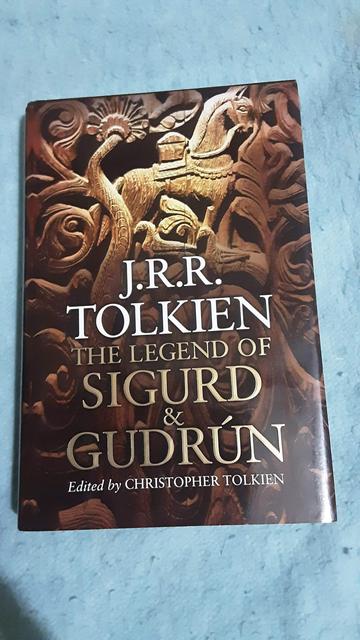
The Legend of Sigurd and Gudrún, by J.R.R. Tolkien (edited by Christopher Tolkien)

This is Tolkien's adaptation/telling of the matter of the Volsungs and the aftermath with the Huns, to bridge a most unhappy lacuna in the main source text for the Icelandic Poetic Eddas. It's a synthesis of several sources, both in Icelandic and later Germanic tradition, but given as two long English poems in the traditional fornyrðislag meter that the Eddas are written in: 8 short lines in a stanza following alliterative rules (essentially cutting the lines of Anglo Saxon alliterative poetry at the caesura to make twice as many). To read this after Chistopher's edition of Heidrek's Saga was a nice pairing. There's plenty of extra apparatus in this book, including material from Tolkien's lectures on Old Norse material. The comment that the Norse poet's intention was to hit you in the eye is indeed accurate. One the material got going it was very gripping. Anyone wishing Tolkien was more like modern fantasy authors and wrote violent and morally grey characters can get their fill.
#Read2026 #Tolkien

Timely that this was recently published, as the Old English Attila appears in this book:

Miller-Atkins, Galen (2025) "Entiscum yrfe Ealdniflunga: Meter and Poetic Style in Tolkien’s Old English Attila," Journal of Tolkien Research: Vol. 23: Iss. 2, Article 5.
Available at: https://scholar.valpo.edu/journaloftolkienresearch/vol23/iss2/5

Entiscum yrfe Ealdniflunga: Meter and Poetic Style in Tolkien’s Old English Attila

Tolkien famously wrote several poems in Old English and Gothic; however, these remain understudied for their philological and poetic qualities relative to his modern English poetic corpus. In the Old English Poem of Attila Tolkien adapts the Old Norse poem Atlakviða into Old English. This essay analyzes the meter and poetic techniques in Old English Poem of Attila, especially in relation to the closely related, Eddic poem Atlakviða. The Old English Poem of Attila exhibits verse patterns and vocabulary from the Old Norse original, but it is firmly rooted in the Old English poetic tradition. Tolkien deliberately blends Old English and Old Norse poetic features in his new composition, reflecting a mixed ancestry for a “lost original” poem of the Nibelung saga.

ValpoScholar