USD Purchasing Power in Real Time Since 2000
Hey all. This was merely intended as a fun visualization of inflation over long periods of time, in a format that’s slightly easier to grok for most people.
That’s it. There’s no further intention behind this, I just thought a real time “decay” visualization would be neat.
Literally everything about how this works is in the source in maybe 30 lines of js. It’s not complicated. Data is from BLS (whether or not that's accurate is another conversation entirely). I auto update the data monthly via a chron job, right around the time new data is published.
I’m not really changing this from where it’s at. It’s done as is. There are other sources out there already if you want to customize the date range or see a graph.
Thanks for checking it out :).
As much as the notion of "Purchasing Power" is <macro>economic, thus perhaps having a greater chance of being related to reality, I've been wondering if - and how - could these long-term measures account for greater diversity and "scale" of "things money can buy".
Nowadays if you're properly rich you can buy a seat on a sub-orbital flight. This wasn't an option in '00, no matter how rich you were.
On the other end of the scale, for basic things a (really) good quality loaf of bread will always be cheaper in Poland than say up north from Oslo, Norway; whereas a USA-designed made-in-China laptop pretty much never did scale with the rest of the "CPI basket"...
Point being: we sure do have numbers - what they really mean in practice is vague at best.
This isn't very surprising. Typical US economic policy aims for 2-3% annual inflation. That counter shows an average 2.6% inflation across 26 years, which is kind of right in the range we'd expect.
It's debatable whether this is good longterm policy - but it's been the norm in the US for decades.
> Typical US economic policy aims for 2-3% annual inflation. That counter shows an average 2.6% inflation across 26 years, which is kind of right in the range we'd expect
We aim for "inflation of 2 percent over the longer run, as measured by the annual change in the price index for personal consumption expenditures" [1].
> "as measured by the annual change in the price index for personal consumption expenditures"
How closely does that track with CPI-U, which is the index this web site is using? If I believe Gemini, PCE should show a slightly lower inflation number?
This ticker's current speed is faster than that, though. It's going about 1e-9 dollar per second. That comes to about $0.03 per year, which as a fraction of the current base of $0.50, comes to 6% inflation per year.
I don't know how that speed was determined. Either it's using a linear decrease since 2000 (which isn't correct, the inverse of exponential inflation would be logarithmic decay, not linear), or it's weighting by recency for the high inflation since 2020 (which may continue, or may not.)
Good eye. The ticker was using the observed rate of change over the two most recent data points, so it's actually biased towards the most recent inflation numbers. I've updated it to simply use the slope between the oldest (January 2000) and the most recent data.
It won't be 100% accurate, but it's close enough to create a visual. And the number is always updated monthly with real data anyways.
The real time number isn't as interesting as the potential future number. If the dollar stops being the reserve currency, the purchasing power of the dollar will crash. No more cheap borrowing, no more low interest rates, hello constant high inflation. The Iran war has made that increasingly likely to happen. It may even have been intentional.
https://www.jpmorgan.com/insights/global-research/currencies... | https://spectator.com/article/the-us-currency-is-under-attac...
> If the dollar stops being the reserve currency, the purchasing power of the dollar will crash
This is far from clear.
> Perpetual trade deficit is modern system of tribute
Probably not. Equatorial Guinea, Palau and Kyrgyzstan run the largest current-account deficits as fractions of GDP [1]. (Current account counts goods and services.)
[1] https://en.wikipedia.org/wiki/List_of_countries_by_current_a...
> it's still overvalued against foreign currencies
That would make imports more expensive and exports more competitive. Some pain, given we run a deficit [1]. But $50bn/month adustment in a $30tn economy is 2%. Not fun. But not a "crash."
(There is a genuine argument to be made that American voters have been rejecting dollar hegemony across multiple elections for a couple of decades.)
[1] https://www.bea.gov/data/intl-trade-investment/international...
> No more cheap borrowing, no more low interest rates, hello constant high inflation.
Do you mean that we’ll have high inflation because we’ll keep running massive deficits? Because many countries that don’t have the reserve currency also have low inflation.
> If the dollar stops being the reserve currency, the purchasing power of the dollar will crash.
And thus manufacturing will return to the US! I thought we wanted that. It's the only way out of the Triffin dilemma.
Double cheeseburger has always had and still has two slices of cheese. The McDouble (which used to be $1) always had a single slice of cheese.
The real hack was asking them to put Big Mac sauce on the McDouble. For $.30 it was pretty damn close at 1/3 the price.
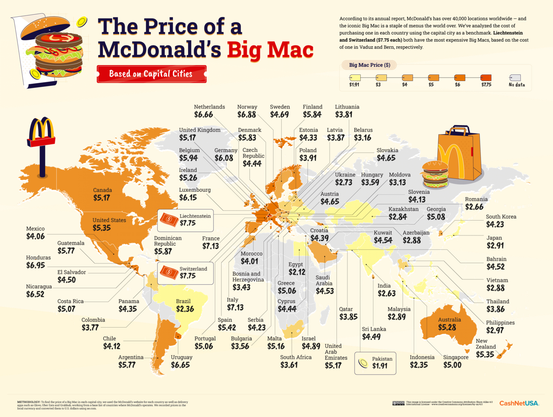
Yeah, same here. Perhaps the Big Mac Index [0] is what you want.
In the last 12-24 months the price of fast food in particular has risen at a higher rate than inflation has hit other types of food and goods. Fast food makes no economic sense anymore.
And you're right, the food has gotten worse as well.