henrygarner
We found an undocumented bug in the Apollo 11 guidance computer code
https://www.juxt.pro/blog/a-bug-on-the-dark-side-of-the-moon/
We found an undocumented bug in the Apollo 11 guidance computer code
https://www.juxt.pro/blog/a-bug-on-the-dark-side-of-the-moon/
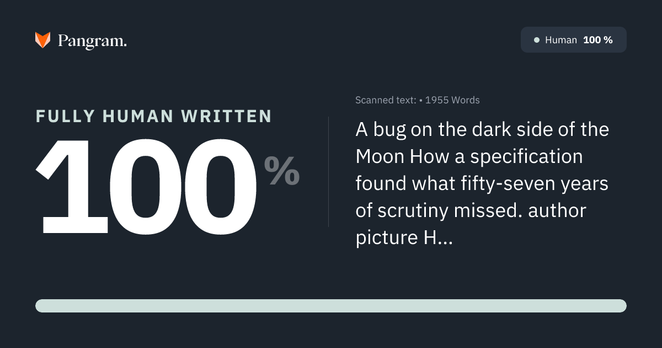
Is it possible for a tool to know if something is AI written with high confidence at all? LLMs can be tuned/instructed to write in an infinite number of styles.
Don't understand how these tools exist.
The WikiEDU project has some thoughts on this. They found Pangram good enough to detect LLM usage while teaching editors to make their first Wikipedia edits, at least enough to intervene and nudge the student. They didn’t use it punatively or expect authoritative results however. https://wikiedu.org/blog/2026/01/29/generative-ai-and-wikipe...
They found that Pangram suffers from false positives in non-prose contexts like bibliographies, outlines, formatting, etc. The article does not touch on Pangram’s false negatives.
I personally think it’s an intractable problem, but I do feel pangram gives some useful signal, albeit not reliably.