 drob518
The cult of vibe coding is dogfooding run amok

It’s truly strange that people keep citing the quality of Claude code’s leaked source as if it’s proof vibe coding doesn’t work.
If anything, it’s the exact opposite. It shows that you can build a crazy popular & successful product while violating all the traditional rules about “good” code.
> you can build a crazy popular & successful product while violating all the traditional rules about “good” code
which has always been true
Yes, and to add, in case it's not obvious: in my experience the maintenance, mental (and emotional costs, call me sensitive) cost of bad code compounds exponentially the more hacks you throw at it
I'm pretty sure that will be true with AI as well.
No accounting for taste, but part of makes code hard for me to reason about is when it has lots of combinatorial complexity, where the amount of states that can happen makes it difficult to know all the possible good and bad states that your program can be in. Combinatorial complexity is something that objectively can be expensive for any form of computer, be it a human brain or silicon. If the code is written in such a way that the number of correct and incorrect states are impossible to know, then the problem becomes undecidable.
I do think there is code that is "objectively" difficult to work with.
What do you think about the argument that we are entering a world where code is so cheap to write, you can throw the old one away and build a new one after you've validated the business model, found a niche, whatever?
I mean, it seems like that has always been true to an extent, but now it may be even more true? Once you know you're sitting on a lode of gold, it's a lot easier to know how much to invest in the mine.
I actually think that might actually be a good path forward.
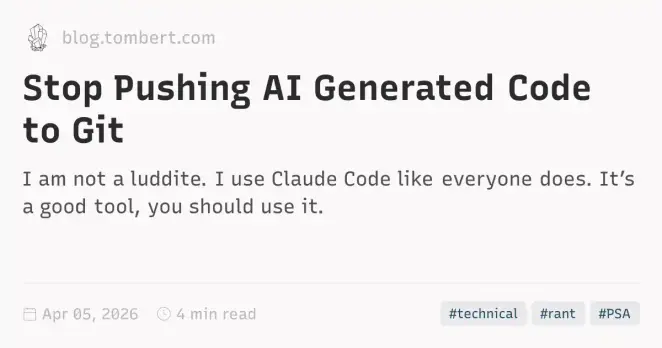
I hate self-promotion but I posted my opinions on this last night https://blog.tombert.com/Posts/Technical/2026/04-April/Stop-...
The tl;dr of this is that I don't think that the code itself is what needs to be preserved, the prompt and chat is the actual important and useful thing here. At some point I think it makes more sense to fine tune the prompts to get increasingly more specific and just regenerate the the code based on that spec, and store that in Git.
This is actually a pretty good callout.
Observability into how a foundation model generated product arrived to that state is significantly more important than the underlying codebase, as it's the prompt context that is the architecture.
Yeah, I'm just a little tired of seeing these pull requests of multi-thousand-line pull requests where no one has actually looked at the code.
The solution people are coming up with now is using AI for code reviews and I have to ask "why involve Git at all then?". If AI is writing the code, testing the code, reviewing the code, and merging the code, then it seems to me that we can just remove these steps and simply PR the prompts themselves.
Yep.
Also, the approach you described is what a number of AI for Code Review products are using under-the-hood, but human-in-the-loop is still recognized as critical.
It's the same way how written design docs and comments are significantly more valuable than uncommented and undocumented source.
> why involve Git at all then?
I made a similar point 3 weeks ago. It wasn't very well received.
https://news.ycombinator.com/item?id=47411693
You don't actually need source control to be able to roll back to any particular version that was in use. A series of tarballs will let you do that.
The entire purpose of source control is to let you reason about change sets to help you make decisions about the direction that development (including bug fixes) will take.
If people are still using git but not really using it, are they doing so simply to take advantage of free resources such as github and test runners, or are they still using it because they don't want to admit to themselves that they've completely lost control?
> are they still using it because they don't want to admit to themselves that they've completely lost control?
I think this is the case, or at least close.
I think a lot of people are still convincing themselves that they are the ones "writing" it because they're the ones putting their names on the pull request.
It reminds me of a lot of early Java, where it would make you feel like you were being very productive because everything that would take you eight lines in any other language would take thirty lines across three files to do in Java. Even though you didn't really "do" anything (and indeed Netbeans or IntelliJ or Eclipse was likely generating a lot of that bootstrapping code anyway), people would act like they were doing a lot of work because of a high number of lines of code.
Java is considerably less terrible now, to a point where I actually sort of begrudgingly like writing it, but early Java (IMO before Java 21 and especially before 11) was very bad about unnecessary verbosity.
A series of tarballs is really unwieldy for that though. Even if you don't want to use git, and even if the LLM is doing everything, having discrete pieces like "added GitHub oauth to login" and "added profile picture to account page" as different commits is still valuable for when you have to ask the LLM "hey about the profile picture on the account page".
> If people are still using git but not really using it, are they doing so simply to take advantage of free resources such as github and test runners,
does it have to be free to be useful? the CD part is is even more important than before, and if they still use git as their input, and everyone including the LLM is already familiar with git, whats the need to get rid of it?
there's value in git as a tool everyone knows the basics of, and as a common interface of communicating code to different systems.
passing tarballs around requires defining a bunch of new interfaces for those tarballs which adds a cost to every integration that you'd otherwise get for about free if you used git
> At some point I think it makes more sense to fine tune the prompts to get increasingly more specific and just regenerate the the code based on that spec, and store that in Git.
Generating code using a non-deterministic code generator is a bold strategy. Just gotta hope that your next pull of the code slot machine doesn’t introduce a bug or ten.