 Eliot Higgins
🧵 Democracy feels like it's in a rough state at the moment across the globe, and we hear various explanations, like polarisation, extremism, disinformation, and loss of trust. But what if those explanations are mainly symptoms and we've been trying to treat them rather than the underlying causes?
If we're to fix these problems then we need to understand what's causing them in the first place. In my opinion, since 2016, too much attention has been paid to issues like foreign interference and disinformation, and not enough time looking at the problems with our democracies.
Let's think about one element of this, the "loss of trust" in institutions that often cited as the reason for our democratic woes. What does that even mean? It's said like trust in institutions is some abstract, inherent thing, but what is that trust based on? Why does it exist in the first place?
It's something I wrote about in my paper, with @[email protected], "Verification, Deliberation, Accountability: A new framework for tackling epistemic collapse and renewing democracy", but started with thinking about the work of Walter Lippmann 100 years ago.
demos.co.uk/research/ver...
Verification, Deliberation, Ac...
Verification, Deliberation, Ac...

Walter Lippmann wrote Public Opinion in 1922. His core insight: the world is too complex for any of us to experience directly. We can't personally verify what's happening in government, the economy, or foreign affairs. So how do we form opinions about them?
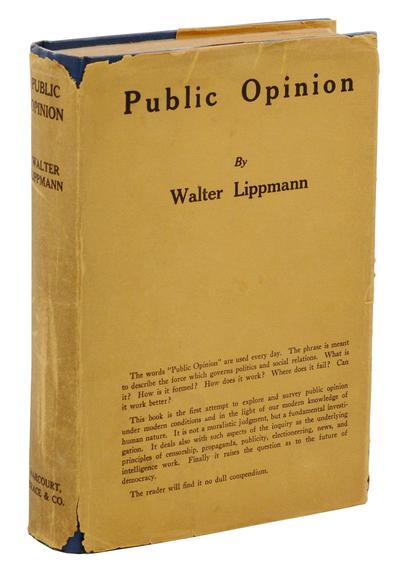
His answer: we don't engage with the world as it is. We engage with "pseudo-environments", simplified pictures of reality we construct from the information available to us. We act on those pictures as if they were the real thing.
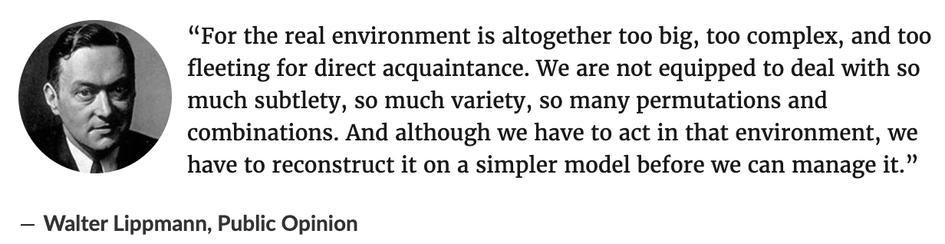
This isn't a flaw, it's unavoidable. No one has the time or access to verify everything that matters in a democracy. We need intermediaries: journalists, experts, institutions. They compress a complex world into something we can work with.
For Lippmann, public opinion isn't formed by citizens discovering truth for themselves. It's shaped by the institutions that construct those pictures of reality. The quality of public opinion depends on the quality of that infrastructure.
Lippmann's solution was radical and essentially technocratic: democracy can't rely on an informed public. Instead, he proposed expert bureaus, independent bodies that would analyse reality and provide reliable information to decision-makers.
In other words, Lippmann thought the answer was to take the construction of those pictures of reality out of democratic politics and hand it to trained experts insulated from public pressure. The public couldn't do this job.
John Dewey pushed back. He agreed with Lippmann's diagnosis, the world is too complex for individuals to grasp alone. But he rejected the technocratic cure. Democracy couldn't be saved by bypassing the public.
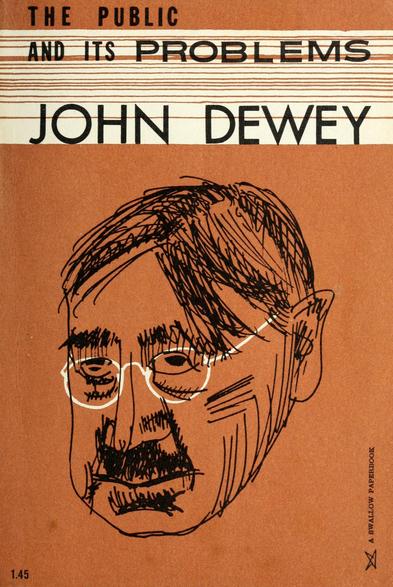
For Dewey, the answer wasn't better experts, it was better communication. A public that could share experiences, deliberate together, and hold institutions accountable wasn't a problem to be managed. It was the whole point.
This Lippmann-Dewey debate still frames democratic thinking today. Do we fix democracy by improving the expert infrastructure that informs the public? Or by improving the public's own capacity to participate? The answer, I'd argue, is both.
If you want to learn more about the Lippmann-Dewey Debate (and you really should), Philosophize This! has an episode that dives into it I highly recommend
www.philosophizethis.org/podcast/dewe...
Episode #130 - Dewey and Lippm...
Episode #130 - Dewey and Lippm...

So back to the original question. When we talk about "loss of trust" in institutions, what is that trust actually in? If Lippmann was right, it's trust that institutions give us reliable pictures of reality. But how?
In our paper, @[email protected] and I argue that institutional trust rests on three things: Verification, Deliberation, and Accountability.
demos.co.uk/research/verification-deliberation-accountability-a-new-framework-for-tackling-epistemic-collapse-and-renewing-democracy/
Verification, Deliberation, Ac...
Verification, Deliberation, Ac...
Verification: can we establish shared facts?
Deliberation: can we reason together about what they mean?
Accountability: can we hold power to account?
These aren't separate nice-to-haves., they're a self-reinforcing pipeline. Deliberation can't work without reliable verification. Accountability can't work without genuine deliberation. When the first tier fails, the whole thing collapses.
And when this pipeline functions, it doesn't just produce trust, it constrains power. It's the infrastructure that protects the public from the unchecked exercise of power. That's what institutional trust is really about.
Then "loss of trust" isn't vague or mysterious. It's what happens when this infrastructure degrades, and with it, the constraints on power. People aren't generally irrational for losing trust, they're reacting to a perceived breakdown in that trust.
So if trust depends on this VDA infrastructure, the next question is: how does it degrade? I think of this as the Arc of Democracy, a pattern where democratic institutions move from substance, to performance, to simulation.
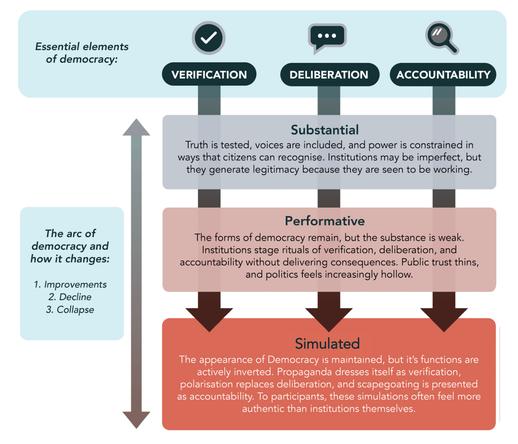
To be clear, I'm not arguing there was ever a golden age. Democracies have always been flawed, exclusionary, and contested. But there's a difference between imperfect institutions that genuinely function and institutions that have hollowed out while keeping their surface forms.
Substance: institutions actually do the work. Journalism investigates. Parliaments scrutinise. Courts hold power to account. It's imperfect, but the VDA pipeline functions. Power is genuinely constrained.
Performance: the forms persist but the substance thins out. Parliament still debates, but outcomes are pre-decided. Media still reports, but access journalism replaces investigation. It looks like accountability, but the constraint on power is weakening.
Simulation: the surface forms remain but they're empty. Institutions exist to legitimate power, not constrain it. Verification, deliberation, and accountability still happen in name, but they no longer function.
The danger of simulation is that it can be hard to see. Everything looks roughly the same from the outside. The institutions are still there. But the infrastructure that protected the public from power has collapsed.
So what happens when institutions slide along this arc and people notice? They don't just accept it. They form what political theorists call "counterpublics", spaces outside mainstream institutions where people try to test truth, deliberate, and hold power to account.
The idea comes from Nancy Fraser, who in 1990 described "subaltern counterpublics", parallel spaces where excluded groups develop their own voice. Her key example was the US feminist movement: journals, bookstores, networks built outside a public sphere that shut women out.
Michael Warner developed the idea further in 2002, extending it to queer counterpublics. The core point: when mainstream institutions exclude people, they don't fall silent. They build alternative spaces to test truth, form identity, and challenge power.
These were fundamentally democratic acts. Fraser and Warner showed that counterpublics can strengthen democracy by widening who gets heard and what gets scrutinised. The concept was born from progressive, emancipatory movements.
I build on Fraser and Warner by applying the VDA framework. The key insight: counterpublics aren't inherently good or bad. What matters is whether they perform verification, deliberation, and accountability substantially, or whether they hollow out or disorder those functions.
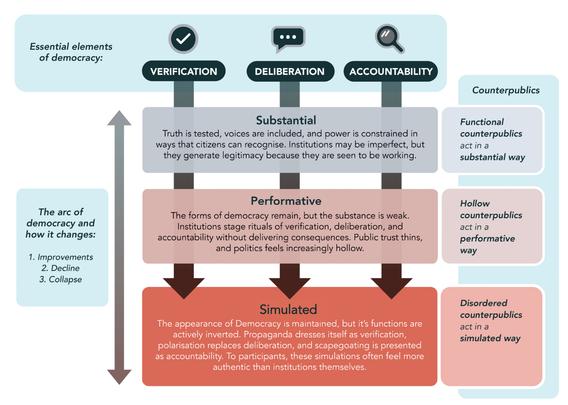
Functional counterpublics do VDA for real. Think civil rights movements, citizen-led investigations, open-source investigation networks. They don't weaken democracy, they renew it from below when institutions are failing.
Hollow counterpublics adopt the language of democracy but without the substance. Lots of debate, no resolution. Symbolic protest, no consequence. They generate visibility and energy, but the VDA pipeline isn't really working.
Disordered counterpublics simulate VDA but invert its meaning. "Verification" becomes selective sourcing. "Deliberation" becomes a loyalty test. "Accountability" means naming enemies. They look democratic on the surface but accelerate collapse.
Notice how these map onto the arc. Functional counterpublics operate with substance. Hollow ones are performative. Disordered ones are simulated. The same pattern that affects institutions plays out in the spaces people build when institutions fail.
So why are we seeing so many more disordered counterpublics now? The answer is a fundamental shift in the information environment. And it connects directly back to Lippmann.
Remember, Lippmann argued we rely on institutions to construct our pictures of reality. For most of the 20th century, that meant editors, broadcasters, publishers. They acted as gatekeepers, not just to information, but to who had a voice in public life.
That gatekeeping imposed some threshold of verification. But it also excluded people. And not just conspiracy theorists, it excluded legitimate voices too. Women, minorities, working-class communities. The counterpublics Fraser described existed precisely because of this exclusion.