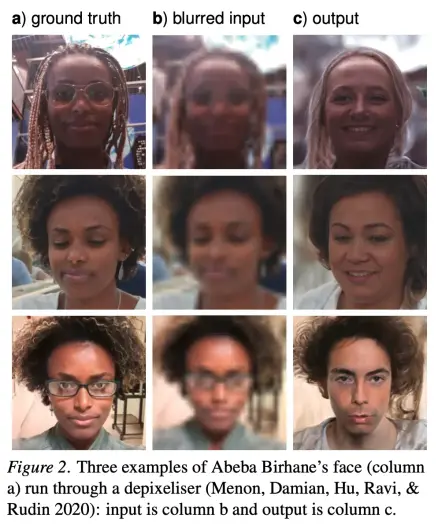
RE: https://scholar.social/@olivia/116357032470708831

Loads of chat and even discourse about so-called AI literacy, but I don't think most realise you need to teach things from quite a few angles and zoomed out.

If people want to just know how the models work, that's not always possible without a much wider base anyway...

Our offering below:

1/n
Also I know a lot of people crave an answer to how they work that extends beyond the maths anyway (even if they don't realise it).

But consider why these descriptions aren't enough about artificial neural networks, but petrol go in piston move wheel spin is enough for cars?

https://scholar.social/@olivia/115411100719613633

2/n

I have a lot of thoughts as to what this means, but it's too long form for here and I will share in due course. But trust me, for adults for sure, that's enough. And if any of those words confuses you, Wikipedia is very good for mathematical concepts.

3/n

The real AI literacy is not to understand any specific maths.

https://scholar.social/@olivia/116188565718565127

4/

Some of critical AI literacy is to understand the purposeful dodging of semantic clarity: https://scholar.social/@olivia/115157825722674869

5/

Some of critical AI literacy is to spot how thinking in any serious or meaningful way has broken down and instead non-arguments or just pure nonsense are presented as sensible statements. If this is done constantly critical thinking itself stops happening...

https://scholar.social/@olivia/115157838955510719

6/

Some of critical AI literacy is to say "hey, you know not all computers pollute or are AI nonsense machines?"

It's not that everyone specifically needs to decolonise computation actively immediately, but just to take a first step and learn to look around us properly.

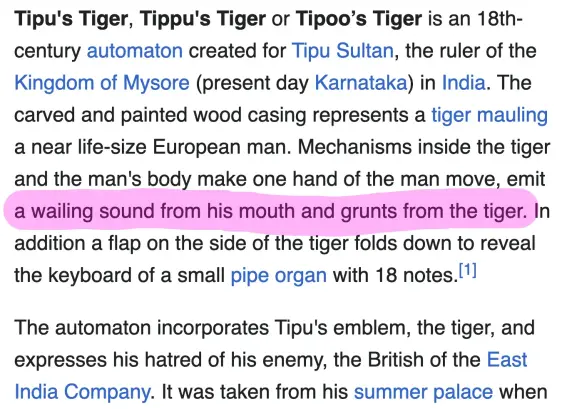
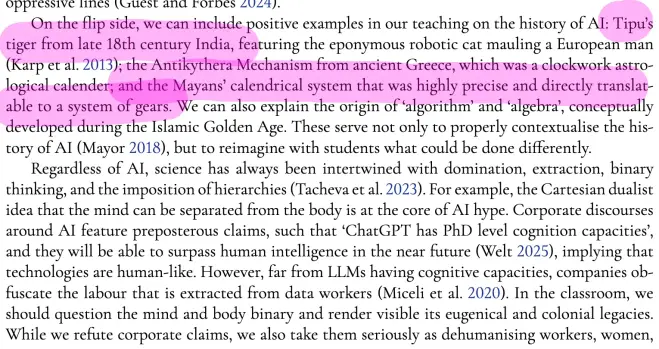
🐯 Tipu's tiger is amazing; sadly stolen & now in the V&A, created in India & depicting a tiger mauling an English man.

7/

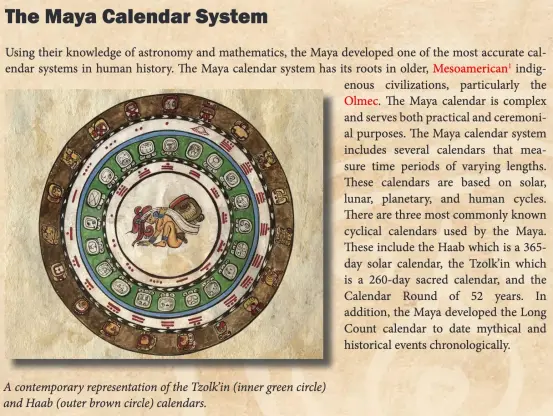
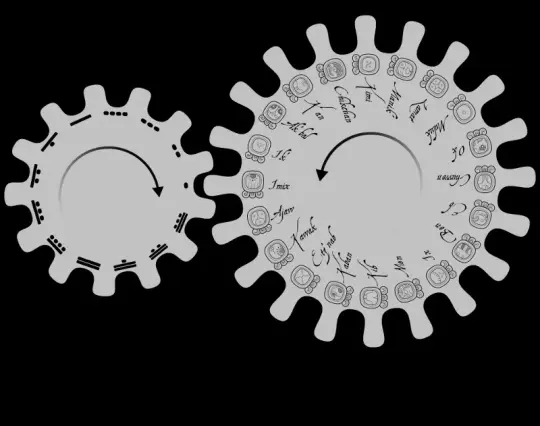
Also the antikythera mechanism and the Mayan calendar, both ways of modelling time passing, the earth and planets, and sun, etc. are wonderful examples of again computers with no pollution inherently and fun for kids:

See more: https://maya.nmai.si.edu/sites/default/files/resources/The%20Maya%20Calendar%20System.pdf
https://www.mayaarchaeologist.co.uk/public-resources/maya-world/maya-calendar-system/

8/

For older learners, yes there are important steps to take including self-reflection such as in this work with @abebab — self-critical AI literacy:

Birhane, A. & Guest, O. (2021). Towards Decolonising Computational Sciences. Women, Gender & Research. https://doi.org/10.7146/kkf.v29i2.124899

9/

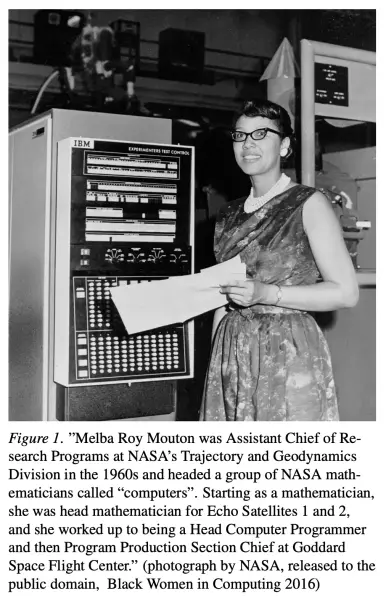
Also another thing for teachers of programming is this — think about how, who, and what you teach and why to and whom. Women like computers too:

https://scholar.social/@olivia/111146940320833033

10/

respecting expertise, and I mean all kinds, is something that degrades significantly under rising fascism... so many depressing and war crime/crimes against humanity-related examples in/from the USA lately https://scholar.social/@olivia/116357060362504588

11/

it's also happening WITHIN science, e.g. https://scholar.social/@olivia/115315385419626564

notice how we say:

> assuming the mantle of the non-expert is innapropriate

12/

also for academics, they need to take certain facts seriously on LLMs:

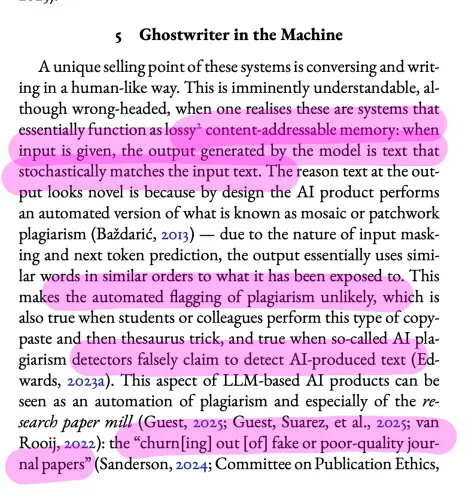
1️⃣ LLMs are usefully seen as lossy content-addressable systems

2️⃣ we can't automatically detect plagiarism

3️⃣ LLMs automate plagiarism & paper mills

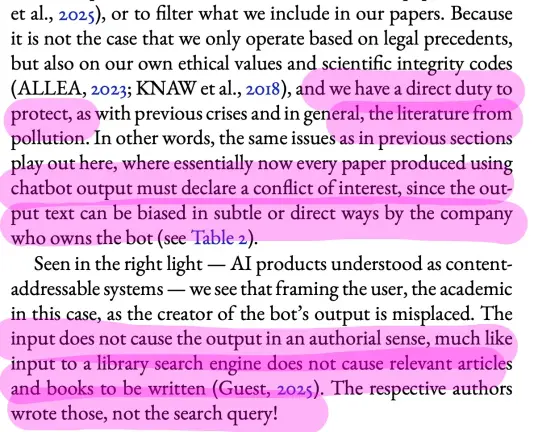
4️⃣ we must protect literature from pollution

5️⃣ LLM use is a CoI

6️⃣ prompts do not cause output in authorial sense

https://doi.org/10.31234/osf.io/dkrgj_v1

13/

@olivia

> 5️⃣ LLM use is a CoI

What is a "CoI"? Is there some part of a word missing?

Thanks for the thread. You raised some important points.