 skullette couille
Man either I’m piloting it wrong or there’s something wrong with my Master of keys deck I had land issues AGAIN 😭
Sharing my list soon for reviews!!
#MagicTheGathering
Sharing my list soon for reviews!!
#MagicTheGathering
Alrighty, deck list time https://archidekt.com/decks/19627348/enchant_dsenchante_enchantment_sac_recursion_control?sort=cmc&stack=multiple
I have added way too much details in the description but that should help contextualise the deck and give an idea of what we’re doing here
For context, I have struggled with keeping consistent land drops and I end up lagging behind especially since the deck also doesn’t have much ramp. I feel like it takes time to find tangible value in my plays, and I often end up in a situation where my commander is cast and the turn after it gets swooped into a board wipe, and I can’t do much, as casting it for 5 mana as a do-norhing feels awful when I’m not keeping up. Which may be an issue with the concept of the deck and the commander itself, so I am aware my plan may not be viable overall haha
I also feel like I often end up in situations where I have a handful of cards that do nothing with each other, so I think that shows a lack of focus and misevaluation in card quality, and most importantly, a deck relying too much on its on synergy to work.
I think in the meantime I will try to sort of overhaul the whole deck and laser focus it better, cutting cards that don’t quite do what I need and simplify it to its core mechanics, adding more low mana card draw. My aim is also to add one more land to the mix to have 40 lands + 2 land-ish cards which should allow comfort for playing control and offering good mulliganing options (my personal preference recently in my decks has been to run 38 as a bare minimum (besides a few exceptions) and usually more lands, but any polite suggestions or feedback is welcome to help me in that process, I’m feeling a bit self-conscious because I know I am terrible at evaluating card quality and building decks so be gentle pls
Thank you for reading me
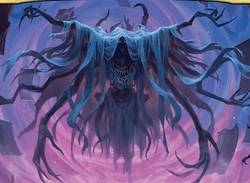
The Master of Keys - Commander deck Control • Sacrifice • Enchantments • Graveyard • Enchantress • Self-Mill (1) Commander • (9) Altars • (6) Burn • (7) Cardboard fetching • (11) Cardboard treats • (41) Land • (8) Mass Disruption • (11) Mill • (3) More MORE!!!! • (12) Protecc • (4) Ramp • (10) Recursion • (10) sparkly fodder • (12) Targetted Disruption • (3) whimsical rat combo Overview Enchanté & Désenchantée is my personal take on building an enchantress deck in Esper colour with a sacrificing twist. The deck is a control deck, aiming to gain value from playing and sacrificing its own enchantments, grinding out opponents in value by recurring enchantments from the graveyard while burning them slowly, until it has accrued enough resources to give an explosive coup de grâce. Soundtrack Around the deck Inspiration The deck was inspired by the Wilds of Eldraine mechanics, in particular its role enchantment tokens combined with the Bargain mechanic, and different payoffs for putting enchantments in the graveyard like [[Warehouse Tabby]] combined with [[Twisted Sewer-Witch]] combined. I wanted to build a deck where these two cards could live without being overshadowed or concentrating the deck on a gimmick. Game plan The main game plan is to use the graveyard as an extended hand to cast enchantments from, and to recurr removal to control the game while burning opponents by casting or sacrificing enchantments. The spot removal suite is entirely made of enchantments, and most of them do not need to stick around to achieve what they need to do (some even benefit from being sacrificed, more on that later). The deck wants to win by burning players via a large amount of enchantments enterring the battlefield or being sacrified, using a payoff like [[Grim Guardian]] or [[Wicked Visitor]]. To achieve control, the deck wants to: Fill the graveyard with enchantments to cast and duds to exile, using predominantly repeatable mill effects. Remove threats or value engine using enchantments, cast from the hand or from the graveyard via [[The Master of Keys]]'s ability. Sacrifice the enchantments to put them in the graveyard, and allow them to be escaped again and again using [[The Master of Keys]]'s ability, while building up card advantage and mana. Rinse & repeat until you can push for a win. In-depths [[Asinine Antics]] This is one of the most explosive enablers in the deck list, as this can spawn a huge amount of enchantments according to how many creatures are on the battlefield, and is the easiest finishing combo to pull off as it does a lot on its own as long as it's combined with burn payoff like a [[Grim Guardian]], which makes it function like a [[Rakdos Charm]] affecting only your opponents on top of debuffing their creatures and generating a supply of fodder, and at its floor, it is a mass disruption spell to turn off big creatures. Another interesting aspect of [[Asinine Antics]] is that it can trigger any Constellation or Eerie payoffs (not just burn), so you can: generate card draw with [[Entity Tracker]]; generate mill with [[Sage of Mysteries]]; board-wipe your opponent's creatures with [[Doomwake Giant]]; phase out non-enchantment permanents with [[Skybind]]. [[Amphibian Downpour]] This enchantments provides similar value to [[Asinine Antics]], with a few key differences. While it cannot generate nearly as many auras in a single spell, it offers the benefits of turning off the abilities of the creatures it is enchanting and being repeatable from the graveyard if the original card gets destroyed or sacrificed. [[Estrid's Invocation]] This is such a fun toolbox card. You can tutor for it with an enchantment like [[Gravebreaker Lamia]] or [[The Cruelty of Gix]], then cast it to flicker the enchantment to tutor for something else, potentially on each of your upkeep; you can generate Wicked tokens on each of your turn with [[Lord Skitter's Blessing]] [[Nashi, Searcher in the Dark]] This deck was originally a Dimir deck using Nashi as the commander, where most enchantments were also creatures to allow them to be recurred in Dimir colour (the lack of white makes it nearly impossible to recurr enchantments from the graveyard). I loved Nashi so much that I initially wanted him to be a secret Commander in the deck as a main mill engine, and that's the reason why I had added a fair amount of low-mana tutors to attempt playing him consistently at the start. Unfortunately, Nashi is hard to play late into the game when the deck isn't built around him being in the command zone, you need some form of evasion, and it becomes costly in terms of card slots and mana on such a tight deck list to allow him to connect every turn. He's still good in the opening hand and can easily scale with the +1/+1 as you can always leave the enchantments in the graveyard though, so he remains in the deck.
Guys, we did it. I updated the list, added a bit more redundancy and it still has some issues but the deck worked a lot better last night. I think adding more repeatable creature recursion and another enchantment sac outlet really helped, as I could use my graveyard as a form of protection against creature removal.
I think I must underestimate how strong the things that I do are, because despite having only value pieces and regularly milling and not pressuring much life total, I was still perceived as a massive threat next to the player who was ramping, sacrificing and recurring lands constantly, pinging us easily for 20-30 damage (he ended up winning), but I suppose that’s control-combo-ish decks for you haha
First game, I had a pretty great opening hand, making the game plan set up very smoothly and fast. Was crippled pretty hard by having my commander removed, greedily chose to put it into my graveyard as I had an enchantment to flicker to get it back to my hand, then got all my enchantments destroyed on the next player’s turn before it got to mine
Second game, I lagged behind when I decided to keep a hand without white mana to speed up time and missed land drops, but I turned the game around in my favour when I sandbagged a bit, kept my commander in the command zone, ate a Bojuka bog before casting a Singularity Rupture when everyone but me had wide creature boards. It really helped me recover as I then could cast my commander for 3 mana, and had half my library in my graveyard, ready to be escaped.
I think I could have won or pressured heavily if I sequenced my turn correctly, as I tried to pull off the rat combo but we ran out of time. I may have been short on mana, but if not, Skybinding a Twisted Sewer Witch for a double ping would have been funny lol (and now I am curious if both in play means I could repeatedly flicker it and constant burn on each end without being able to remove her step unless Skybind gets removed first)
Interestingly, someone also said after the games that they got more scared initially than my deck really was when I described it as a control deck, because according to them, I didn’t play it as a control deck, expecting me to counterspell everything. I am still learning how to play MTG and piloting the deck, and to be fair didn’t play as many removal as I should have while I could, but maybe I am also misunderstanding control as an archetype.
I am not sure how one would describe the deck considering the foundation is accruing value via a removal and a card draw engines, trying to slow down the game by sherriffing any greedy plays or high-value pieces until I have enough mana and cards to push for a win. To me, that’s exactly what control is, and while it can also be by fully denying any plays, I am not sure it’s as viable as a strategy at a multiplayer table even if you have a removal engine, but maybe I am wrong.
I do think that next time, I need to spend more resources on removal during my earlier turns, especially once the engine is set up instead of trying to add more value pieces or trying to move my game plan forward.
I think I am conscious of multiple things:
– I don’t want to appear too threatening;
– I don’t want to remove things that are not a problem for me (as I used to try to be a team player against The Threat™️ to then see other players just keep to themselves and leave me to die first, so I try to learn to be more selfish)
– get very protective of my value pieces, so I do not fully tap out because I don’t want to leave my stuff open to be removed, as 3 turns feel like plenty of opportunity to cripple a deck that current lacks resilience;
– and finally, I can be overly conscious of people’s feelings and do not want to create too many feelbads lol
I also feel like I am fighting against the clock when playing against green decks, I feel the need to pressure the game with threats before they can get 30 lands into play because I don’t see how I can win against that.
That’ll be my homework for the future and my next games
but also can we make Sol ring a GC thanks
@SqueletteCool i think your definition or control is accurate. To me, control is puting effort to slow down the game enought to be able to win with something a bit late. Tho its not crasy to fear a control deck will be about mass counterspells and locking the game^^
 Lily 🏳️⚧️
 Artemis