What kind of GM are you?

Greetings, programs! With the MCDM community’s help, I’ve prepared a survey of GM styles, so that I can use factor analysis to find the common variables underlying GMs’ responses, and come up with a scientific answer to “what kinds of GM styles are there?” The survey has 43 questions and takes a few minutes to complete. The more people answer, the better the data we’ll get.

EDIT: We got 101 responses and now we’re analysing the data. First results: There are 9 dimensions of GM style! Not sure what they are, but there’s 9 of them.
What is your GM style?

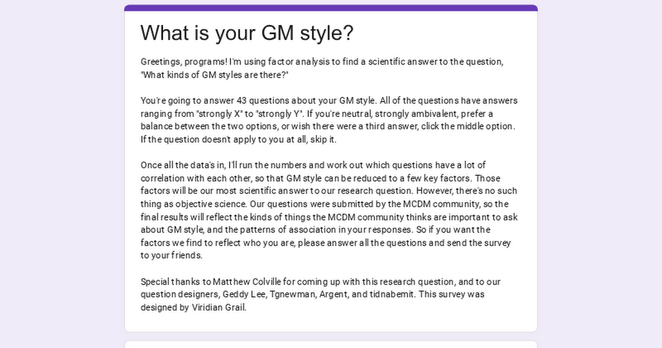
Greetings, programs! I'm using factor analysis to find a scientific answer to the question, "What kinds of GM styles are there?" You're going to answer 43 questions about your GM style. All of the questions have answers ranging from "strongly X" to "strongly Y". If you're neutral, strongly ambivalent, prefer a balance between the two options, or wish there were a third answer, click the middle option. If the question doesn't apply to you at all, skip it. Once all the data's in, I'll run the numbers and work out which questions have a lot of correlation with each other, so that GM style can be reduced to a few key factors. Those factors will be our most scientific answer to our research question. However, there's no such thing as objective science. Our questions were submitted by the MCDM community, so the final results will reflect the kinds of things the MCDM community thinks are important to ask about GM style, and the patterns of association in your responses. So if you want the factors we find to reflect who you are, please answer all the questions and send the survey to your friends. Special thanks to Matthew Colville for coming up with this research question, and to our question designers, Geddy Lee, Tgnewman, Argent, and tidnabemit. This survey was designed by Viridian Grail.

Google Docs

I just submitted my responses. Can’t wait to see the results!

I’ve been GMing now across 40 years or so, and my GM style these days is very different to when I started. These days, I’m much more a “fly by the seat of my pants” GM, with all of us building a story together. I see my role as bringing unexpected elements in to the story we’re building, so that the players themselves have a dynamic environment to build their characters against, rather than it just being collaborative storytelling.

I use dice for a similar reason. They allow for the unexpected and for unpredictable outcomes. They mean that the players themselves feel uncertainty when making choices for their characters.

Do you spend more time on encounter prep, or art prep?

That’s my secret. I never prepare

In all seriousness, there’s a couple of questions like that, asking which type of content I spend more prep time on, but I genuinely don’t spend time doing prep on anything, which makes it hard to answer those question. I voted in the middle, but it won’t distinguish my answer from someone who does prep, but spreads their time equally.

“Are you the only one in your group who GMs?”

I am in 3 groups, in 2 of them I am GM. From these 2, in one I’m the only GM; in the other there are 3 GM’s.

A bit hard to answer questions like this on a 5 point scale.

Fun initiative. A bit narrow in its scope as others said because it focuses on DnD style games and fails to encompass much of the rest. Notions like encounter and art prep make no sense if these things are not part of the game. Same with “behind the screen” if there’s no screen, but especially annoying to put sandbox and railroad with no definition on a single scale. Feels like a questionnaire asking about whether you’re catholic or protestant, ignoring the rest of the world’s perspectives.

A fair criticism, as these questions were submitted by the MCDM community, and most of us play Draw Steel, so the questions are probably biased towards games like Draw Steel.

However, if a GM mostly runs Blades in the Dark as a player-directed experience, and spends way more time collecting music and paintings to set the scene and mood, rather than preparing heist obstacles for their Crew, I’d say that GM runs an art-prep-heavy sandbox game. Such a GM might also prefer to hide enemy factions’ plans from the players and blindside them with twists, or roll on the complication table in front of the players and let them see how the mechanics are creating the story. So while I agree with your point, I don’t actually find your examples convincing. Perhaps you have experience with games even less like D&D than BitD, and I’m simply too narrow minded to understand your critiques.

Nah, you’re probably right that I was not very good at explaining myself.

I think this one link can hopefully make my point clearer: 1d6chan.miraheze.org/wiki/Everyone_Is_John

Using that game would then make less sense to ask about encounters or challenging players/characters, or railroaing, or sandboxing.

Same for example if a game has a specifically defined setting not made by gm or players, does not have encounters and is not involve the idea of challenging anyone. Technically, I can go around the world classifying people as “proactive” or “reactive” in the way they see life, but it would not necessarily mean much to many of them.

But it is fine, I’m far from being representative. Many questions work on a broader scale, but some did not. Especially if my perspective on ttrpgs does not align with the way things are often presented in groups where DnD is a synonym for ttrpgs.

Wowee, that game looks like fun! I’ll go play it with My friends now!
“Does your world have spinoff adventures and oneshots?” I GM an anthology series, each session is a self contained adventure, but there’s an overarcing plot, like Stargate or The Clone Wars.

@Grail Filled it in, but a lot of questions seem to presuppose a certain play style and would have benefited from a 'does not apply' option. 🙂 For instance:

"Do you reveal behind-the-screen information to players after the session?"

I don't like behind-the-scenes information and tend not to have much, if any (we usually play story games with lots of player input and GM improv), so there's no way to answer the question correctly. 😅

Just put in the middle option, or if you want, skip the question. None of the questions in this survey are required, unless I fucked up.
@victorgijsbers surely 'Almost never' then applies just fine?

@Grail Some of the questions were phrased in a way that made them unanswerable.

I'll go ahead and do closest-I-can-get, but there are so many baked-in assumptions that it'll render my answers worthless.

You can go ahead and skip those questions if you like.

@Grail Too late; I just used the "3" answers to mean "this doesn't apply at all to my games and it's ridiculous that anyone would assume it might." 😂

This applied to questions that amounted to "Do you live on Mars, or a moon of Mars?" questions that amounted to "Do you eat burgers, or pizza?" and those that amounted to "Would you rather eat nails or broken glass?" 😆

That’s fine, a neutral answer is good too.

Out of curiosity, which questions did you find most absurd?

@Grail

Ooh. I'd say the ones that were nails-or-glass ... two things that I'd never do, and the idea of some combination or middle ground between them equally undesirable.

No thanks to nails.
No thanks to glass.
And no thanks to nails-and-glass salad.

Which ones were those?

@Grail Too many to list, but one example is "Is your game an open world sandbox or a linear railroad?"

Nails or glass. Yum.

I didn’t know there were options outside of the spectrum of those two. What’s your game?

@Grail

Most of the GMs I know have several worlds and games. Many have dozens, and some have hundreds.

So the questions that talk as if I have just one - as you just did - were strange to me.

Anyway, bedtime for me. Best of luck with it.

Oh, I have several too. I’ve run in Doskvol, Orden, the Planescape, and two homebrew worlds I invented. I answered all of those questions with a weighted average of My worlds.

questions i had trouble with because of build in assumptions

Do you prefer to plan and track events going on in the background, or improvise them?

i utilize a lot of random tables in prep and at the table, so i guess improvising? but on the other hand i keep track of things that were the result of random stuff.

Do you prefer rules heavy or narrative heavy systems?

systems like shadowdark, black hack and its off-shoots are rules lite, but are they narrative heavy?

Who does the worldbuilding in your setting?

i plant seeds and do a bit of initial landscaping how they grow is determined during play, but those first sessions are what sets the tone.

Do you integrate players’ backstories into the plot?

My players don’t come up with intricate backstories, but earlier adventures might have consequences later and characters created after a first characters died often get some in-world knowledge, because they are not a random farmhand setting first out to be an adventurer.

How much setting information do you share with your players out of character?

i often only have broad strokes, before it comes up at the table and if it comes up it’s often a players idea that becomes “canon”. I am discovering this world almost as much as my players.

Who is responsible for immersion?

everyone at the table, i am not a story dispenser. my role might be called Game Master, but i am as much Player of the Game as the Players of their Characters are. We are doing this together, none of us is offering a service.

Do you spend more time prepping lore and clues, or events and encounters?

i don’t see how those things are opposed to another. An armed Caravan of Drows is Lore and Encounter, the idea might have started as one or the other, but at the very least after the session is over it will be both.

How much do you enjoy PC death?

Sometimes that becomes a great story, which i enjoy, sometimes it just happens, which i don’t feel much about and sometimes it happens because I did not communicate danger well enough or players interpreted a situation way different than i did, and we only realized after the fact, which feels bad. It’s nothing i have a general opinion about.

You can answer all of those questions with one of the intermediate options. If it’s entirely 50/50, neither/neither, or both?both?both., you should answer with the middle option. The spectrum has a middle.
I did with most of them, but they still made me scratch my head a bit, simply because they don’t quite fit into my mental model of “game master” or in the case of “narrative vs rules heavy” because i am not sure what kind of games are what and ultimately if those things are mutual exclusive to begin with.

@Grail
I tried working through it but I don't think you can learn much about how I gm from these questions, as they are full of deep unaware dnd assumptions.

It might be good for the needs of MCDM players, as it seems that's the field draw steel tries to fill, but my gaming style has pretty different assumptions.

Interesting questions, although I had to vote 3 on things where I was ambivalent about two things or in favor of both things. Like I don’t do a or b so I clicked 3, and for another question I frequently do both x and y so I clicked 3.

A tricky thing, is that I don’t GM the same way a zero prep horror game where death is certain, and a blockbuster RPG campaign. And that many questions depend on the specific context. Having players who need to come home by the last train means I have a hard deadline to end a session. But if that player sin’t there we can find the right moment

Anyway, thanks for your pool, and curious about the results

i prefer to run games that some would call “narrative heavy” like Blades in the Dark but i am a stickler for the rules.

A well made game will have rules that each make the game more fun, so the temptation to ignore them should be rare.