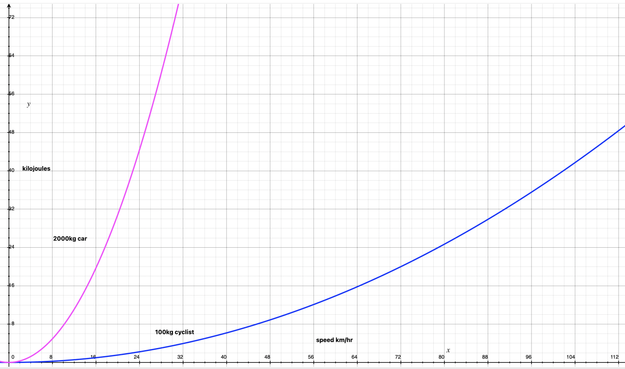
I was curious about kinetic energy of a bike vs car at different speeds. I knew it was significantly different but I wanted to understand what the differences between a slow cyclist and a fast cyclist.

thought I'd share for others. I _think_ my maths is right, but please double check.
@xssfox I think your maths is correct but not necessarily meaningful.

According to this

https://en.wikipedia.org/wiki/9%C3%9719mm_Parabellum

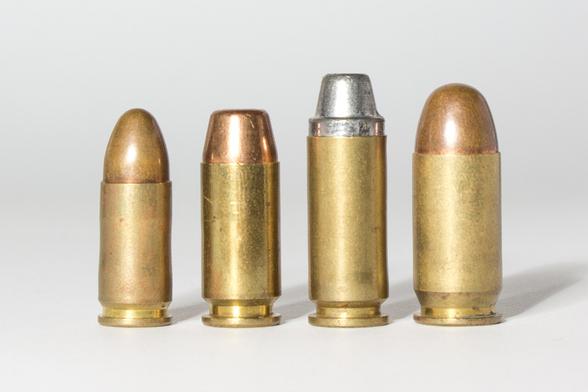
a 9mm pistol round has an energy of about half a kilojoule - bumping along the bottom of your graph - but much more likely to be lethal than either a car or a bike travelling at 20kph.

I don't think energy is a good proxy for hazard.

I'd be much more interested in other statistics - pedestrian deaths per km travelled, for example. It seems hard to find such statistics though.

9×19mm Parabellum - Wikipedia

@EI3JDB i'd disagree, since a bike can't be loaded into a 9mm pistol. while not perfect its a good proxy for the stopping distances required and the forces placed on a person in an incident.

While I don't think its in this report - there's likely enough data to infer deaths per km : https://www.victoriawalks.org.au/Assets/Files/Understanding-Pedestrian-Crashes.pdf

from memory it has breakdowns of pedestrian incidents and type of vehicle

@xssfox That is better data than most - thanks for that.

Tables 12 and 18 suggest that pedestrian deaths and hospitalisations are similar for motorcycles and pushbikes, which is an interesting result, given you'd expect motorbikes to be heavier and moving faster. But, although there are more hospitalisations from pushbikes, there are more fatalities from motorbikes.

The vast majority seem to be cars, though, which is what we'd all expect.