 hjhornbeck
 Manawyrm | Sarah
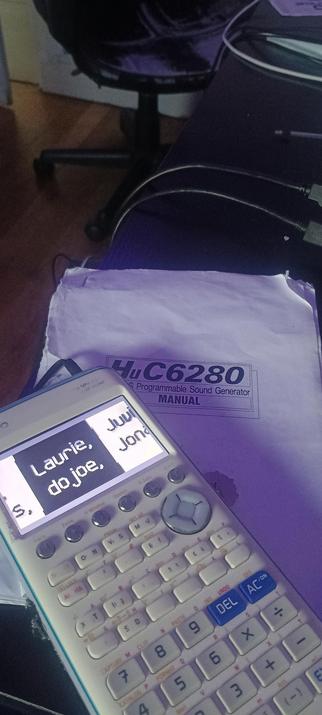
Just released my first ever demoscene demo at Revision 2026 in the Wild-Compo:
A tech demo for Casio fx-9860G graphical calculators!
Sourcecode: https://github.com/Manawyrm/Casiomania
Details: https://kittenlabs.de/casiomania/
Just released my first ever demoscene demo at Revision 2026 in the Wild-Compo:
A tech demo for Casio fx-9860G graphical calculators!
Sourcecode: https://github.com/Manawyrm/Casiomania
Details: https://kittenlabs.de/casiomania/
@lda No idea what happens without a t6k11 (I mostly only use it for the initial snow and contrast setting).
Give it a shot on a different calculator with SH-4 if you've got one :)
(no promises, though :D)
@manawyrm hm, after removing basically all calls to t6k11-related functions (and with build-fxg3a), it still failed
looks like it's caused by the audio thread using DMA channel 0 (channel 0 and 1 are reserved for gint tasks on the fx-CG50, 0 IIRC is for sending VRAM over and 1 is... something? I honestly forgot why it was used)
I think you'd also need to mess with the C0MID address used as it's hardcoded (I'd say my branch of gint defines fields for that, but the forge it's on is getting hammered by AI scrappers, sorry!)
Still doesn't seem to get past the introduction sequence, so I assume there's something wrong with the DMA code still...
@manawyrm UPDATE: turns out the hang was because I used the wrong DMARS selector (I geninuely forgot each DMARS field held 2 RIDs!)
It now works (mostly) fine on fx-CG50/G90+E (except for audio playback speed, but that could likely be fixed by using a better value for the SCIF's SCBRR/computr it on the fly)
@Ronflaix no timers (those are used for grayscale!) but DMA yes.
Every time the DMA finishes sending bits, it triggers an interrupt which will then generate a new PCM buffer and also convert that into the PWM bitstream.
No mixing at all, just single stream, but you could totally mix if you wanted too.

 Vivi
Vivi LDA [doki doki waku waku
  ]
] Schenkl | 🏳️🌈🦄
 James Mitchell
 halcy @
 feuerrot
 coldclimate
 Joe
Joe dmi 💽
dmi 💽  sb arms & legs
 ROllerozxa
 yetzt
yetzt Stu
Stu 48kRAM but with parity
 iLow
iLow Ronflaix
 Andreas Scholl (Zeronine)