 Charlon
Built a multi-agent spec generator. Claude and Codex draft specs in parallel, cross-review each other's work, then a final arbiter produces the consensus spec.
Two models, two perspectives, better result.
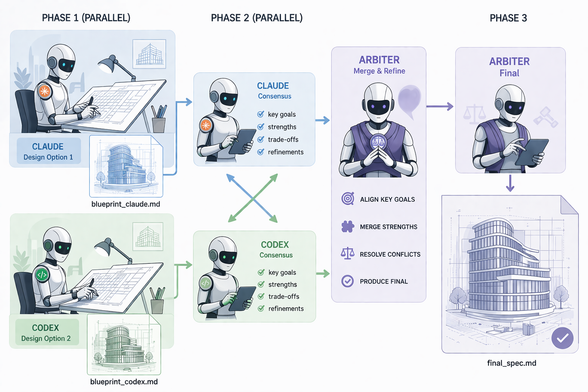
Built a multi-agent spec generator. Claude and Codex draft specs in parallel, cross-review each other's work, then a final arbiter produces the consensus spec.
Two models, two perspectives, better result.
@charlon Hi,
What is your usecase for this? I mean the examples in git do sound too simple.
I am using Codex a lot for an app. Whenever there is a new feature (e.g. complete CUDE incl DB adjustments), it worked pretty good with some very simple lines of prompt.
While like the approach you outlined, i have the feeling thats its less and less relevant because the models can handle it in nowadays in one shot. If something is missing, just 2 followup prompts
@rello For simple CRUD, you're right, one model is enough.
Where it shines: I was building a game engine with collision detection. Claude and Codex each kept introducing their own recurring bugs. Never the same ones.
By making them cross-review, each one catches the other's blind spots. The final spec avoids bugs both models individually keep making.
For "add a settings page" you don't need this. For "implement 2D physics with edge cases", it saves hours of debugging.
 Rello
Rello