 Michael Knudsen
 Tony “Abolish ICE” Arcieri🌹🦀
California is "bending the duck curve" with batteries:
Grid batteries reach stunning new peak of 44 pct of evening demand in world’s fourth biggest economy
California is "bending the duck curve" with batteries:
Grid batteries reach stunning new peak of 44 pct of evening demand in world’s fourth biggest economy
Look at it!! LOOK!
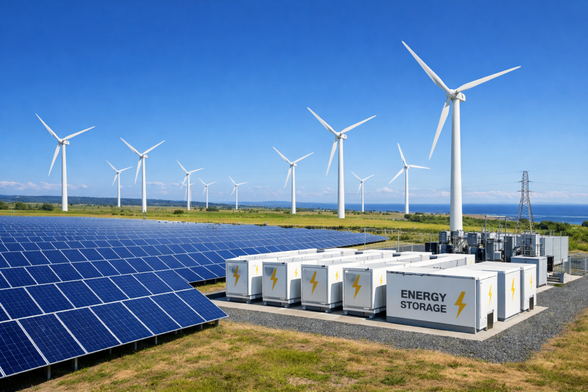
On Feb. 1, California’s batteries bridged the solar gap with seamless precision. After discharging through the night until sunrise, they spent the daylight hours charging, then pivoted back to exporting power well past midnight – effectively sustaining the state on solar energy for a full 24-hour cycle.
@bascule can we make a website everybody needs to visit before using words like "capacity" and "power"?
Or do I need to accept that capacity now is measured in watts?
@ligasser nobody is misusing words here. The word “power” doesn’t even appear in my post or the article. It’s talking about instantaneous supply and demand which are appropriately measured in watts.
Are you getting nuke bro brain?
> More than 90 per cent of California’s battery fleet has been built in the last five years, lifting total capacity to more than 17 GW from just 1.3 GW in 2020, according to Ember analyst Nicolas Fulghum.
Anyway, definitely no nuke bro here. Just a smartass with some solar panels on top of his roof and who calculates twice a year if batteries are finally worth it... So I prefer my capacity in Jules and not watts :)
@ligasser the capacity is actually the important figure here for evening generation, because it's what's required to meet evening demand.
It's the y-axis on that chart.
@bascule OK, it's nitpicking. But in order to correctly compare comparable values, I think we should get used to follow a common way of defining what is happening:
- Power, [W], as the instantaneous delivery, like litre/s for a waterhose
- Capacity, Energy, [Ws], [Wh], [Jules], as the reserve in the system, like litres of water
Both are important - one to fulfil the instantaneous need, one to hold to it as long as possible. And I hope both will increase so we can ditch non-renewables!
And for reference: The batteries peak power delivery corresponds to that of seven EPR-II nuclear reactors.
... which would take 20-30 years to build.

 Kevin Russell
 tasket
 Linus Gasser
 Poul-Henning Kamp
 talpa
talpa Fazal Majid
 Thomas Enebo ✅