I wish I could use the DOS / IBM PC style smileys in terminal games. They were, in fact, designed for "ansi art" style fixed width character games. However, there isn't the convention in fonts that it should fit into a single character with a monospace font, so you can't use this or a lot of the lovely characters that DOS games would use.

Also look at them! They have such nice, minimalist character!

And yes, they WERE intended for games: https://www.vintagecomputing.com/index.php/archives/790/the-ibm-smiley-character-turns-30
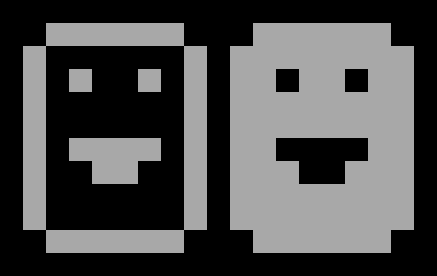
From the article above:

> If you look at the first 32 characters in the IBM PC character set you’ll see lots of whimsical characters — smiley face, musical notes, playing card suits and others. These were intended for character based games — see “Snipes” if you can still find a copy.
>
> [...]
>
> Now, what to do about the first 32 characters (x00-x1F)? ASCII defines them as control codes, carriage return, line feed, tab… These characters originated with teletype transmission. But we could display them on the character based screens. So we added a set of “not serious” characters. They were intended as display only characters, not for transmission or storage. Their most probable use would be in character based games.

@cwebber
I was recently digging around the early Smalltalk systems and they did this too.

@cwebber
Here's an example from Smalltalk-76 with the characters converted to unicode.

printon: strm | t [
strm append: [self≡nil⇒ ['nil']; ≡false⇒ ['false']; ≡true⇒ ['true']
t ← self class title.
strm append: ['AEIO' has: t∙1⇒ ['an '] 'a '].
t]]

Edit: Sorry if it wraps badly.
Edit2: Switch to quote since Smalltalks have always used proportional fonts 
Edit3: ≡ ⇒ ← ∙ are the custom chars they used in this sample.