 gloriouscow
For the first time in maybe - decades? Someone has a complete, high-resolution CGA light pen system for the original IBM PC.
(It's me. I'm the someone)
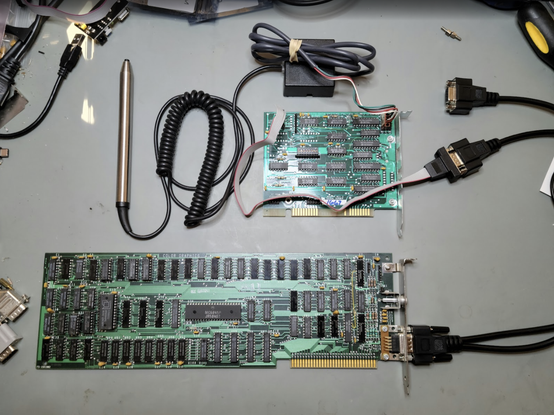
For the first time in maybe - decades? Someone has a complete, high-resolution CGA light pen system for the original IBM PC.
(It's me. I'm the someone)
The card on the bottom is a CGA of course, but the card in the middle is a PXL-350 high-resolution light pen interface.
The way it works is that it receives the horizontal and vertical sync signals from a splitter cable attached to your video card. It then runs two binary counters that reset when a sync pulse is received.
1/
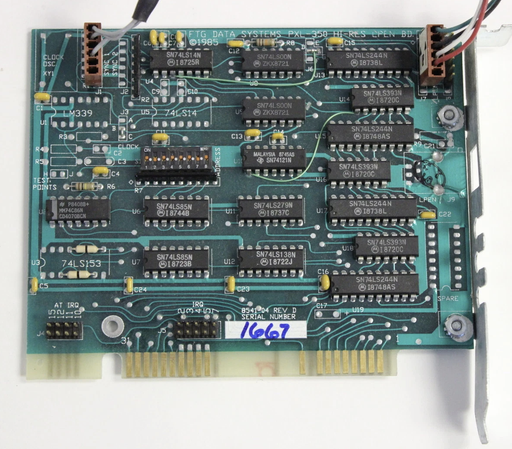
The light pen drivers can latch the counters - probably by writing to IO address, and then read out the counters. It's a fairly simple card, all discrete off the shelf parts, so I should be able to trace it out.
In high resolution graphics mode, the card offers a 16x improvement in horizontal resolution. From an absolutely dismal 40 to the expected 640.
Actually, it's even better than that. Since the tracking is now from sync to sync, the pen will track in the overscan as well, which was another annoying limitation of the CGA light pen header.
/2
This card lacks a crystal itself, it runs its timers off the OSC pin of the ISA bus, which is 14.318MHz, corresponding to the CGA dot clock.
This means this card only has 720ish pixels of horizontal resolution, so this is more or less okay for EGA as well.
The next revision of this card, the PXL-380, includes a 48MHz crystal making it compatible with just about any display of the time period.
/3
I'd argue its a bit unfair to discuss how bad the light pen was without one of these cards. They were pretty much for sale immediately, and almost every light pen vendor would sell you one, sometimes throwing the pen in for free.
Warp Speed's "Phaser" card sold for $70 on top of the $200 you were paying for the pen. It's a no brainer for 16x the resolution.
/4
Where things get a bit dicey is that the pixel resolution requires some ..extensions to the Int 10h function 4 light pen interface IBM defined.
If only someone had scanned a light pen manual. Then we might know what those extensions were...
/5
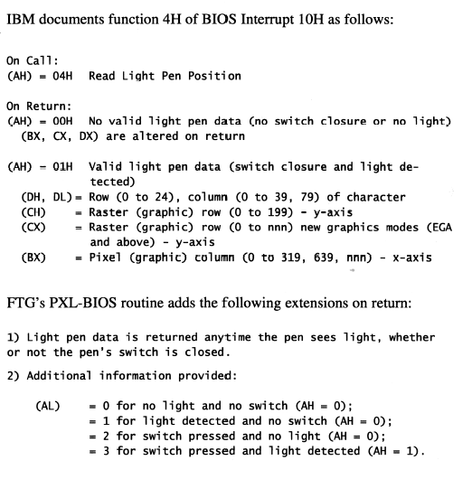
It's just hard to feel excited about this. Yeah, I can put it in my 5150 once I get it fixed, and I can enjoy all that super high resolution.
But I don't have Lenipen :(
/6
Let's fast forward a few years. It's 1995. Some company has just released this hot new operating system called Windows 95.
Cow is in their sophomore year of high school.
You might think the PC light pen well and truly dead at this point.
BUT YOU WOULD BE WRONG
This is the PXL-390. It is a new generation of light pen card, the discrete logic replaced by a single large CPLD.
FTG, realizing how annoying all their cables and adapter boxes were (and realizing that your beige 486 does not have a grommet hole) has finally decided to put proper connectors for things on the card. How luxurious!
/7
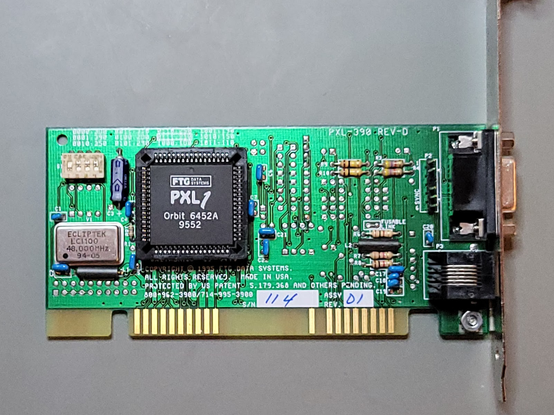
Don't think you can just plug in any ol' thing into that sync header. It may look tempting to plug your DE-9 splitter from video right in there, but you will send +5V up your video cable and that might not be so good.
/8
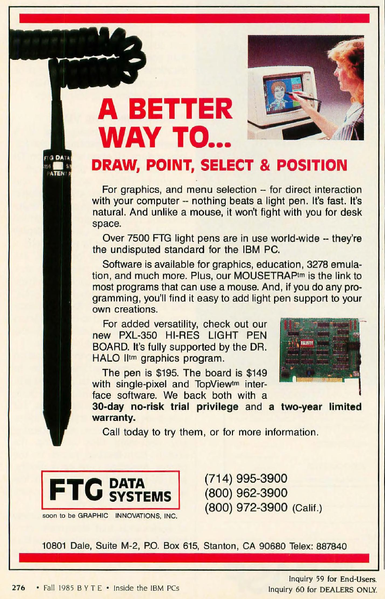
Oops, forgot to post this. Here's an original ad for the PXL-350 from 1985.
It cost $150, or about $450 today. That puts FTG's full package at about $350, vs Warp Speed's combo at $270. The warp speed pen works fine - but FTG did eventually take over the market so they'd wind up with much better driver support.
/9
Sort of a fun story is that FTG would eventually acquire one of their competitors, HEI - well, competitor might be a strong word, since HEI was selling FTG's light pen interface cards with their own pens.
HEI had nicer pens. FTG's early pens were often noted to produce a somewhat "fingernails on chalkboard" sound when moved across the glass of your CRT.
Eesh.
So the companies merged, and FTG acquired HEI's "FastPoint" trademark and started selling boards and pens under that brand name, eventually even renaming their website to FastPoint.com. But the FTG name never really went away completely.
The fastpoint.com website went dark sometime after 2006 - a date that corresponds pretty well with market adoption of the flat panel display.
What an odd coincidence, that.
/10