 Track_Shovel
The good old days
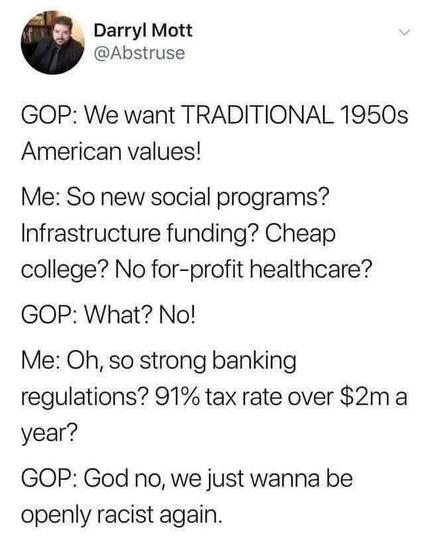
The 1950s were great (for white people) because wages were high enough to pay for a house and support a family of five, with only one parent needing to work - even for ‘untrained labor’ jobs.
This was made possible by higher taxes for the rich and strong unions. Both disappeared, and the effects are evident.
This was made possible by higher taxes for the rich and strong unions.
And a devastating world war that destroyed the infrastructure of every other industrialized country on the planet, but left the USA almost entirely untouched, leading to a massive demand for tools and materials for rebuilding that could only be met by the USA.
If the Americans want the 1950s economy for white people back, not only do they need the social programs from the 1930s that survived until the 1950s, they also need a devastating world war somewhere overseas that the US only joins halfway through once those other countries have their infrastructure completely obliterated. Starting a war in Iran won’t cut it because then it’s the US having to pay for planes and bombs and artillery, rather than selling to both sides as the US did up until it joined the allies in WWII.
Big, but not enough. If people really want the feeling of wealth from the 50s, another world war not involving the US needs to happen in addition to the labour protections, high tax rate on the wealthy, etc. That’s why it’s essentially impossible to get to there from here.
Having said that, it’s still possible to have a lot less wealth disparity.
The World War thing was massively overblown. Yes, we did the Marshall Plan, but this was a small part of the US economy. It’s mostly a myth that we had the booming middle class because everyone else had their industrial base destroyed in the war. Look at an actual plot of exports as a share of GDP:
Today exports make up three times the amount of our national economy than they did in the mid 1950s.
Yes, you can find figures that show the US absolutely dominating the global production of certain goods like cars in the 1950s. But what’s important to note was that almost all of this production was consumed domestically. The US produced a lot of stuff, but it also had a ton of wealthy consumers. And that’s the other thing. People living in bombed out ruins don’t have the money to buy brand new Fords. Yes, the other countries weren’t producing much, but they also weren’t buying much either.
We musn’t overlook the most impactful financial leverage the US acquired from the war. Centuries of colonial wealth was transferred to the US as European allies decimated by the war and paid all they has to the US for weapons. By the end of the war the US held three quarter of the world’s gold reserves, allowing it to institute the Breton Woods system, making the US dollar the world’s reserve currency. This with the America’s disproportionate manufacturing capacity left intact - more than 50% of global manufacturing from a nation with less than 10% the global population - and the Marshall Plan which contributed to persistent demand for American goods created a feedback loop which allowed America to become the world’s most factory, banker and strongest consumer simultaneously.
American lore focuses on some type of intrinsic exceptionalism but the reality is the stars aligned for them in this particular period and they, credit to them, they took full advantage of it. Don’t see it ever happening again though. The game’s different when you’re at the top, as I’m sure they’re realizing.
 Xerxos
 merc
merc