

Dear Openshift and Kubernetes users,

after my single-node OpenShift cluster broke for the third time (pods not coming up, no idea what went wrong this time), I reinstalled the machine and tried MicroShift.

I overlooked the tiny detail in the documentation that there are subscription repos for RHEL10, but only packages for RHEL9. So I had to reinstall my machine after trying RHEL10 first.

In general microshift seems to be an easy way to get a OpenShift-like "cluster" running on a single machine. I'll report back once I did some more thorough testing.

#OpenShift #MicroShift #Kubernetes #DevOps #Linux #RHEL #HellYeah #SelfHosting
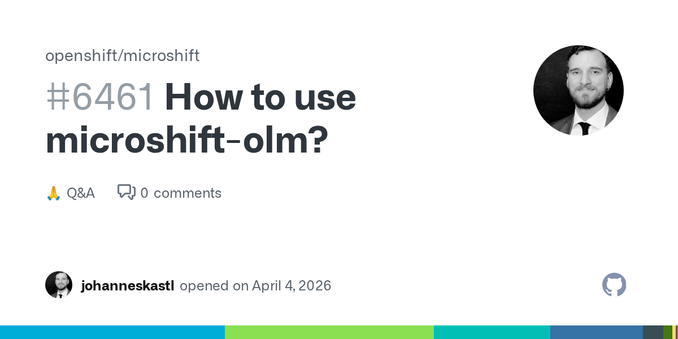
Two things I noticed:

The microshift-olm package provices the Operator Lifecycle Manager, but apparently only a very limited subset. I could not get it working at all.
https://github.com/openshift/microshift/discussions/6461

There are packages for ArgoCD, called microshift-gitops. Those install a part of ArgoCD. You get the repo-server, redis and the application-controller. But no WebUI. I have not found out yet, if I can still use the argocd CLI to connect to the cluster and e.g. sync an application, as it normally (AFAIK) relies on the web component being exposed via ingress, loadbalancer or port-forward. I'll report back if I get it working. Other than the missing WebUI, it does what ArgoCD is supposed to do: sync stuff into the cluster. Nice.

#OpenShift #MicroShift #Kubernetes #DevOps #Linux #RHEL #HellYeah #SelfHosting

How to use microshift-olm? · openshift microshift · Discussion #6461

Dear maintainers, I set up a new microshift machine using the latest relase 4.21 for RHEL9. I also installed the microshift-olm package, but could not get anything working. I was hoping I would get...

GitHub