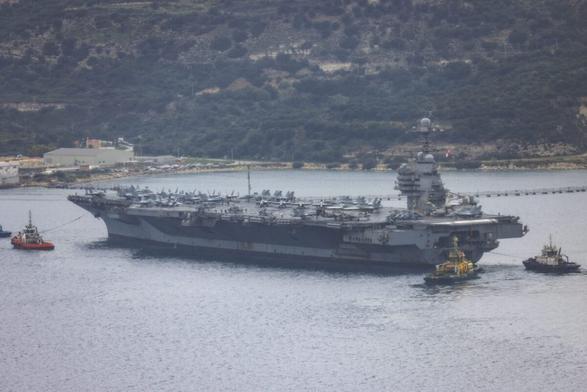
 Chuck Darwin
The neoconservatives,
who dominated the Pentagon and the White House after 9/11
believed the US could use force to remake the Middle East,
and their project left us with two enduring concepts that still shape American military power and politics today:
creative chaos and strategic deception.
These are the intellectual doctrines of neoconservatism,
an ideology that bears constant re-examination.
Legacy One: Creative chaos
The intellectual architect of creative chaos was Michael Ledeen,
a scholar at the American Enterprise Institute.
In 2002, he wrote:
“Creative destruction is our middle name,
both within our own society and abroad.
We tear down the old order every day…
They must attack us in order to survive,
just as we must destroy them to advance our historic mission”.
This worldview had already been incubating for years.
In 1998, the "Project for the New American Century", (PNAC)
-whose signatories included Donald Rumsfeld, Paul Wolfowitz, Richard Perle, and John Bolton
- sent a letter to president Clinton insisting that
‘removing Saddam Hussein and his regime from power… now needs to be the aim of American foreign policy’.
The letter was written three years before 9/11 and before any claims about Iraq’s alleged weapons of mass destruction.
After the attacks, these men moved into the highest ranks of the Bush administration,
and the invasion of Iraq
was sold to the American public and the rest of the world as a mission to eliminate WMDs and spread democracy.
In 2003, Vice President Dick Cheney famously predicted that American forces would be ‘greeted as liberators.’
Instead, Iraq descended into sectarian slaughter and gave birth to the nightmare of ISIS.
Today, a new generation of the same pundits has sold Trump the identical delusion:
that Iranians will welcome foreign intervention with roses.
In reality, the defiant crowds filling the streets of Tehran today tell a different story
—one of unanimity and fierce resistance to American/ Israeli aggression.
Legacy Two: Strategic deception
If creative chaos was the ideology, strategic deception was its tool.
In late 2001, the Pentagon created the Office of Strategic Influence (OSI).
Its purpose was to shape public opinion abroad, especially in western Europe and the Middle East.
But when the New York Times reported on the office in February 2002, the details were explosive:
OSI had proposed providing
“news items, possibly even false ones’,
to foreign media.
Critics deemed it Orwellian,
and called on Defence Secretary Donald Rumsfeld to put an end to this ‘misguided experiment in news manipulation”.
The political fallout quickly followed.
On 26th February 2002, Rumsfeld dropped the mask:
“I went down that next day and said fine,
if you want to salvage this thing, fine,
I’ll give you the corpse”,
he told reporters.
“There’s the name.
You can have the name,
but I’m gonna keep doing every single thing that needs to be done
and I have.
That was intended to be done by that office is being done by that office,
NOT by that office,
in other ways”.
The Office of Strategic Information was closed in 2002,
its name was buried,
but its functions and expertise were quietly shifted elsewhere.
And this was a dark preview of things to come over the following decade.
In 2011, the Pentagon issued a "Joint Publication 3-05",
which formally replaced “Psychological Operations” (PSYOP)
with “Military Information Support Operations” (MISO).
The rebranding was deliberate,
but the mission was the same:
“planned operations to convey selected information and indicators to foreign audiences
to influence their emotions, motives, objective reasoning,
and ultimately the behaviour of foreign governments, organisations,
groups, and individuals”.
https://www.middleeastmonitor.com/20260403-the-carrier-of-creative-chaos/