 supersquirrel
Native Americans have been playing with dice in games of chance for more than 12,000 years, according to a new paper published in the journal American Antiquity.
Native Americans have been playing with dice in games of chance for more than 12,000 years, according to a new paper published in the journal American Antiquity. And the oldest examples of Native Amer - Sopuli
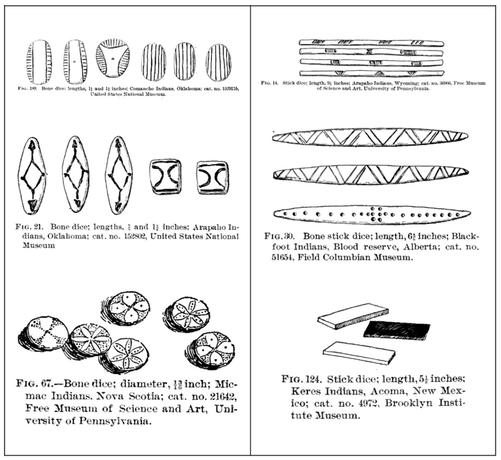
cross-posted from: https://sopuli.xyz/post/43595585 [https://sopuli.xyz/post/43595585] > Native Americans have been playing with dice in games of chance for more than 12,000 years, according to a new paper published in the journal American Antiquity. And the oldest examples of Native American dice predate the earliest currently known dice in the Old World by millennia. > > “Historians have traditionally treated dice and probability as Old World innovations,” said author Robert Madden, a graduate student at Colorado State University. “What the archaeological record shows is that ancient Native American groups were deliberately making objects designed to produce random outcomes, and using those outcomes in structured games, thousands of years earlier than previously recognized.” > > Madden’s interest in Native American gaming started with Maya ballgames and then expanded to include Native American dice and games of chance. These were rudimentary dice with just two sides, rather than the six sides of modern dice, typically described as “binary lots.” And Madden found they were common to virtually every Native American tribe. Archaeologists had traced the use of such dice back 2,000 years, but most were hesitant to conclude that dice-like artifacts older than that were, in fact, dice. > > “We always have that problem with archeology, which is you find something, and you say, well, what is this, how was it used?” Madden said in a CSU podcast. “One of the things we often rely on is something called ethnographic analogy, which is, do we have some kind of historic record of people using things like this, hopefully in the same area and hopefully with a cultural connection. If we see that, then we can make an inference that maybe the same object made in the way was used for the same purpose.” > > The most comprehensive study of Native American dice, gambling, and games of chance dates back to 1907, with the publication of ethnographer Robert Stewart Culin‘s 809-page report, “Games of the North American Indians.” Culin began by delving into the collection maintained at the Field Columbian Museum of Chicago, including the field notes and manuscripts written by curator George A. Dorsey, an anthropologist. Dorsey introduced Culin to various Native tribes, where Culin collected even more information about Native American games and gaming artifacts. Culin also consulted with other scholars and collectors to produce his final report 14 years later, which includes over 1,100 illustrations and descriptions of 239 sets of dice from 130 different tribes. > A morphological test > > Madden used Culin’s magnum opus to come up with four diagnostic criteria for confirming whether a given Native American artifact is an example of Native American dice. First, they must be two-sided objects. Second, the two sides must be readily distinguishable from each other, usually by applying color or markings to one side, although in rare cases they can be distinguished by shape, with one side being convex and the other being concave. > > Third, they must fall into one of four shape categories: flat (bone dice or stick dice), plano-convex (one flat side and one rounded side), convex-concave or “cane dice” (one rounded side and one concave side), and convex-convex (two rounded sides), usually peach pits or plum stones marked to distinguish between the two sides. And finally, the objects must be of the right size and shape to be held in the hand and cast onto a playing surface. > Flat dice types: (left) bone dice; (right) stick dice > Flat dice types: (left) bone dice; (right) stick dice. Stewart Culin, 1907 > Types of plano-convex dice: (left) round stick dice; (right) wood dice. > Concave-convex and convex-convex dice: (left) cane dice; (right) peach- and plum-stone dice > Types of plano-convex dice: (left) round stick dice; (right) wood dice. Stewart Culin, 1907 > Concave-convex and convex-convex dice: (left) cane dice; (right) peach- and plum-stone dice. Stewart Culin, 1907 > > Once Madden devised his four-pronged test, he combed through the archaeological record to apply those criteria to any artifacts labeled gaming pieces. “In most cases, these objects had already been excavated and published,” Madden said. “What was missing wasn’t the evidence, it was a clear, continent-wide standard for recognizing what we were looking at.” > > Madden was able to conclusively identify 565 Native American dice from 45 different sites and designate an additional 94 artifacts as “probable” dice. Objects with a drilled or pierced hole were excluded from his assessment because they could just as easily be beads or other decorative objects rather than dice. He also excluded objects whose two sides could only be distinguished by shape, with no clear markings, for similar reasons. The oldest artifacts, from Folsom deposits in Wyoming, Colorado, and New Mexico, date back to the end of the last Ice Age, some 12,000 years ago. > > According to Madden, dice and gaming in these societies weren’t anything like contemporary gambling, where the house always has the edge; rather, they likely served a social function. > > “These games are one-on-one; there’s no house,” said Madden. “It’s a fair game, everybody’s got an equal opportunity, equal conditions, and it was used as a form of exchange, particularly between groups of people who did not come into frequent contact with each other, so they didn’t really know each other. It’s really a form of gifting over time that creates enduring reciprocal relationships. It’s not about a commercial transaction where you and I are going to swap something and then go our separate ways.” > > The findings also shed light on early Native American concepts of probability. “When we see the origins of dice, we’re literally seeing the origins of probabilistic thinking,” said Madden. “That’s always been thought to have begun in the Old World, in the Bronze Age, about 6,000 years ago. This research shows that Native Americans were making dice, generating random outcomes and using those random streams of probability and harnessing them in games of chance 6,000 years earlier. So, if we want to understand the history of probabilistic thinking, we now need to look into the Old World at the end of the last Ice Age.” > > That said, “These findings don’t claim that Ice Age hunter-gatherers were doing formal probability theory,” Madden added. “But they were intentionally creating, observing, and relying on random outcomes in repeatable, rule-based ways that leveraged probabilistic regularities, such as the law of large numbers. That matters for how we understand the global history of probabilistic thinking.”
 Coelacanth