i'm obsessed with the musician underscores right now. her new album U is some of the best DIY production i've ever heard. (to say nothing of her songwriting, sense of melody, vocal delivery, lyrics, etc)

i'm working my way through a 10 hour stream she did breaking down tracks from her album Wallsocket. i'm only about an hour in, and i've already picked up dozens of production techniques and cool ways to use ableton. (i've spent smt like 5,000 hours in ableton, so picking up dozens of new ideas in an hour is pretty exciting for me.)

i bought her album on bandcamp so that i could get the WAVs and analyze how they're mastered. figured i'd share my findings from looking closely at the song "Music" through a bunch of meters. let's go!

instantaneous LUFS tends to hover around -7, peaking at -5, which is waaay up from the -14 everyone says spotify will nail you to. true peak is as high as +.4db.

bass is really clean under ~90hz, mostly triangle, occasionally sine for the wubs. and it's loud — peaking at -6db. and it goes quite low, down to like 28hz at times.

bass is pretty much mono under 120hz, even though the bass synth has a bunch of higher harmonics that feel spread, so overall it feels wide.

looking at the track in mid/side, it seems like the bass is mono all the way up to like 8k, then it goes wide. weird.

in the chorus, the kick, snare, crash, and vocals (especially) are the most prominent elements in the side, and pretty much everything else has most of its energy in mono.

in the verses, the vocals flip between being pure mid and split L/R (separate takes, not haas)

at 0:50 when the bass goes wide and out of phase, there's still a lil hint of bass in the mid down at 60hz for the mono mix. but we get a lot of side bass at 90hz. also, this is one of the only moments in the song where we hit negative phase correlation, otherwise it hovers at +1 for the whole song.

also at 0:50, we have a pure snare hit in side. spectrum looks like humps on a camel's back, peaks at 80hz, 1k, 8k, notch at 300hz.

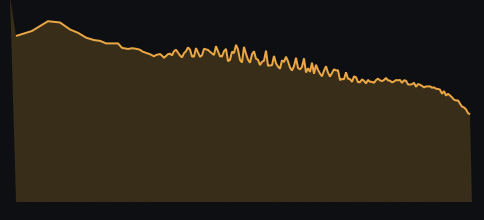
looking at overall EQ, the mid is sort of a downward slope, with a gentle roll off above 10k (see image). side is more flat, roll off below 100hz and above 10k

waveforms overall look pretty slammed, but there are _tons_ of pockets of silence, and most of the energy is in the bass — both probably help to avoid fatigue. peaks all look nicely rounded.

having the kick and snare show up in the side really helps them stand apart from the bass, i guess. i also slightly suspect the bass is a few ms late so that we get clearer transients from the kick and snare.

alright, cool, that's a lot of reference for me to work from as i dial my own mixes/masters.

[did any of this make sense to an outside observer? was it interesting? questions?]

Music: https://www.youtube.com/watch?v=UNYqwpx7Cys

Breakdowns: https://www.youtube.com/watch?v=GMql4OfFJWU
#theStudio

@spiralganglion I find this analysis a bit fascinating. Is this actionable to you? For me I'm like, this is interesting but I don't know how I would take this info to my DAW 😄 do mastering engineers think about all of this stuff? I know nothing.

(also this track is catchy, thanks for sharing!)

@xavier

Yeah, this is all highly actionable! All the stuff I mentioned is stuff I plan on taking into consideration when I mix / master my own songs. not necessarily because i want to make the same kind of music as this song, but rather because i now know so much more about what composition / recording / mixing / mastering decisions would need to be made to achieve the way this song sounds.

For LUFS (which I see via iZotope Ozone, but there are a ton of free loudness meters out there), I've previously been scared to have short term higher than -14, but now i might be more comfortable going to -10. it also helps me to know that the reason a lot of professionally mastered music sounds louder than the music i make is because it just plain is louder. it's not just that they did a better job mixing or mastering.

aside, if you use ableton this is lovely: https://www.youtube.com/watch?v=phPv2DUZBF4

also, i've historically been unsure how low to allow bass frequencies to go. i figured that there wasn't any point in letting stuff dip under 60hz, for instance, because i assumed most speakers would suck at reproducing it and it'd just introduce noise/distortion. but i guess everyone has good enough speakers and headphones these days, and perhaps all the psychoacoustic processing in airpods (eg) was designed to handle, like, modern rap/pop music with lots of subbass.

also, seeing that the overall EQ profile has the bass like 6db louder than the mids and like 9db louder than the highs is fascinating. like, i know with my ears that this is what modern music sounds like, but i figured it was achieved by some means that wouldn't show up in the spectrum — because i've always believed (wrongly) that you should mix kinda flat. i'd assumed that the feeling of powerful bass was achieved by, like, something about wave shape or clever use of phase that made bass perceptually loud. nope, seems like it's just raw energy. cool.

also, the way frequencies roll off above 10kHz. that feels intentional. i'll need to see if that's happening in my mixes (i usually roll off the highs and lows on every layer to control loudness and noise — i often make cuts with EQ instead of reducing gain when mixing, for instance).

the stereo correlation stuff is also actionable. to me, this song doesn't sound nearly as narrow as it looks on the meters. i usually try to spread most of my layers somewhere in the stereo field, and have almost nothing dead center except low bass and kicks. in this song, the bass (low AND mid) is almost entirely center, as are the vocals, and much of the synth and drum energy. but, crucially, there's snare and kick in the sides, which helps them pop out compared to the insanely loud bass. so if i wanted to, i now know how i could achieve a mix that has a stereo field like this song does — keep most things mono, but allow non-bass stuff to lightly splash over to the sides (from reverb or whatever), and intentionally use the sides to make things stand out, and then only throw stuff hard L/R (and, especially, out of phase) very briefly for effect.

(aside: it has been like 20 years since i last looked closely at a professionally mastered track through all my metering tools. i should have been doing this all along! like, back then i didn't even know about mid/side.)

also, the bass lives mostly between 90 and 30hz, and the kick lives up at 100-ish, so they mostly stay out of each other's way. that helps because i often wonder, like, where to put them. should the kick be down at like 60, and the bass up in the 70-120 range? turns out: no! not if i want something that sounds like this song, at least.

Flufs v1.1 - Accessible Metering System for Ableton Live

YouTube

@spiralganglion thanks for the explanation, I understand now. this makes a lot of sense!

I do a lot of listening to songs I want to sound like, trying to figure out the arrangement mostly. I'd never though of looking at the spectrum, panning and loudness in this way, but now I wanna try that.

most of this stuff I still do almost entirely by vibe, like sailing in the fog, hoping to land somewhere neat by accident. this feels like it could help :D

@xavier yeah, i feel like after 20 years of winging it and slowly learning how these tools work, i'm ready to do a modicum of science.
@spiralganglion well don't hesitate to share more of that science as you do it!
@xavier @spiralganglion this thread/post is great. seconded. would love to see more mix notes/listening notes on fedi/merv. thanks for sharing!