surprisetalk
Marc Andreessen is wrong about introspection
https://www.joanwestenberg.com/marc-andreessen-is-wrong-about-introspection/
Marc Andreessen is wrong about introspection
https://www.joanwestenberg.com/marc-andreessen-is-wrong-about-introspection/
Is the 1 percenters getting dumber or acting like it?
Like 10 years ago, I felt like Andreesen and Elon were thought leaders. Now they sound like idiots.
Did I or did they change?
Did I grow up and they changed to a younger audience and what I used to enjoy was just a different kind of stupid?
I doubt that. The only thing social media removed was scruples and shame.
People were ashamed to say such dumb things and now they think they have some kind of deeper knowledge.
Their thinking didn’t change.
I think they also suddenly had to deal with a bunch of people being mean to them, and telling them they were wrong, which drove them a little mad.
Sort of an oppositional defiant thing, filtered through immense wealth and power
Blocking people that annoy him on Twitter is the only humanizing thing about him. Deciding that someone has annoyed you enough on that platform that you don't care to ever hear from them ever again is the only thing that made that platform usable when you have any minimal audience.
"I've known you for all of 10 seconds and enjoyed not a single one of them" followed by blocking is good, actually. That doesn't make you any more correct or wrong, of course.
After one becomes wealthy, social media easily becomes the only place where anyone says no to them. When everyone who surrounds you tells you "you're absolutely right, let me get that for you", you atrophy the muscle that let's you course correct when you're making a mistake, and when someone disagrees with you it feels that much stronger.
Wealth is not the only way this can happen, you see it with notoriety and power who have gotten used to " being right" (Dawkins comes to mind), and now this experience is being "democratised" by LLMs.
I have a tangential theory to this.
Being rich != being famous. There are tons of extremely wealthy people out there that keep a very low profile. Sure they might be well known within their circle but ask the average person and they have no clue who that person is. I would say this is the case for like 90-95% of billionaires.
Musk, Andreessen, Zuck and others were all in this camp 10 years ago but they all decided that simply being rich wasn't enough, they wanted to be famous. These folks have all the resources and connections to become famous so they can get on all the podcasts, write op-eds, and are guaranteed to get the best reach on social media and thus the most eyeballs on their content and the most attention paid to them.
But when you go from making a few media appearances a year to constantly making media appearances in one way or another is that you need more "content" so to speak. Just like a comedian needs more content if they are going to do a 1hr special versus a 10min set at a comedy club.
The problem for all these guys is they have a few genuinely insightful ideas mixed in with a ton of cooky and out of touch ideas. Before they could safely stick to the genuinely insightful ideas but as they've made more and more appearances, they have to reach for some of those other ideas. They don't realize that their cooky ideas sound very different than their few insightful ideas. They think all their ideas are insightful based on the feedback they have been getting for the past decade or so.
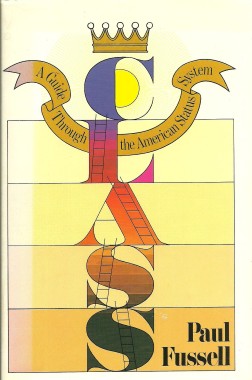
I need to reread it but Paul Fussell makes the case that old wealth is inconspicuous and secure (and maybe inherited) versus nouveau riche which is about visible luxury, branding, and showy consumption. I don't remember if he mentions the need to promote ideas.
https://en.wikipedia.org/wiki/Class:_A_Guide_Through_the_Ame...
I think Musk definitely financed many of his ventures on his personal brand. The amount of capital he could raise because of his public persona as some kind of Tony Stark, made all the difference.
Same for Andreessen, a VC's success is built on his ability to raise capital and pick winners. His whole strategy, like Musk, was also on building a public persona to raise capital and get people to believe in his picks.
> Did I or did they change?
I’d say both.
They ran out of novel things to say which is expected of anyone because there’s only so many non trivial things one could say. But then unlike normal people they didn’t stop talking because being rich they are bored and they want to be in the limelight all the time. So they end up talking nonsense.
You also changed, you are now wiser and have developed BS detector.
> They ran out of novel things to say which is expected of anyone because there’s only so many non trivial things one could say. But then unlike normal people they didn’t stop talking because being rich they are bored and they want to be in the limelight all the time. So they end up talking nonsense.
Why do they always feel like they need to pull stuff out of their butts to make themselves sound like they know what is going on? In some ways I think it's related to the stock market "just meet the next quarterly goal" kind of thinking. Who cares if you don't come up with something pithy to say for a few years. Have big impacts over time instead of tons of little ups and downs all the time.
> Why do they always feel like they need to pull stuff out of their butts to make themselves sound like they know what is going on?
Massive, unconstrained egos? They think they're hot shit, because they surround themselves with yes men.
I'm reminded of this:
> Beneath the grand narrative Musk tells, when he takes things over, what does he actually have the people under him do? What is the theory of action?
> He has people around him who are just enablers. All these Silicon Valley people do. All his minions. And they are minions — they’re all lesser than he is in some fashion, and they all look up to him. They’re typically younger. They laugh at his jokes. Sometimes when he apologizes for a joke, which is not very often, he’ll say that the people around him thought it was funny.
> When he was being interviewed at Code Conference once, he had a couple of them there. He told a really bad joke, and they all went like: Ha-ha-ha-ha. And I was like: That’s not funny — I’m sorry, did I miss the joke? And they looked at me like I had three heads. (https://www.nytimes.com/2025/02/07/opinion/ezra-klein-podcas...)
My theories:
a) most people achieve social capital through relationships. Rich people gain it by distinguishing themselves among their already distinguished peers. Even if being obnoxious is what’s making you famous, you’re still more famous than anyone you know.
b) The cadre of rich people you’ve actually heard of self-select for craving attention and validation. Like most people, they aren’t good enough at anything to be famous organically, and like many of those people, are also insecure about their profound lack of specialness. But, few people have the money to buy the attention they crave.
Fair enough. But the software eats the world essay did change the world. Maybe he was lucky, but I still think he managed to position himself in order to be heard with that essay.
Maybe I am naive.
How do you think it changed the world? I don’t think that was an especially prescient thing to say/write at that time. The idea that software was poised to continue to grow in 2011 was pretty obvious to most people. It is true that some companies were undervalued and many VCs and other folks were scarred from the dotcom bust.
But if you go back and read it, you might notice that a lot of the companies and software he discussed and predictions along with them failed to be true or lasting.
I think mostly it was a good catchphrase.
There is a shift in society on what can be said and what they keep private. Back then you would pull stings in background, now you can bribe thenUS president in public.
Also: Back in the days™ statements where edited by marketing people and others before publication. Now people blast out stuff on their own via "social media"
I think people get dumber as they age. I feel like I'm probably dumber than me 10 years ago. No one wants to admit it, but I sense it in myself and I think I can see it in other people. I feel like peak brain is probably like 22 years old if we are being honest. Yeah you might still be doing dumb kid stuff but you are at the age where you just have this energizer bunny inside. You can just go to the library and churn multiple all day and night sessions. Sleep in one day and perfectly recovered. I "know" more now but I'm definitely slower than when I was younger.
Would be great if we didn't spend so much time faffing in school on stupid stuff and got into our strides in our career maybe 5-10 years earlier. When I think about my first research job, that could have probably been done in middle school vs undergrad. Wasn't really any more challenging than when I worked part time in a restaurant in terms of the tasks. I probably could have been working on some thesis under an advisor for my hs years instead of being stretched thin over the boilerplate curriculum. And then I probably could enter the workforce at 18 and have enough to get up to speed on the job pretty fast. By 22 I'd be in management right at the peak of my mental faculties and skill buildup.