 The Picard Maneuver
The speed of light
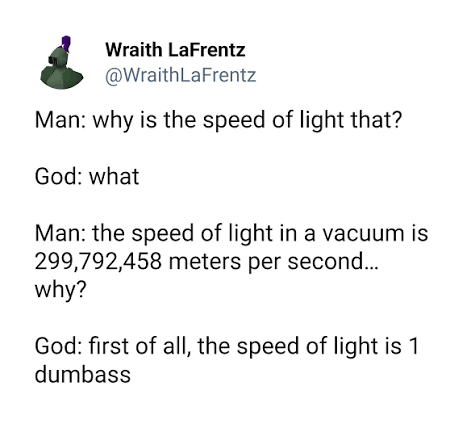
c is a measurable constant, not come unit that is arbitrarily defined. Like Boltzmann’s Constant, or the ground state hyperfine transition frequency of the Cesium-133 atom… it just… Is.
Therefore, it is a useful tool to define units. You claim it is a tautology because we write it in units of meters per second, while the meter is defined based on c. This is easily disproven, as you can represent the speed of light in any unit of velocity. It is a fundamental constant, derivable through experiment without any unit a priori.
It’s not about the units i used. It’s about using something to define itself. The same problem happens when you use c to define empty space since empty space can define c.
Once you decide which units are used in maxwells equations then the electromagnetic permeabikity and permissivity pops out as a proportions of c.
Read more Feynman if you don’t believe me.
Literally the entire point of the comment that you’re responding to is that it isn’t true for the metre, and it isn’t true for any SI units.
Your entire claim of tautology rests on the assertion that the speed of light is defined by something external to light itself. That’s false. It remains false irrespective of which SI measurements you swap in.
Just because the speed of light can be expressed in terms of SI units, doesn’t mean its definition depends on them. Which is the point that wolframhydroxide was making.
This directly disproves your original assertion of tautology.
Every metric of speed of light is necessarily relative to other things. Even if you define as 1, now you must be able to know what one unit of time is relative to one unit of distance, and if you do not know that then you do not know that your speed of 1 means.
All fundamental units are defined relative to each other in physics, and all other units are defined relative to the fundamental units.
It’s not useful to tell somebody it is constant without a way to make use of it. Without knowing how it’s defined relative to other things we can’t use it.
The thing about all the absolute physical constants is that they are almost all based on units defined relative to other things. Unitless constants (defined only as a ratio) are extremely rare (like the fine structure constant) - but even then you have to make up units to measure them (although you can still agree on unitless values with somebody else who chose different base units for measurements).
I was unaware that the person to whom I was replying, who claimed to be intimately familiar with the complete works of Feynman, needed instruction in how to “make use of” a fundamental constant of nature. If that is something you think is necessary, perhaps you should see to their instruction in such matters, as you are so confident in your faculties of condescending instruction.
Furthermore, I am acutely aware of the existence and nature of dimensionless constants, thank you very much.
The two constants - the speed at which light moves, and the unperturbed ground-state hyperfine transition frequency of cesium - can be combined to define every measurement of time, length, and velocity. They are the constants by which everything else is defined.
Throw in mass, which is easy - a certain number of atoms of a specific element will also have a universally constant mass. Combine it with the other two constants and you have force, energy, and work, and voila, you can describe nearly everything in classic physics.
…The Planck constant is a set distance. It’s being used here to define other things as a constant. The very article on the kilogram states outright that SI units’ foundation is three constants: “a specific transition frequency of the caesium-133 atom, the speed of light, and the Planck constant.”
Vacuum permeability is how much electric currents affect magnetic fields in a vacuum. As in, when there are no other interferences. It is not variable. The speed of light when there is no interference is not ‘affected by’ vacuum permability any more than a cartesian graph is ‘affected by’ the set of real numbers. Vacuum permeability describes vacuum, it doesn’t define it. Same goes for permittivity.
You ARE correct about the kilogram no longer being a number of specific atoms, though.
 teft
teft wolframhydroxide