Typography nerds, I need your opinion! (And help πŸ™)
Channeling your inner Robert Bringhurst – how would you write a percentage in English correctly?
100 % – with a space, because % is a unit
6.4%
100% – who needs a weird space here?
68.2%
100 % – with a thin space, don't half-ass it!
19.7%
Honestly, who cares, really…
5.8%
Poll ended at .

@matthiasott

It’s a symbol and not a unit. So it’s β€œ50% of 1 meter is 50 cm”.

Source: https://styleguide.iec.ch/?docs=iec%2Ftypographic%2Funits-and-symbols

@DevWouter β€œThe internationally recognized symbol % (per cent) may be used with the SI. When it is used,
a space separates the number and the symbol %.”
Source: https://www.bipm.org/en/publications/si-brochure
πŸ€“
I think using it without the space is more common in English, though, you are right. This is an interesting source, by the Chicago Manual of Style: https://www.chicagomanualofstyle.org/qanda/data/faq/topics/Abbreviations/faq0097.html
SI Brochure - BIPM

SI Brochure

BIPM

@matthiasott

Going a bit further the 9th version of the SI also to put a space between it.

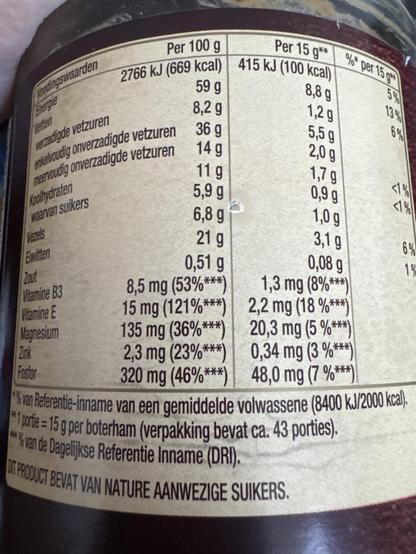
Looking at the back of nutrition values of (Dutch) peanut butter I noticed that in the second column it mixes both styles.

And most formatting strings don’t add space between percentages.

Fluff! This is annoying. 😁😣

@DevWouter πŸ€ͺπŸ˜‚
@matthiasott @DevWouter
I don't know who wrote those style guides, but we def write both units and percentages without spaces. I think it might be a knock-on effect from a weird thing that has been happenning in recent years where people start putting spaces between everything in Maths - 2 + 2 = 4, instead of 2+2=4 - and I have no idea how that became a thing to begin with. I have to tell my students to stop doing it because online answers have no spaces and will mark as wrong if there's spaces

@SmartmanApps @matthiasott

That might have a different cause? Such as "E = mc2" describes 3 values where the right side describes a multiplication?

Did a bit more digging, but couldn't find the reason, but I assume the space rule was used to take poor penmanship/printing into account so that one could avoid that "50% of 9g and 1l" be confused with 500/0 of 99 and ll". This also explains the few exceptions (such as degrees and angles)

@DevWouter @matthiasott
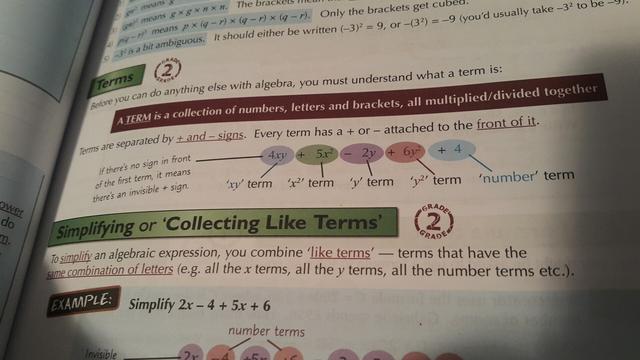
"describes 3 values where the right side describes a multiplication?" - no, the right side is a single Term/Product, whereas mxcΒ² would be multiplication of 2 Terms https://dotnet.social/@SmartmanApps/110846452267056791

"the few exceptions (such as degrees and angles)" - there are no exceptions in Maths - no spaces between scalar and units

πŸ’‘πš‚π—†π–Ίπ—‹π—π—†π–Ίπ—‡ π™°π—‰π—‰π—ŒπŸ“± (@[email protected])

Attached: 1 image #MathsMonday week 2, Terms. Simply put, in #Mathematics Terms are separated by operators and joined by brackets. The most common example is 2a=(2*a). This makes it simpler to write fractions. e.g. 1/2a rather than 1/(2*a). That also means 1/2a isn't mistaken as half a, which would actually be written as a/2. Notice in the latter that the a is to the left of the division, which means it's in the numerator, and vice-versa for the former (more about this aspect of #Maths #Math later, but first)...

dotnet.social

@SmartmanApps

Yes on the first part: multiplication should have been product. (Quick question: Would it be correct to say that the product, although a single term, by it self contains two terms?)

As for the second part, I was talking about the official standards such as SI, NIST, etc.

@DevWouter have you seen a reference for where mcΒ² is explicitly declared to not be a multiplication? Clearly it's equal to mΓ—cΒ² for any value of m (c being constant only has one value), so I think it can happily be called multiplication. A typical explanation might be "multiplication of a and b can be written as ab, aβ€’b, or aΓ—b. They all mean the same thing".

@FishFace

It’s more that my terminology was wrong. The product here is the result of a multiplication. The product describes the term, the multiplication the operation.

Keep in mind that the discussion was about definitions of math and how it should be typed.

@DevWouter yes you can make such a distinction but it can lead to issues if you assume that others always make it very carefully. I would say that the word product *emphasises* the result while multiplication *emphasises* the operation. At least, with this in mind, you won't be led astray when others do just that!

These style guides are, at the end of the day, a bit esoteric and arbitrary. But stuff looks nicer if everything is coherent, unlike in the picture!

@FishFace

I think we all are in agreement that being a bit pedantic is a requirement in this discussion. 😁