🧡 3 papers by me & my team @ulliecker.bsky.social @fabiocarrella.bsky.social @emilyspearing.bsky.social @almogsi.bsky.social ask an urgent question: if you tell people they're being manipulated by AI β€” deepfakes, AI-written articles, microtargeted ads β€” is the manipulation defanged?
Thread πŸ‘‡

1/10

AI-driven manipulation comes in three forms, each tested in our research:
β€’ Deepfake videos
β€’ AI-generated misinformation articles
β€’ Personality-targeted political ads
We ran multiple preregistered experiments to see if warnings protect people.
Spoiler: They largely don't.

2/10

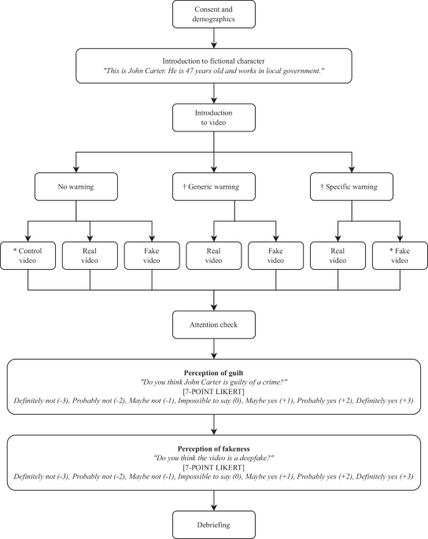
Paper 1 (Clark & Lewandowsky, Communications Psychology, 2026): participants watched a deepfake video of a person appearing to confess a crime or moral transgression. Some participants were warned beforehand that it was fake.

https://www.nature.com/articles/s44271-025-00381-9

3/10

The continued influence of AI-generated deepfake videos despite transparency warnings - Communications Psychology

Three experiments show that people continue to rely on the content of deepfake videos when making moral judgements, despite prior warnings that the videos were fake, underscoring the limitations of AI transparency.

Nature

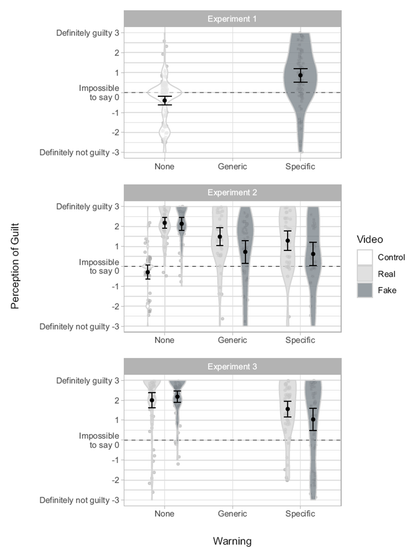
Even with a specific warning β€” "this video has been flagged as a deepfake" β€” participants still judged the person significantly more guilty than controls.

Critically: even people who said they believed the warning were still influenced by the content.

4/10

A generic warning ("deepfakes exist") had no effect on whether people thought the video was fake β€” but still shifted guilt judgments compared to a content-free control.

"Seeing is believing" persists even when you know what you're seeing is fabricated.

5/10

Paper 2 (Spearing, Gile, Fogwill, Prike, Swire-Thompson, Lewandowsky & Ecker, Royal Society Open Science, 2025): can warnings reduce reliance on an AI-written misinformation article?

https://royalsocietypublishing.org/doi/10.1098/rsos.242148

6/10

Countering AI-generated misinformation with pre-emptive source discreditation and debunking

Abstract. Despite widespread concerns over AI-generated misinformation, its impact on people’s reasoning and the effectiveness of countermeasures remain un

The Royal Society

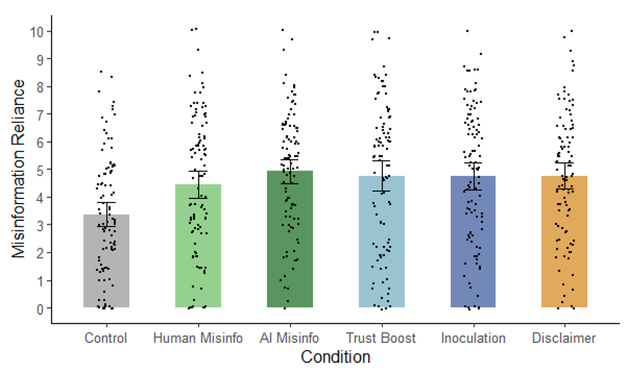
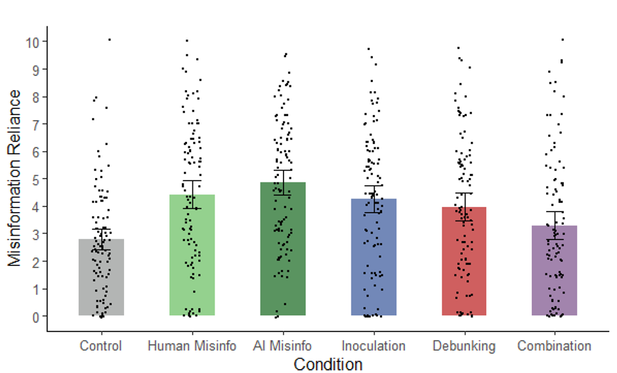
First surprise: labelling an article as written by ChatGPT vs. a human made no difference. People were equally misled.

The standard ChatGPT disclaimer ("I can make mistakes") also had zero effect on how much people relied on the misinformation. Zero.

7/10

A source inoculation ("AI can fabricate info") did reduce general trust in AI β€” but still didn't stop people relying on the specific misleading article.

Only inoculation + debunking combined eliminated the misinformation effect entirely. One tool is not enough.

8/10

Paper 3 (Carrella, Simchon, Edwards & Lewandowsky, Communications Psychology, 2025): can popup warnings β€” "this ad is tailored to your personality" β€” neutralise microtargeted political ads?

Three studies, N > 1,700.

https://www.nature.com/articles/s44271-025-00188-8

9/10

Warning people that they are being microtargeted fails to eliminate persuasive advantage - Communications Psychology

Warnings about personality-based microtargeting in political ads fail to reduce their persuasiveness, as shown in three studies. Targeted ads remain significantly more persuasive than non-targeted ones, raising concerns for transparency-focused policies.

Nature

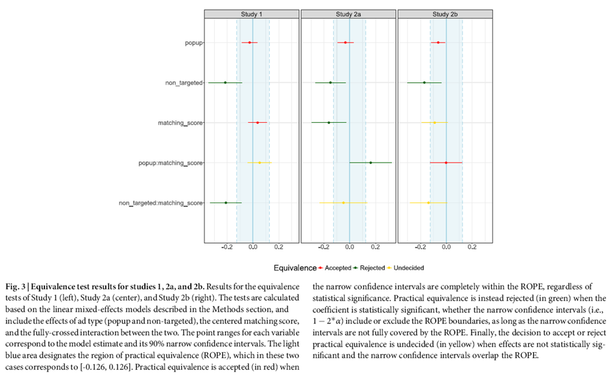
Personality-targeted ads were significantly more persuasive than non-targeted ads in all three studies.

The popup warning had no practically meaningful effect. Equivalence tests confirmed the popup's impact was statistically indistinguishable from zero.

10/10