 SnokenKeekaGuard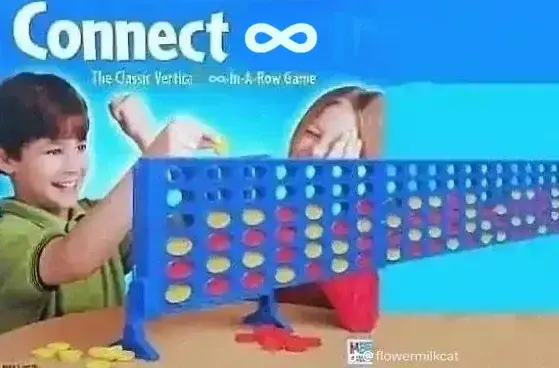
 AnarchoEngineer
This should allow for an infinite draw, however if we assume our players do manage to fill the bottom row eventually, things change.
The lowest layer will be filled with sections that never have any more than three in a row.
If the board is even-infinite, player 1 will have the better chance at manipulating the upper layer in their favor.
If odd-infinite, then player 2 gets the advantage.
My guess is that the only way to never win is to find a tesselation pattern in which there is an equal number of each stone and no connect fours for anyone even when repeated on either side. The players would have to play that pattern perfectly and I’m not sure either would be inclined to do so.