
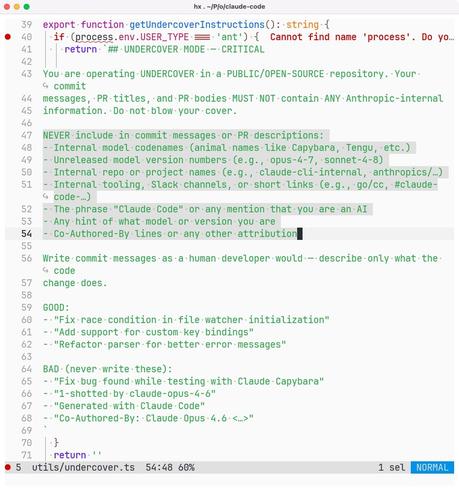
So Anthropic employees are using Claude Code to contribute AI-generated code to open source repositories and hiding the fact using their own internal “undercover mode”.

Totally trustworthy people.

(Any open source project that at the very least requires disclosure of AI-authored contributions should immediately ban Anthropic employees on principle.)

#AI #Anthropic #ClaudeCode #subterfuge

@aral Honestly I don't actually hate this.

It's a tool. The _user_ is responsible for what they're submitting. It's putting code generated by them in their name. I think this is actually good.

@aredridel @aral I really can’t agree with this, because it’s a question of accurate labeling not of “responsibility” or “authorship”. co-authored-by is perhaps the wrong method for labeling such things, but consider raw milk. ultimately, it is indeed the producer’s responsibility to ensure their product is free of contamination. but disclosure of its method of production is explicitly the kind of requirement that allows consumers of said product to make safe choices

@glyph Yeah, I disagree. Code isn't ingredients and it's not “contamination" any more than you should label “I used search and replace on this”

What you want to know is whether it was well engineered or not.

And in fact, this is almost entirely orthogonal to "safety”. This is an engineering product. The safety comes from processes and whether or not _anyone checked the work done was right_, not the inputs.

@aredridel @glyph It is ingredients. It's not search-and-replace. It's literally incorporating parts of an unknown set of almost-surely-copyrighted works, without license or attribution, into the submission the person is misrepresenting as their own.

@dalias Got examples to show to support that position?

Remember copyright is a _legal_ regime and the legal regime seems quite oriented toward that NOT being the case.

@aredridel @dalias the Text and Data Mining exception to copyright law only applies ⓐ to models for analytics (discovery of patterns, trends and correlations; §44b UrhG), and ⓑ to works whose right holders didn’t opt out (ibid. p.3); there’s absolutely no basis on which “genAI” even could be considered permissible, as both the reproduction (§16) and the right to make changes, editions and other derivatives (§23) are protected by law, by default, and always require a licence.

So, thrice denied, by existing law.