 Anna Vasina
From The Old Bucharest
George D. Florescu
1935
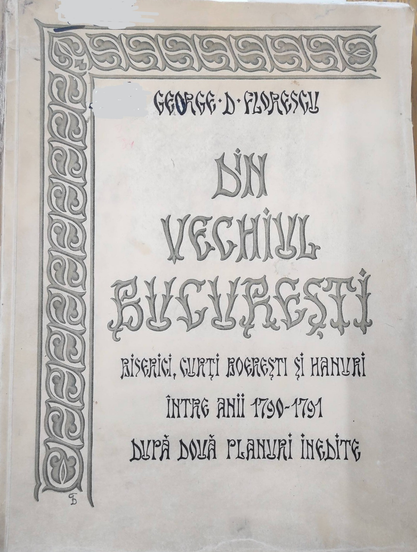
From The Old Bucharest
George D. Florescu
1935
@a_vsn Yes, I know a little about this style in Cyrillic thanks to Varya Goncharova (https://anrt-nancy.fr/en/projets/ti-gh-tle) and this article by @dobody https://www.delyo.be/blog/rants/2026-01-31-cyrillique-histoire/
But I didn't know it inspired latin letterings! This is very exciting. Are there other examples of this?
@eugbidaut Varya did a great job on researching the Vyaz' style, though I didn't see her full disertation, I can only assume that she relied on the Bulgarian and Eastern Slav sources, as they are more accessible in terms of language.
The Romanian case is somewhat unique, because their language is not part of the Slavic family, it is considered to have Latin roots, that's why at some point in history, they decided to detach from the Byzantine roots, thus rejecting the South-Slavic typographic tradition and switching towards the Western Latin Script in the 1860's (after multiple attempts of a Transitional Alphabet — Cyrillic + Latin). But then again, during the interwar period they decided to make some use of the old style flair in the Latin type. (long story short)
 Eugénie Bidaut