What are some kinds of lists you make? I've covered myriad bases here, but there are definitely more:

Identification/membership/category lists - big one, includes everything from bird types, language families, car models, philosophers, …)

invitation lists - events, projects

rubrics - lists of criteria to determine who can be nominated to win a prize, or the qualities needed for a machine part

todo lists

music playlists

supply & shopping lists (for a given goal, general stock-up, or fun!)

@slowenough I basically never make any lists in your first category (identification/membership/category) - just something that I never do (closest might be literal memberships for an event - but that’s more a invite list) as well I basically never do any lists of “rubrics” - another type of list that just never comes up for me.

I have endless todo lists and the other big category that you don’t include at all is inventory or completed lists - as well as lists for stuff I want to engage with

@slowenough to clarify the later these aren’t “todo” lists.

They are stuff like:

All the books I have read this year

All the books coming out later this year that I might want to buy / books I want to read (sorted by medium and if I already own them vs a list of ones I might want to buy)

I keep lots of similar lists for films and tv shows and audio content I might want to seek out in the future. Again I don’t think of or treat these as my todo lists which I manage very differently

@Rycaut Thanks!

Just finished editing further and making it a blog post, with at least one more category? Will come back and go through your posts here and reply & edit further... https://eqpa.wordpress.com/2026/03/31/lists/

Lists

I’ve been collecting and making lists much more consciously for the last few years. There are many particulars to what kinds of lists I work on most intensively — reading and/or writing. I in…

Equanimous Passion

@slowenough nice post.

One thing that truly gives me joy is seeing how differently people can use and think about even really seemingly simple concepts and tools (like lists)

For me seeing the variety stretches my own imagination and serves as a reminder that anyone building any types of tools (even the most physical ones like notepads/paper) should never assume they have thought of all the ways people might use and want to use that tech

A lot of tech however assumes there is a right way

@Rycaut There's an endless, ideally healthy tension between monolithic apps on one end and build-your-own construction kits on the other.

Developers have excellent building blocks, and tools, to customize their work spaces to their exact needs even without new code.

LLMs could vastly increase the number of people who understand programming well enough that they can develop & maintain custom tools mostly themselves. Unix' Small Things Loosely Joined, but via chat & GUI rather than command line.

@Rycaut Most people who mess with enough project/calendar/to do software eventually realize that the vast majority of the challenge is in being clear what our priorities really are, being honest with ourselves about our patterns and flows around taking on & accomplishing tasks, etc.

The clearer we are about our priorities, the easier we can make *any* system work for us. And the more we understand ourselves, the better we can craft a system that can tap our strengths to mitigate our weaknesses.

@slowenough I'm not a fan of LLMs in any shape (and I say this as someone whose first startup 26+ years ago would be considered an "AI" startup today)

And not unrelated to my dislike of LLMs there is a huge body of human-computer interface research that suggests that the vast majority of people (on the order of 90+%) do not customize software IN ANY WAY beyond the defaults of how they get it (beyond any customizations that are forced upon all users of that app) and this holds on ALL platforms

@slowenough but one of the constant tensions I have seen (as a manager of developers and as an advisor to countless startups and big companies) is that most software developers and "power" users are in the small minority who DO customize software and their tools - and assume that everyone else does even in the face of a LOT of serious research showing that most people do not.

Decades ago, early in my career, I made the choice not to customize my own systems when I was supporting others

@slowenough before that (this was more than 30+ years ago) I had tons of customized shell scripts and tools in my preferred UNIX systems - but when I needed to support a bunch of people across many different machines I learned that there was value in learning to use those systems with the default tools and paths etc - otherwise I became reliant on my customized tools (and this could backfire painfully when troubleshooting a new system)

it also means that picking good defaults matters a lot

@Rycaut Defaults are so impactful, I fear a tech future where more & more if them are set to serve extractive profits. And more generally, a world there aren't enough people who know how to set them.

Or even just enough people who know how to change them!

It's bad enough now and LLMs — or even just the hype around them — make this an inflection point that could could make it worse, or better, as they go from cannibalizing search and junior developers, to whatever they focus on next.

@Rycaut I mean, I appreciate language translation, and really don't care if the back end is an LLM or some other machine/artificial intelligence tool. 🤷

LLMs have been so overhyped and overinvested in. :-P Ever since the image models and then OpenAI strarted to take off, I've had deep critiques that have gradually gotten clearer.

The $ bubble is many tragedies, just waiting to happen.

Wish there was more attention, and investment, in public interest efforts. https://publicai.network/

Public AI Network

A coalition building AI as public infrastructure.

Public AI Network
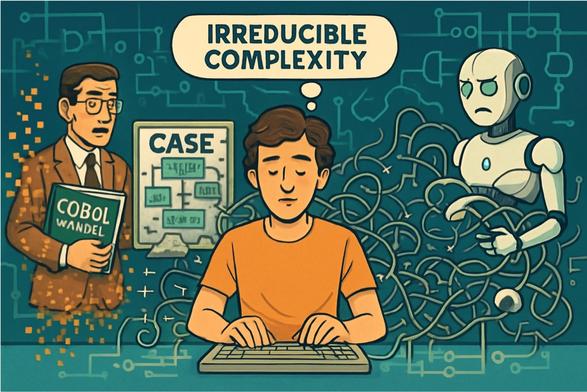
@Rycaut This is the article that got me over the hump to start being able to see where one upside might be. As soon as I read it I realized I had already seen it happening, a non-coder friend got entranced with vibe coding early on, I could see he'd been bitten by the creativity & power bug. :-) His interest faded as the real complexities emerged, but I can easily imagine him getting back into it late, knowing that he has things to learn about programming. https://www.caimito.net/en/blog/2025/12/07/the-recurring-dream-of-replacing-developers.html
Why We've Tried to Replace Developers Every Decade

Every decade brings new promises: this time, we'll finally make software development simple enough that we won't need so many developers.

Caimito Agile Life