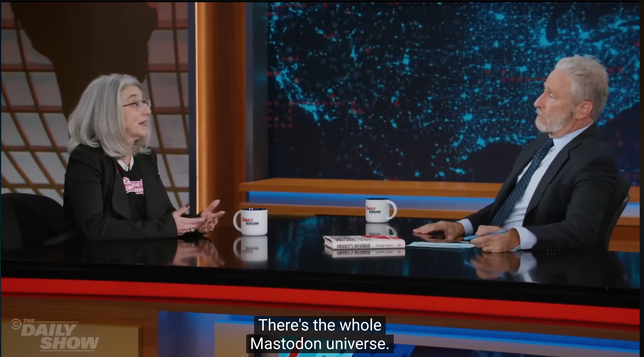
Nice to see a Mastodon shout-out on The Daily Show last night, thanks to @eff Executive Director Cindy Cohn!

It's a longer segment, with some interesting nuance around social media and censorship later in the conversation.

(disclosure: I am an EFF Member / sustaining donor)

YouTube link (I don't think there's a Peertube version) https://www.youtube.com/watch?v=QkC1aK7jfLo

@andypiper @eff Great interview. I agree with Jon Stewart, there is no free speech on corporate social media platforms.

Using Facebook or X is like watching a film produced in North Korea. You just get whatever Zuckerberg or Musk wants you to see. They kick you out for any reason they choose, they throttle popular opinions and push extremist ones instead.

And for that reason, I don't buy the argument that regulating these businesses is censorship. Those platforms *are* censorship..

@andypiper @eff ..the EFF seems to have an American libertarian standpoint here, which seems kind of outdated. It doesn't work.

I can't sue an anonymous user in some random country because they posted something harmful on X. I can't sue Russian trolls. I can't realistically sue meta or x.

Moving to another platform like Mastodon is ok, but that's shifting the burden to users.

@andypiper @eff I'd like to see the EU ban foreign corporate social media platforms, period. We did it for television and print — there are laws against majority foreign ownership of media in some EU countries. We need to do the same to meta and x and TikTok.
@txtx @andypiper @eff I think you're wildly missing why the EFF has such a standpoint on these things, especially pertaining to speech.

First of all, lawsuits like that are extremely hard to enforce. They wouldn't do any good. We've already seen how that looks with the UK trying to put such fines on 4Chan and its owners. So unless you expect fucking extraditions for people posting bad words online, which is ridiculous, I don't know what your point in bringing up this inability is.

Secondly, regulating corporate social media almost always also means that the hobbyists and small site owners are hit in the crossfire as well. This would be incredibly difficult to navigate without censoring the internet as a whole even moreso than it is now, again demonstrated by the OSA alongside OS-level age verification laws. At least it shifts the burden away from the user though, right?

And lastly, as far as banning foreign ownership of social media companies, how would this be defined in your hypothetical here? Would my fediverse instance, being entirely U.S. based, get banned in the EU? If not, how are we defining "corporate" social media and what other types would be legally defined? How do we put things into this policy that prevent the misuse of it against small instance owners in the future? I don't see a realistic way to do this without making some serious compromises on the freedom to communicate with others on the internet. Also imagine if the US implemented a similar rule, or other countries for that matter. Everyone would be in their own walled-off silo, which is not what the internet was intended to be nor what it should become.

@thesofafox

Ummm...solving problems via lawsuits was the recommendation from the EFF. She's wearing an actual "sue the government" t-shirt in that interview.

I specifically said I *cannot* be expected to sue either these companies nor random internet people, so we need other solutions.

Redirect your rage please.

@andypiper @eff

@txtx @andypiper @eff not necessarily raging, seems like I misread since I thought you were complaining about not being able to sue people. My bad there 🤷‍♂️

As far as preventing small instances from getting hit though, yes in theory that's easy but good luck having legislators actually write a comprehensive law that hits one and not the other. I have yet to see it in practice when it comes to digital laws.

@thesofafox For a working example, have a look at existing foreign media ownership laws in France or Germany, for print/television. They were enacted many decades ago.

They don't prevent every evil thing from happening, but they don't have to. An 80% improvement is an improvement.

@txtx trying to search up said laws doesn't come up with anything you previously described, so linking to a source would be wonderful.

But in any case, I also highly disagree with any law that disallows foreign media presence. That's the same kind of tactic that got Al Jazeera forced out of Israel. It's also the same tactic the U.S. used to get Tiktok into the hands of U.S. companies. It's the same reasoning that states like Russia and NK use to block out critical media from other countries. In no way do I see that actually being a net positive for anybody except for the government in which that law is enacted.

@thesofafox Here is an overview of the strictest laws in the EU. France has the clearest rules about foreign ownership. Other countries also have media concentration laws (such as Germany) which are not listed on this map, but in practice have a similar goal.

https://www.rcmediafreedom.eu/Multimedia/Infographics/Foreign-media-ownership-in-Europe