 Ramsey Nasser
I'm thinking about the axios exploit, ai slop pr deluge, agents ddosing servers and apis, foss and the open web under attack from multiple angles...
the "tragedy of the commons" is a debunked economic idea that you can't have free access to a shared resource because "everyone is a self maximizing rational actor" and will overuse the shared resource to their own benefit and the detriment of others. this is simplistic and refuted by history.
I feel what happens more often is *specific sociopathic actors* take advantage of the collective resource and attempt to claim it for themselves, often destroying it in the process.
common land in england was not overused and depleted, it was enclosed, deliberately, by powerful actors, and taken away from commoners.
anarchic projects like the Paris Commune, Kronstadt, Catalonia, Rojava, Chiapas don't collapse under their own weight because they are not sustainable, they are destroyed from the outside, deliberately, by violent people for whom the success of an egalitarian society is an existential threat.
foss and the open web are not straining under the weight of individual over consumption, they're being attacked, deliberately, by malicious actors seeking gains and power.
why does this matter?
when the focus is on the thoroughly debunked view that "all people" are a certain way, prone to overconsumption and "rational self maximization", you're not only wrong but also impotent. there just isn't much to do. if the problem really is "human nature" then we're cooked and may as well give up.
if we accept instead, as I'm pointing out, that projects with aspirations of egalitarianism and freely shared resources can succeed but *will come under external attack by the forces of capital, the state, and the defenders of hierarchy* we are not only in alignment with history but we are no longer helpless. we have something to defend, something worth fighting for.
in the history of anarchism this defense manifested as militias. I don't know what the equivalent is for foss, the open web, and open computing in general, but we should probably figure that out.
the law condemns the man or woman
who steals the goose from off the common
but leaves the greater villain loose
who steals the common from off the goose
and geese will still a common lack
until they go and steal it back

The Askew Sisters - Goose & Common (Official Video)
 Matthew Lyon
@nasser my guess is that the guy who postulated the “tragedy of the commons” idea was a sociopath, because sociopaths assume everyone else is a sociopath too; it’s part of how they internally justify things to themselves
(I’ve worked for half a dozen people who’ve turned out to be sociopaths, I’m not an expert by any stretch but I have come to notice things)
@mattly it also doesn't help that "economics" as a discipline seems to have all the intellectual rigor of a podcast
 datarama
 Econproph
@nasser @mattly
umm, it was a biologist (Garrett Hardin), who first posited the concept of "tragedy of the commons".
It was a Nobel Memorial Prize winning economist, Elinor Ostrom, that not only debunked "tragedy of commons" but documented the conditions under which a commons succeeds and thrives, using both empirical data and theoretical models.
umm, it was a biologist (Garrett Hardin), who first posited the concept of "tragedy of the commons".
It was a Nobel Memorial Prize winning economist, Elinor Ostrom, that not only debunked "tragedy of commons" but documented the conditions under which a commons succeeds and thrives, using both empirical data and theoretical models.
 International House of Death Rays
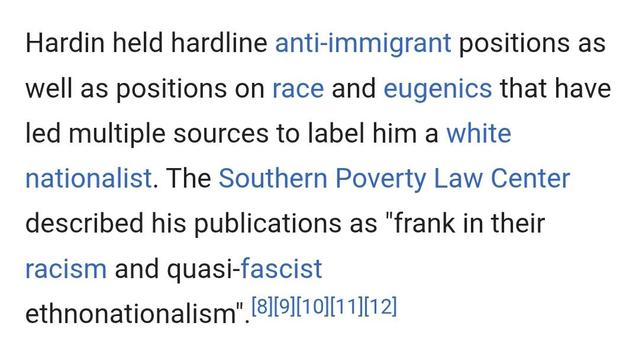
@econproph @nasser @mattly yeah, and he was a notorious bigot and fascist. No need to pathologize him, he was just a piece of shit
 Adrian Riskin
 Violet/Multi
@nasser The FOSS equivalent are less-clearly-defined communities sharing a set of ethics and goals, I think. For example, Codeberg e.V., Phosh.mobi e.V. or Project SERVFAIL.
They don't have to be distributed, they can also be more localized third spaces: Hackerspaces, book clubs, cycling groups
They don't have to be distributed, they can also be more localized third spaces: Hackerspaces, book clubs, cycling groups

@nasser At the risk of falling into more fundamental motivation-based debate: Not all malicious actors know they are malicious. (They should be stopped from perpetuating harm either way.) Sometimes there's a good faith argument to be made; enemies can become allies (especially in seemingly-strict hierarchies)
 GhostOnTheHalfShell
On this point, I would like to direct people to a book titled “ hierarchy in the forest” by Boehm. It explains the consensus framework that cultural anthropology has developed to enumerate the material conditions and social factors that lean societies towards egalitarianism or towards hierarchy.
I cannot recommend it highly enough. It is very useful for thinking about these topics.