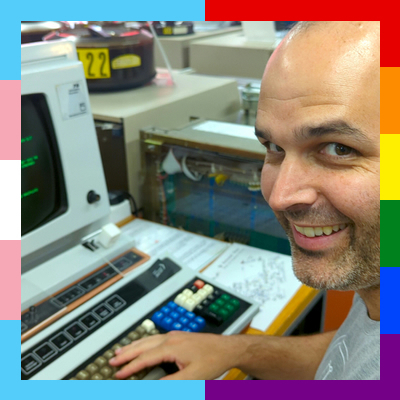
Today is the annual #TransDayOfVisibility.

*waves at all the lovely trans people here*. I am delighted to share this space with you.

There is still so much more than we - cis people - can and must do to make the world safer and friendlier for trans people.

Practical thoughts:

1) actively encourage trans people into your community and spaces. Be explicitly clear that they are welcome.

2) promote and enforce robust codes of conduct, and ask for this in events to which you contribute.

3) report anti-trans content to your own instance admins, and to the hosting instance admin if it makes sense to do so.

4) buy stuff (if you are in a position to do so) from trans people. Loads of trans people in the fediverse have small shops selling cool bits and pieces (drawings, books, jewellery, and more).

5) if you control the design of forms and systems, do not collect gender information unless necessary (and I don't have a good example of when this might be, but someone might)

6) push back against laws and policies which discriminate against, or make life harder for, trans people. Write to your MP, and be vocal in your support.

#TransDayOfVisibility

@neil

re 5:

you're probably actually asking for pronouns or titles so you can address someone correctly in a invoice or email template. Ask for that directly, rather than asking what shape genitals they have, cos that's freaking weird dude.

Outside of medical or sex work contexts I can not think of a reason you really really need to know someone's gender.

"We need it for the advertising profile" isn't as good an excuse as you think it is. Splitting billions of people in to two buckets isn't an effective marketing strategy.

@mindpersephone @neil

> Outside of medical or sex work contexts I can not think of a reason you really really need to know someone's gender.

I didn't think of sex work contexts, but I was going to suggest that the medical context is only common context where I think knowing the gender and biological sex information is an absolute requirement (hormone effects on medication, birth control, etc etc)

Speaking as my employed-persona, it can help human data stewards with entity resolution, but it's really not a requirement (and isn't really, overly that helpful from a statistical pov because it's ~50/50 that it's mistakenly entered in the first place)

@feff @mindpersephone

Pronouns, absolutely!

Medical stuff: happy to be told that I am wrong, but I'd have thought that gender was less relevant, than knowing which organs etc someone has, or what drugs they were on? (Ensuring that a trans woman with a prostate still gets offered screening, trans man with breasts etc.)

@neil @feff @mindpersephone (Non clinical NHS Wales employee, not speaking on behalf of any part of NHS Wales, part of my health board's queer working group)

You're right about gender being less relevant but for simplicity we use gender markers.

-----

Context and details: For NHS Wales, gender is an important marker (and age) because that's how we define the default inclusions for screening everyone (according to your GP record)

For trans people, you will by default be invited to get the same screening as your gender. You would then need to opt in and out of the appropriate screening based on your AGAB

(More info here: https://phw.nhs.wales/services-and-teams/screening/information-for-people-who-are-transgender-or-non-binary/)

GPs should be having a discussion with trans people when they change their gender marker if they're following https://www.gmc-uk.org/professional-standards/ethical-hub/trans-healthcare to cover screening and the alike

For then any other trans specific healthcare, that's handled by CAVUHB's Welsh Gender Service with dedicated experts to best support those people https://cavuhb.nhs.wales/our-services/welsh-gender-service/

----

It's one of those things which prob should be better handled with forms like GMS1W (form for joining a GP permanently) which still only have male and female markers on them.

Outside of non-binary markers, some do argue that it may be better from a confidentiality and equality view that only relevant bodies know of someone's trans status which does change how they provide that care, and otherwise treat trans men healthcare in the same manner as any other man (because they're men) with any medication in the same manner as regularly prescribed medication

----

That's a lot of text to describe why and hopefully that helps in some way, advocacy groups are pushing to improve this sorts of problems. One can hope it gets resolved soon.