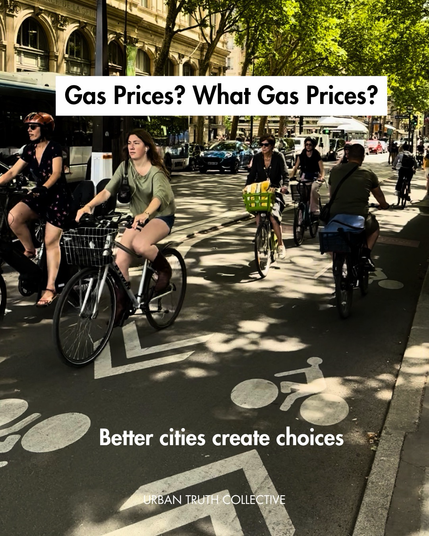
“Gas prices? What gas prices?”

Even without insane and illegal wars, the thing about any dependency, including car dependency, is that once you’re dependent, they can do whatever they want with the prices.

Real freedom is choices. Better cities create choices. Graphic via the Urban Truth Collective. Check out our website here:
https://www.urbantruthcollective.com/#UrbanTruth

@BrentToderian Unfortunately, Urban Truth Collective doesn't seem to be on Mastodon...

@BrentToderian #AltText4You a group of people cycle cheerfully along a leafy urban street under the strap line "Gas prices? What gas prices?"

Below is the text "Better cities create choices"

@simon_brooke @BrentToderian

or rather...

“along a leafy street in Paris”

@BrentToderian

This might well be the 'urban truth' - but what about the other half ? - the half of humanity that live in the countryside, villages and small towns ?

Campaigners need a much more realistic focus on people for whom there is no alternative to car dependency - in many cases precisely because of the centralisation of essential services in cities ! - or, of course, because they are elderly, disabled, have lots of small children, need to carry equipment, etc, etc...

Reducing car dependency for many people is a matter not of more bike lanes or better public transport, but vast changes to the physical infrastructure of the developed world - that will take decades. Not recognising this just makes green campaigns seem unrealistic to many, perhaps most people - often to those that would otherwise be most sympathetic to nature conservation - and in this I would include all those who want to travel to very remote countryside locations precisely to experience nature's calm.

For these people EVs are essential, as part of a very long transition away from the way the world is currently built and organised. The campaign focus should therefore not be against EVs, but against the personal car ownership model, and towards the creation of car co-ops in every village and neighbourhood, that can combine the built-in advantages of the car (travel from your home to exactly where you want to go, however lonely or remote) with a massive reduction in car numbers and emissions - and, incidentally, a democratising of car access.

@GeofCox @BrentToderian ”people for whom there is no alternative to car dependency”

That is what car dependency is, feeling you have no alternative.

And a lot of that dependency is because of other people’s car use. EVs don’t solve this, less car use does, and most importantly, less prioritisation of cars. Cars need to be removed from the first-class-citizen status that is present in almost every society today. That doesn’t mean cars should be banned, but switch places with people.

@ahltorp

I think you've rather missed my point. For some people - for example city-dwellers that are able to walk or cycle or use public transport with little difficulty - reducing car dependency is one set of relatively easily solved problems; but for others the problems around reducing car dependency are much more difficult - and I would say can ONLY be mitigated using electric car co-ops.

Therefore, rather than adopting, and promoting the negative view - 'EVs don't solve it' - environmentalists need to move to the positive: 'setting up EV co-ops is a great solution'.

@BrentToderian

@GeofCox @BrentToderian I think you missed mine. Car numbers are important to reduce, sure, but if car *use* still remains the same, nothing has been gained in road safety.

Road safety for pedestrians and cyclists is the important factor for reducing car dependency, from urban centres to rural settings. If you are scared for your life when not in a car, you will feel that the car is necessary.

And being scared for your life is not a side effect, it’s the foundation of car society.

@ahltorp @BrentToderian

You've shifted the discussion from environmental to road safety issues - and I don't agree that 'road safety for pedestrians and cyclists is the important factor for reducing car dependency'. Car dependency is much more structural - it's to do with where people live, where they work, where services are located, where they want to go for leisure pursuits, etc...

I think you're still thinking inside the able-bodied, child-free urbanite framework. We can easily go by bike to all the towns and villages around our home on cycle paths or virtually traffic free roads. That is not the problem. The problem is that we couldn't have done that when we had 4 small children living at home with us - nor will we be able to do it when our health deteriorates (as, in the end, everybody's does). Some services are only in cities - 100km from us; there are indeed services to help people get to things like medical appointments, etc... they use cars.

@GeofCox The people in the picture above would not be using bikes if they didn't feel safe. This has everything to do with environmental issues.

The safety problem is a much bigger factor outside of urban areas, where the roads are narrow, the speeds high and car drivers more reckless.

You're using what I'm calling the Appeal to Solidarity Fallacy (https://mastodon.nu/@ahltorp/111716164646253880): there are people who "have" to use cars, so everyone has to be allowed to use cars indiscriminately.

@GeofCox Of course you can use bicycles with 4 small children, if the roads are safe. Very small children go in the trailer, the older go on their own.

The small overlap between people who can't bicycle because of health
reasons and people who can drive a car despite the same health reasons
is not big enough to warrant a society that places indiscriminate car use above people safety.

Even I, able-bodied as I am, can't use the roads in rural areas without being threatened. Deliberately.

@ahltorp

You have missed the point again. Nobody is arguing that 'there are people who "have" to use cars, so everyone has to be allowed to use cars indiscriminately'. Indeed, the discussion is not about the pros-and-cons of car use at all - it's about how to effectively campaign for, and ultimately reduce car use.

@GeofCox No, you have not argued for reducing car use, only reducing the number of cars.

You have consistently argued against reducing car use by saying that I'm "thinking inside the able-bodied, child-free urbanite framework", and that "we couldn't have done that when we had 4 small children living at home with us".

Your model is restricting the freedom of movement for adults and especially children, by keeping the same paradigm of car-first societies and environmental harm.

@ahltorp

No - arguing that campaigning for less cars and car use is more effective when based on realistically acknowledging that reducing car ownership/use is easier for some than for others is not at all the same as arguing against reducing car ownership/use.

Throughout this discussion I have been talking about what constitutes effective campaigning, argumentation and measures to reduce car usage and emissions - you're straining to see in this implications about the aim itself - but we don't disagree about the aim, just about how to best achieve it.

@BrentToderian I wish more cities were human and bicycle friendlier.