Two recent non-technical pieces on the philosophy and practice of mathematics:

"Mathematical methods and human thought in the age of AI", by Tanya Klowden and myself: https://arxiv.org/abs/2603.26524 (also discussed in https://terrytao.wordpress.com/2026/03/29/mathematical-methods-and-human-thought-in-the-age-of-ai/ ). This was a solicited piece for a forthcoming compendium in the philosophy of mathematics.

"What does it mean to think like a mathematician?", https://terrytao.wordpress.com/wp-content/uploads/2026/03/talk-ver-3.pdf . These are slides for a talk I gave during a Pi Day (Mar 14) event at the local Curtis Center. The talk will be posted shortly.

Mathematical methods and human thought in the age of AI

Artificial intelligence (AI) is the name popularly given to a broad spectrum of computer tools designed to perform increasingly complex cognitive tasks, including many that used to solely be the province of humans. As these tools become exponentially sophisticated and pervasive, the justifications for their rapid development and integration into society are frequently called into question, particularly as they consume finite resources and pose existential risks to the livelihoods of those skilled individuals they appear to replace. In this paper, we consider the rapidly evolving impact of AI to the traditional questions of philosophy with an emphasis on its application in mathematics and on the broader real-world outcomes of its more general use. We assert that artificial intelligence is a natural evolution of human tools developed throughout history to facilitate the creation, organization, and dissemination of ideas, and argue that it is paramount that the development and application of AI remain fundamentally human-centered. With an eye toward innovating solutions to meet human needs, enhancing the human quality of life and expanding the capacity for human thought and understanding, we propose a pathway to integrating AI into our most challenging and intellectually rigorous fields to the benefit of all humankind.

arXiv.org
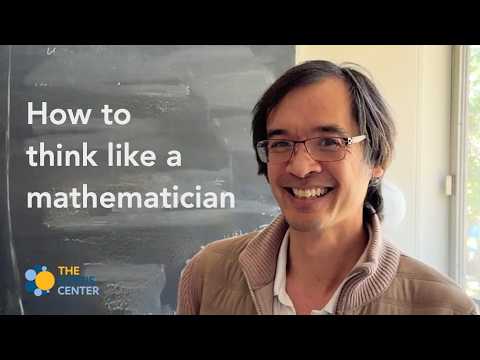
Video for the pi day talk I gave is now available: https://www.youtube.com/watch?v=kRcro90Aj0w
Terry Tao "How to think like a mathematician" presented by the UCLA Curtis Center

YouTube
@tao have you given up on Navier Stokes?

@tao I really like the "freedom to fail is freedom to ask dumb questions" perspective.

An off-kilter question. I am curious about your take on the ethics of ai generated images (as the training data contains copyrighted material).
Also is citing chatgpt enough? An equivalent issue is this: I remember in school that we were told not to cite it as "Google Images" but rather the website Google was pulling the image from.

@tao With as much respect as possible, I think comparing this situation to the Copernican revolution is rather misrepresentative of the skeptical position.

"Instead of denying the
existence or importance of these planets...one can instead accept that both
human and artificial intelligences exist in the same ontological category."

To me, this sentence seems to implicitly assume a false dichotomy. One can both accept the existence of some artificial intelligences in the same ontological category as human intelligences and also think that the AI currently being developed specifically (or even more broadly, turing machines) are not among these intelligences. This is what I believe.

In this sense, the comparison to the Copernican revolution is not correct. There is not a formal hypothesis akin to the heliocentric model of the solar system even being proposed: intelligence is not even well defined.

To me, the situation is far more comparable to the 'epicycles' used by the ancient astronomers to make the geocentric model work: they assumed that because their 'metrics' for astronomical predictions were being met, that they were approaching an accurate view of the solar system and the universe. This analogy seems far closer, since in some sense, neural networks can be viewed as non-linear generalizations of Fourier series, and therefore generalized epicycles.

In particular, in order for me to accept modern AI as having the same ontological status as human intelligence, I need factual evidence to do so, and no such factual evidence has been provided.

This is why I think the conversation among mathematicians and programmers is in desperate need of more factual information, instead of opinions.

@tao I think the best human-AI collaboration arises not when AI replaces thinking, but when it compresses and stabilizes an already developing line of thought.
The human sets the horizon of the problem, selects the essential intuitions, keeps the direction, and prevents the work from dissolving into noise. The AI accelerates exploration, comparison, and formalization.
So the key human contribution is not only to “have ideas,” but to hold the semantic trajectory together. The key contribution of AI is not full authorship, but assisted crystallization.