maurycyz
A sea of sparks: Seeing radioactivity
Maybe he used banana as the scintillator.
That's unrelated. He's been diligently substituting bananas in many experiments to mostly disappointment.
...but occasional delight.
The banhattan project has been a fiasco.
Chicago Peel 1 accomplished fission of fruit flies, which we felt was promising.
The subsequent banana nuclear bomb tests have been an unmitigated disaster. There are so many damn bananas in and around the bikini atolls, just nothing. Not even a fizzle. Mojave is littered with peels. Oppenheimer slipped and broke his leg.
Rumors are the Soviets are using avocados. Maybe that is the key. We are now constructing a demon core from an avocado split lengthwise.
This puts Raffi in a whole new light. Also maybe the Banana ball team are refugee all-stars.
You won't make one at home, but cloud chambers[^1] reveal individual alpha particle tracks.
There's one in the Musée des Arts et Métiers in Paris — blew my mind!
[^1]: https://en.wikipedia.org/wiki/Cloud_chamber
Edit: turns out people make these at home all the time. Sick!
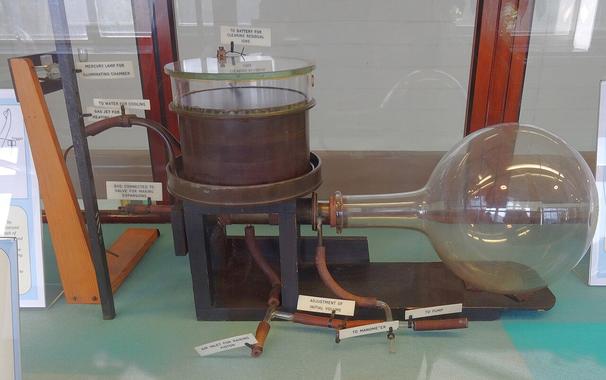
Well, google for "DIY cloud chamber" did result in quite some entries. Apart from youtube channels, with the first entry a guide from CERN:
https://home.cern/news/news/experiments/how-make-your-own-cl...
How to make your own cloud chamber
US / LHC communicator Sarah Charley explains how to make a cloud chamber (Video: Sarah Charley/US-LHC) Cosmic rays are high-energy subatomic particles that constantly bombard the Earth from outer space. Thousands of these particles pass through our planet, and through us, every second. This natural radiation is harmless and invisible, but the tracks that the particles leave behind can be seen using a cloud chamber. Over the years, several experiments at CERN have used cloud chambers to detect particles. The Gargamelle experiment, for example – designed to detected neutrinos – was 4.8 metres long, 2 metres in diameter and weighed 1000 tonnes. The large CLOUD experiment at CERN today also uses a cloud chamber, to investigate the effects of cosmic rays on cloud formation. Though the cloud chambers at CERN each took many years to plan and build, you can make your own cosmic-ray detector in the classroom providing you have access to the right materials. Although make sure your teacher or guardian is there to help you – you will need to be careful handling dry ice and isopropanol which can be dangerous. In the video above, US / LHC communicator Sarah Charley shows us how to make a “Continuously Sensitive Diffusion Cloud Chamber”. Originally developed at UC Berkeley in 1938, this type of cloud chamber uses evaporated alcohol to make a “cloud” that is extremely sensitive to passing particles. It is based on the same principles that determine the formation of clouds in the sky. If air is saturated with water vapor and then cooled, tiny droplets of mist form around floating bits of dust or other material. They also form readily around ions; electrically charged atoms or groups of atoms. When a charged particle, such as a proton, passes through the chamber it leaves behind a trail of ions as it strikes molecules in the air along its path and tears away electrons. Mist droplets form around these ions, creating a cloud track. By studying the track, or a photograph of it, we can determine the energy and electric charge of the particle that produced it. Every kind of particle has a characteristic cloud track, which varies in shape, length, and width. Many elementary particles have been discovered through their characteristic cloud track. For more detailed instructions and a full tutorial, see here.
This can be done at home with a little effort. Less effort if you can get dry ice easily.
https://hackaday.com/2019/01/13/see-the-radioactive-world-wi...
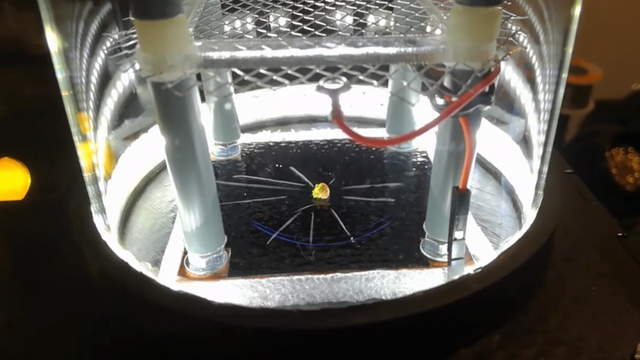
You can easily make them at home (source, I did last weekend!).
- Dry ice (mine came from something shipped cold)
- Dark piece of metal (I used a 3D printer hot bed) on top of dry ice to get cold
- IPA vapour (I poured some on a shop towel)
- Some transparent container to house it all - I found a glass display cube on the side of the road, fish tanks or Tupperware also work.
- Torch or something to provide side lighting
Very cool to see evidence of the particles zooming around us, can highly recommend.
If you haven't experienced a spinthariscope, I can highly recommend it. I bought one as a Christmas present for a buddy and we both enjoy its demonstration of radioactivity.
UnitedNuclear has these and a bunch of other interesting tidbits if anyone wants to give it a try. I bought a small bottle of heavy water as well, which I of course sampled and can confirm it has a slightly sweet taste to it.
You really have to get your eyes adjusted to the dark to see anything with the spinthariscope. It ends up looking mostly like static on a green crt, but if your only reference frame is a cloud chamber, the volume of particles that are emitted from such a weak source is pretty remarkable.
https://dberard.com/home-built-stm/ shows individual atoms.