 Aaron DeVries
In the 1957 Disney feature "Mars and Beyond" there is this little segment about media depictions of Mars including the war of the Worlds. The animation is silly but the martian fighting machine walk cycle is fun and interesting.
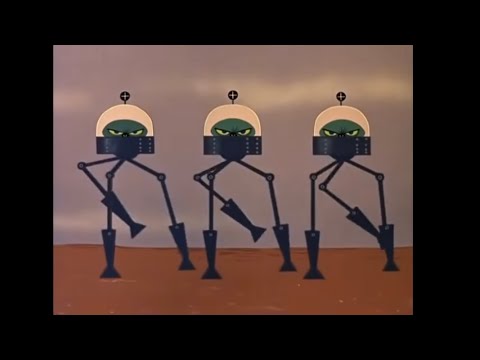
In the 1957 Disney feature "Mars and Beyond" there is this little segment about media depictions of Mars including the war of the Worlds. The animation is silly but the martian fighting machine walk cycle is fun and interesting.
@Aaron_DeVries @swope It is straightforward in 3D if you see the hub as rotating.
IIRC, Wells describes the motion of the tripods to be rotating, or maybe I'm just confusing with The Tripods.
Either way, a rotating hub makes it all work okay.
I think that implies the rotating hub has to have a lateral offset from the body above it (leaning to the side).
The center of mass of the body needs to stay above the line between the two feet on the ground. The lifted leg swings out to the side.
It's essentially wheeled locomotion (unicycle) approximated by 3 legs.
@swope @Aaron_DeVries It is not necessary for the line between the two feet on the ground to be constant.
If you look at the location of the feet when they plant onto the ground, you see them alternating left/right like a biped. But since there are 3 feet, each individual foot switches between left and right with each stride.
Anyway, this doesn't really make a big difference either way. In both cases, there's nothing stopping the feet from passing directly under the hub.
You do not need an
@swope @Aaron_DeVries offset, you just need some lean (or the equivalent of lean, in the form of bending the knees to emulate the lean).
But yeah, the feet pass (mostly) underneath on one side of the rotation, and swing around on the other side of the rotation.
@isaackuo
Alternating left/right foot placement is going to cause a lateral sinusoidal motion of the CoM, like a railroad worker walking with one foot on either side of a rail. That lateral acceleration costs energy.
I think the foot placement of the advancing leg is going to be like countersteering on a bicycle.
Lateral balance is statically unstable (2D inverted pendulum on the lateral-vertical plane, pivoting about the line between the two grounded feet).
@swope @Aaron_DeVries I dunno ... I feel like there are LOTS of bipedal creatures and almost all of them (including ourselves) walk with feet going left-right rather than directly in a line. I feel like this evidence that it's more efficient that way.
But in any case, I'm really talking about replicating what's in the animation, not what is most efficient.
When people walk slowly we have wider foot placements, but when we walk with more speed the foot placements are more narrow. I think it's a trade between stability and efficiency.
I did find this tripod robot that does a sort of coiling motion to unload the advancing foot:
https://youtu.be/ARMJr3zDDP8
I think the 2D animation looks fine, but it would be hard to replicate in a 3D animation without looking unrealistically out of balance.
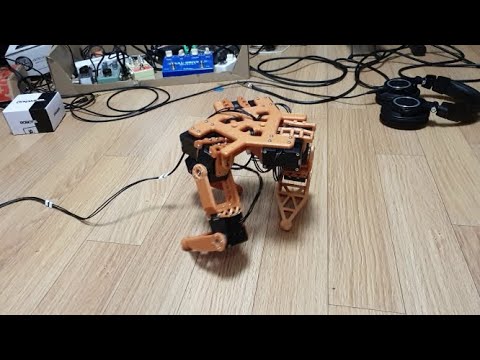
@swope @Aaron_DeVries Hey, I think that motion could match the description of tilting and swaying!
It looks inefficient and ungainly, of course. That's basically the problem with some sort of symmetric 3 legged motion.
(As opposed to a gait with two outer legs moving together, with a central leg opposed.)
But it is possible to go fast and smooth and efficient with a rotating hub. I've actually thought seriously about this as used for a three legged AFV.
Like, imagine a Bradley-like hull with
@swope @Aaron_DeVries a revolving tripod underneath. But the feet are angled perpendicular to the legs, and they can counter-rotate.
It seems like the thing can't walk, just rotate in place, right? But if you tilt the whole thing left (or right), then it can sort of roll forward/back by using the stool as a tilted wheel.
It's weird, but it can potentially have some advantages over tracks or normal wheels.
@isaackuo @Aaron_DeVries @swope
I'd have to check the books, but in John Christopher's "Tripods" series my impression was that the base plate was continuously rotating as the tripod walked. I don't know if the crew compartment for the Masters was, though.
Edit: Come to think of it, the crew compartment probably was also rotating, because the Masters were tripods who would move by spinning when they were in a hurry. So they would not be prone to dizziness.
It's been dozens of years since I read The Tripods, but I think you and @isaackuo are correct that when moving fast the tripods (and the masters inside the dome) did the sort of rotation hub motion.
@cptbutton
I don't know if that level of detail was ever given for the war machines in War of the Worlds, but all the film adaptations seem to avoid showing a continuous gate (that I can remember). I specifically remember looking for the foot placements, but they are hidden behind the foreground.
@cptbutton @isaackuo @Aaron_DeVries
I'm not finding the passage online about how John Christopher's tripods moved, but apparently the introductions to later editions of the 2nd book say he consulted with Asimov:
https://skullsinthestars.com/2025/07/04/the-tripods-the-city-of-gold-and-lead-by-john-christopher/
I don't have the books handy.
Whoops, seems like the blogger got the wrong consultant -- it was Arthur C. Clarke. And he sort of punted on the solution.
But indeed The Tripods did a sort of whirling spiral, similar to @isaackuo 's rotating hub.
I got the passage from https://www.google.com/books/edition/The_City_of_Gold_and_Lead/PQ4uAAAAQBAJ
@isaackuo @cptbutton @Aaron_DeVries
Here's another odd solution, flip the body like a pancake on every stride:
https://youtu.be/7XsaJwKKBYo
@isaackuo @cptbutton @Aaron_DeVries
This robot seems to be twirling like Christopher's Tripods:
https://www.academia.edu/64260335/_title_Analysis_of_gaits_for_a_rotating_tripedal_robot_title_
@swope @Aaron_DeVries @isaackuo
Digressing, but I've wondered what the Master's green-tinted native atmosphere was, such that their atmosphere was toxic to humans but could be made human-breathable by filtering it through green sponges. And that Earth's natural atmosphere was toxic, or at least unbreathable to Masters.
Green suggests chlorine. Maybe the sponges reacted with chlorine in a way that liberated oxygen?
Did the Masters plan to reverse the Great Oxidation Event?
Was _War of the Worlds_ the first example of xenoforming in sci-fi?
Maybe a question for @nyrath
@swope @cptbutton @Aaron_DeVries @isaackuo
Beats me. There was The Voice In The Night, but that was ten years *after* War of the Worlds.
https://en.wikipedia.org/wiki/The_Voice_in_the_Night_(short_story)
@swope @cptbutton @nyrath @Aaron_DeVries Not aliens, but I figured Jules Verne might have written something with similar themes:
https://en.wikipedia.org/wiki/The_Purchase_of_the_North_Pole
It involves wealthy capitalists with a scheme to alter Earth's climates and get filthy rich with coal under the current arctic region.
Maybe more relevant is this:
https://en.wikipedia.org/wiki/The_Germ_Growers
This involves an alien invasion, with germs used to wipe out humans.
I would say 1950s, because Soviet and American submarines did sonar mapping of the Arctic under the ice.
But think small islands are still being discovered as the ice is retreating.
@isaackuo @60sRefugee @swope @cptbutton @nyrath @Aaron_DeVries for example, imagine what a band of rich greedy villains might do if they actually wanted say Russia's vast swaths of permafrost tundra to warm up, or icy nothern passages to open for year-round or even cross-polar shipping, or Greenland's ice sheet to melt so becomes easier to get at the rare minerals beneath.
but no. no, that is too wild to even contemplate!
*looks at world news headlines*
er, nevermind
 swope
swope Isaac Ji Kuo
 Captain Button

 Winchell Chung ⚛🚀
 60sRefugee
 synlogic4242