speckx
Voyager 1 runs on 69 KB of memory and an 8-track tape recorder
Voyager 1 & 2 is one of my favourite human science achievements, not even so much from technology standpoint, as it's relatively simple compared to what we have now (although that's one of the charms), but just the fact that it's so far away, it still more or less works long after the scheduled mission end time, we can communicate with it and despite all the modern technology progress, it would take decades to catch up. Absolutely amazing and inspiring!
>despite all the modern technology progress, it would take decades to catch up.
Could you elaborate on this?
I assume OP means that a probe launched today would take decades to exit the solar system.
Voyager 1 and 2 are 25 and 21 billion kilometres away, respectively.
Even if we built a rocket just designed to get stuff as far away as quickly away as possible, it would take decades to catch up to where they are now.
Could we even catch up to them at all with the current propulsion technology? Not only did they have decades of head start but they took advantage of a unique planetary alignment that I don't think will come back around anytime soon.
Yes, easily. The alignment doesn't really matter for that. Almost all your speed gain comes from just Jupiter. Saturn is 30% the mass and 2/3 of the orbital velocity, so your gain from Saturn is only 20% of what you can get from Jupiter (and also your potential gain is limited by a minimum approach distance greater than the rings, or you'd hit them.) And the ice giants are slower and smaller yet; Voyager barely gained from Uranus and actually slowed from Neptune since it wasn't routed to gain speed there.
New Horizons achieved 80% of Voyager's velocity with just Jupiter, and it wasn't really trying to optimize for speed, it approached Jupiter only to 10 million km (over 100x greater than the planet's radius.) A probe dedicated to a fast slingshot past Jupiter could easily overtake Voyager. We haven't had any need to try, unless one of the missions to specifically study the heliopause-interstellar area happens. It would still take a while to catch up to Voyager's head start, but it's doable.
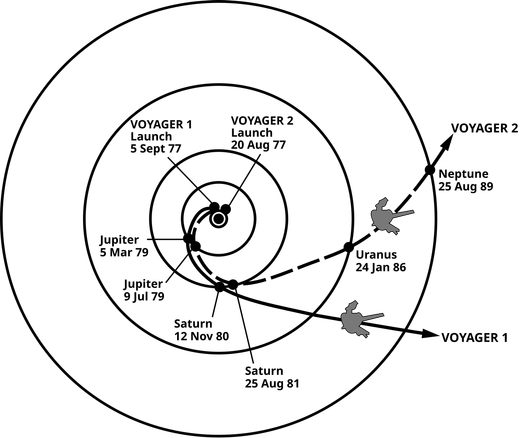
Take decades to catch up to the location of either voyager probe. The probes have be traveling for a long time. They have also taken advantage of a rare planetary alignment that allowed them to visit a lot of planets and get gravity assists from them (converting a tiny portion of the planet's angular momentum into orbital speed for the spacecraft)
A large amount of Voyager 1 & 2 's success isn't just technological it is the ability to take advantage of a specific planetary alignment for a gravity assist [1] that can only occur every 175 years [2] .
[1] https://en.wikipedia.org/wiki/Gravity_assist
[2] https://en.wikipedia.org/wiki/Voyager_1#/media/File:Voyager_...
They are dangerous and reckless. They were also done in the name of humanity, but without humanity’s consent.
I despise the naive scientists who did them as much as those who brought the damocletian sword of nuclear weapons on us.
I assume you are against them due to the silent forest hypothesis? Better not announce ourselves, because anything out there might not be friendly to us?
The vast space of everything seems to me that any intelligent life eventually discovers physics to get out of this dimension. Dune space feudalism is unlikely
The dark forest hypothesis assumes that it's easy to travel between stars, so interstellar conquests are possible. But it doesn't seem to be the case.
There are no material goods that can justify the material and energetic expense of any interstellar travel. You'd be far better off just using a particle accelerator to forge any chemical element and then assemble them into molecules using nano-replicators.
The best you can do is to send information, possibly with the help of gravitational lensing.
Sci-fi mode on: given that the potential galactic civilization is going to be information-based, who's to say the Earth is not already under attack? An interstellar fleet of large invasion ships with soldiers is not feasible, but a small drone with an AI that connects to terrestrial networks and steers the civilization towards collapse is possible. I'd start investigating if TikTok algorithm developers got some nudges from a weirdly knowledgeable source.
They read The Three Body problem
Earth's "radio bubble" is well over 100 light years across now. If there are aliens out there, they are probably already on their way to ask us in person why Ross, the largest Friend, doesn't simply eat the others.
Don't forget that the mission planners figured out the "Grand Tour", calculating orbits and trajectories to slingshot around the Solar System. All with 1960s technology.