I feel like I did in February and March 2020, only this time, it's about the war in Iran rather than a novel virus. Big things are coming, and too few care to acknowledge or believe it.

In February and March 2020, I was one of a few people warning what the “novel coronavirus” was about to do. People wouldn't (or couldn't) listen because no one could conceive of businesses closing, conferences canceled, or hospitals bursting.

1/x

(Even in retrospect, people still can't perceive it, with a growing collective amnesia about how bad things really got and the belief we “overreacted” to overflowing morgues and a million dead Americans.)

But, if you're really paying attention to the news—not just the headlines or the rhetoric—we're again at a precipice of something incredibly disruptive. People think we've seen the worst of our war with Iran, given how gas prices have spiked. That is simply the tiniest tip of the spear.

2/x

Within weeks, the closure of the Strait of Hormuz will start causing real and long-lasting damage, such as shortages of medication and exploding costs for fertilizer this planting season. Gas prices will go even higher. Food prices will rise. Airlines will cancel flights. Shipping costs will get even pricier. Businesses will close temporarily due to shortages, and some will shutter permanently because they cannot sustain themselves through the disruptions.

3/x

Helium needed to run MRI machines will be in short supply. Some countries in the developing world could see a 50% reduction in their harvests compared with prior years due to fertilizer shortages, causing food crises and more mass migration.

At this point, the best-case scenario we can hope for is that Trump walks away from the war. He'll claim victory, but he'll leave Iran controlling the Straits of Hormuz, and Iran will almost assuredly charge tolls to raise money to recover.

4/x

That means this costly war will leave Iran with more radical leadership and in a stronger economic position, and the US will be in greater danger of terrorist attacks and with permanently higher prices. And that's the BEST-case scenario—but at least things will seem fairly normal.

Things only get worse if that doesn't happen. The Trump administration is sending more troops to the Middle East and is reportedly drawing up plans for a ground invasion.

5/x

US taxpayers will need to foot the bill, and the deficit will rise even further. For example, the US has already fired around 25% of its inventory of Tomahawk missiles in Iran, and at current production levels, it will take as much as 9 years to replace those missiles. A longer war, significant disruptions, businesses closing, jobs lost, more needless death, and even greater economic and geopolitical disturbances.

6/x

And yet, everything seems pretty normal today, doesn't it? We gripe about higher prices at the pump and longer lines at airport security, but life is chugging along as if it's normal.

Remember how normal everything felt in early March 2020 and how rapidly the world changed in the six weeks that followed? We may again be in a period like that.

7/x

It wouldn't hurt to contact your representatives in Congress, ask them to assert themselves as is their responsibility, and bring a hasty end to this painful conflict. But, otherwise, the entire world is now sitting on a bus being driven recklessly by American leaders with uncertain and varying goals and dubious judgment.

Put on your seatbelts.

8/x

@augieray

What I've been wonder is what to do to try and brace for impact

@alienghic I wish I knew.

@augieray

My guess was the less your life depends on fossil fuels, the better off you'll be.

Installing solar if you can either a formal system, balcony system or even portable solar recharging.

Getting your region to support bikes and transit and pushing for cheaper smaller more fuel efficient cars and ebikes being sold in the USA. (Maybe we could let in the cheap Chinese EVs.)

Might also be good to be taking composting seriously.

I've also been wondering how likely we'll see drone attacks on USA infrastructure. Drone attacks on power substations have been really common in Ukraine and Russia, and Trump has been threatening Iran with something similar.

So if they had the capability, I could see Iran trying to attack US oil refineries and electrical power substations, which would lead to rolling blackouts.

But I don't know how likely that is to happen.

@alienghic @augieray for examples of how bad a hit on a US chemical or petroleum plant could be, see the USCSB YouTube channel. (These are accidents, not acts of war, but they give an example of what kinds of explosions/chemical releases/effects are possible.)

@epicdemiologist @augieray

Wow that's some horrifying stories.

@alienghic @augieray For a less horrifying one, look at the Arkema chemical plant during Hurricane Harvey. It's still like a a slow-motion train wreck, but everyone did what they were supposed to (except nobody expected FIVE FEET of rain!) and there were no deaths or serious injuries.

@epicdemiologist

The one I started with was the paint factory

@alienghic There have been at least two incidents where flying debris narrowly missed hitting a vessel full of hydrogen fluoride. Nightmare fuel.

@epicdemiologist

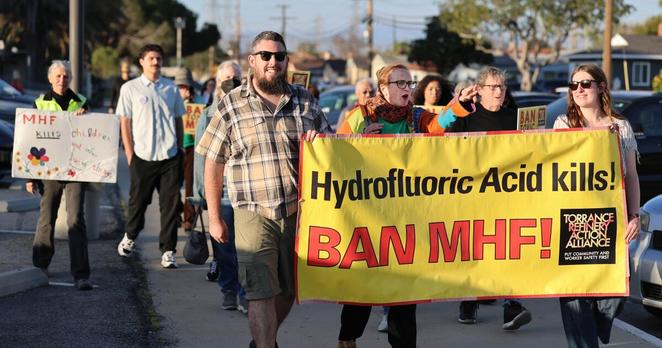
That reminds me of this on going protest.

For years one of the local refineries has a tank of hydrofluoric acid.

I think I saw a theory if that were punctured it could cause a couple miles of lethal gas.

https://www.latimes.com/environment/story/2026-02-07/torrance-refinery-mhf-hf-hydrofluoric-acid

considering hydrogen fluoride turns into hydrofluoric acid around water I don't know which is worse.

Torrance residents call for the ban of ‘flesh-eating’ chemical used at refinery

U.S. Rep. Maxine Waters reintroduces a bill that would require refiners to find alternatives to MHF within five years, or be fined per infraction.

Los Angeles Times