1/ "The world is facing a 'ticking time bomb' from its supply of oil, according to a briefing note from JP Morgan. Physical scarcity of oil is about to unfold across the globe, spreading sequentially through April from east to west, causing major economic disruption worldwide" v ChrisOWiki #IranWar
2/ "The blocking of the Strait of Hormuz has reduced traffic through the strait by 97%, cutting off most of the Persian Gulf oil and gas supply from tanker shipment. The reduction in the supply of oil is twice as large as seen in any previous oil crisis, according to the IEA." #IranWar
3/ "This has not yet resulted in physical shortages of oil – although shortages have already been seen, for instance in Australia, this has been due to excessive demand caused by panic buying rather than an interruption in supply. That is about to change." #IranWar
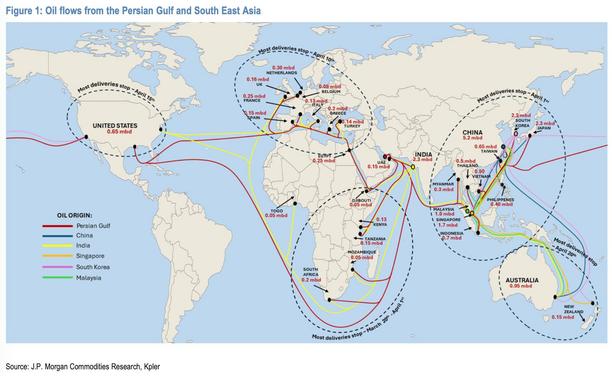
4/ "J.P. Morgan Commodities Research / Kpler has charted the global distribution of seaborne crude oil exports from the Persian Gulf to global trading hubs, with approximate delivery cutoff dates annotated by region to reflect the arrival of the last Gulf shipments." #IranWar
5/ "Asia dominates as the primary destination for Persian Gulf crude. The three largest single recipients are: 🔺 China — 5.2 millions of barrels per day (mbd), by far the largest importer 🔺 Japan — 2.3 mbd 🔺 South Korea — 2.2 mbd 🔺 India — 2.3 mbd" #IranWar
6/ "Together, these four nations absorb the vast majority of Persian Gulf output, reflecting Asia's structural dependence on Middle Eastern oil to fuel its industrial economies. China and India in particular are now far bigger consumers than in previous oil crises." #IranWar
7/ "European destinations are numerous but individually modest. The continent receives oil through several routes, with the Netherlands (0.30 mbd), France (0.25 mbd), UK (0.16 mbd), and Italy (0.13 mbd) as the leading recipients." #IranWar
8/ "Collectively, European imports are significant, but no single country approaches the volumes seen in Northeast Asia." #IranWar
9/ "The United States receives a comparatively small 0.65 mbd, reflecting its increased domestic production since the shale revolution." #IranWar
10/ "Australia (0.95 mbd) stands out as a substantial recipient for a mid-sized economy, reflecting its limited domestic refining capacity and geographic proximity to Asian supply chains. The lack of domestic refining capacity is already emerging there as a political flashpoint." #IranWar
11/ "While the Persian Gulf is not the only supplier of crude, the oil supply routes emerging from it are by far the most numerous and wide-ranging, reflecting the Gulf's position as the world's primary crude oil supplier." #IranWar
12/ "The non-Persian Gulf flows in Asia — from Singapore, South Korea, Malaysia, and India — are shorter-haul and concentrated within the Indo-Pacific, reflecting regional refining and re-export activity." #IranWar
13/ "Most deliveries from the Gulf are in the process of stopping between now and April 20th. Regions closest to the Gulf are feeling the impact first, with Europe, the US and the Pacific last due to the longer shipping distances:" #IranWar
14/ "🔺 Southern Africa / Indian Ocean — March 20th–April 1st (earliest) 🔺 East Asia — April 1st (China, Japan, Korea cluster) 🔺 Europe — April 10th 🔺 United States — April 15th (latest) 🔺 Australia/Pacific — April 20th (latest)" #IranWar
15/ "After these dates, the Gulf oil currently at sea runs out, and the next wave of deliveries will arrive later, costlier, and in smaller volumes from different producers." #IranWar
16/ "This will have the biggest impact on China. At 5.2 mbd, any disruption to Persian Gulf supply would hit China harder than any other nation, with limited short-term substitution options. Approximately a third of China's oil supply comes from the Gulf." #IranWar
17/ "Europe has more supply diversity than Asia, given its access to North African, West African, American, and North Sea alternatives, explaining its relatively lower per-country import volumes." #IranWar
18/ "In contrast to the rest, the US is largely insulated from Persian Gulf supply shocks compared to Asian peers, though it remains exposed through global price mechanisms – in other words, higher costs elsewhere will be reflected in the cost of imports to the US." #IranWar
19/ "As JP Morgan's briefing note says: "Much like during COVID, the shock unfolds sequentially rather than simultaneously—a rolling supply disruption moving westward, dictated by shipping times and buffered unevenly by regional inventories."" #IranWar
20/ "This means Asia—heavily reliant on Gulf crude and products—is already feeling the squeeze as pre-closure cargoes have largely dried up." #IranWar
21/ ""In April, Southeast Asia’s demand is expected to fall by about 300 kbd, but losses could climb rapidly—surpassing 2 mbd in May and approaching 3 mbd by June—if OECD stock releases remain contained within their respective countries." #IranWar
22/ ""Africa is next, with effects becoming more pronounced in early April, though outcomes will vary widely depending on local stock levels and import dependency. Up to 250 kbd of demand losses are possible in April if inland stocks are low." #IranWar